SoAL Film Fest Marks Five Years With Ambitious Lineup at Downtown Mobile Venues
The South Alabama Film Festival celebrates its fifth year with three days of screenings, documentaries, and workshops at downtown Mobile venues in.
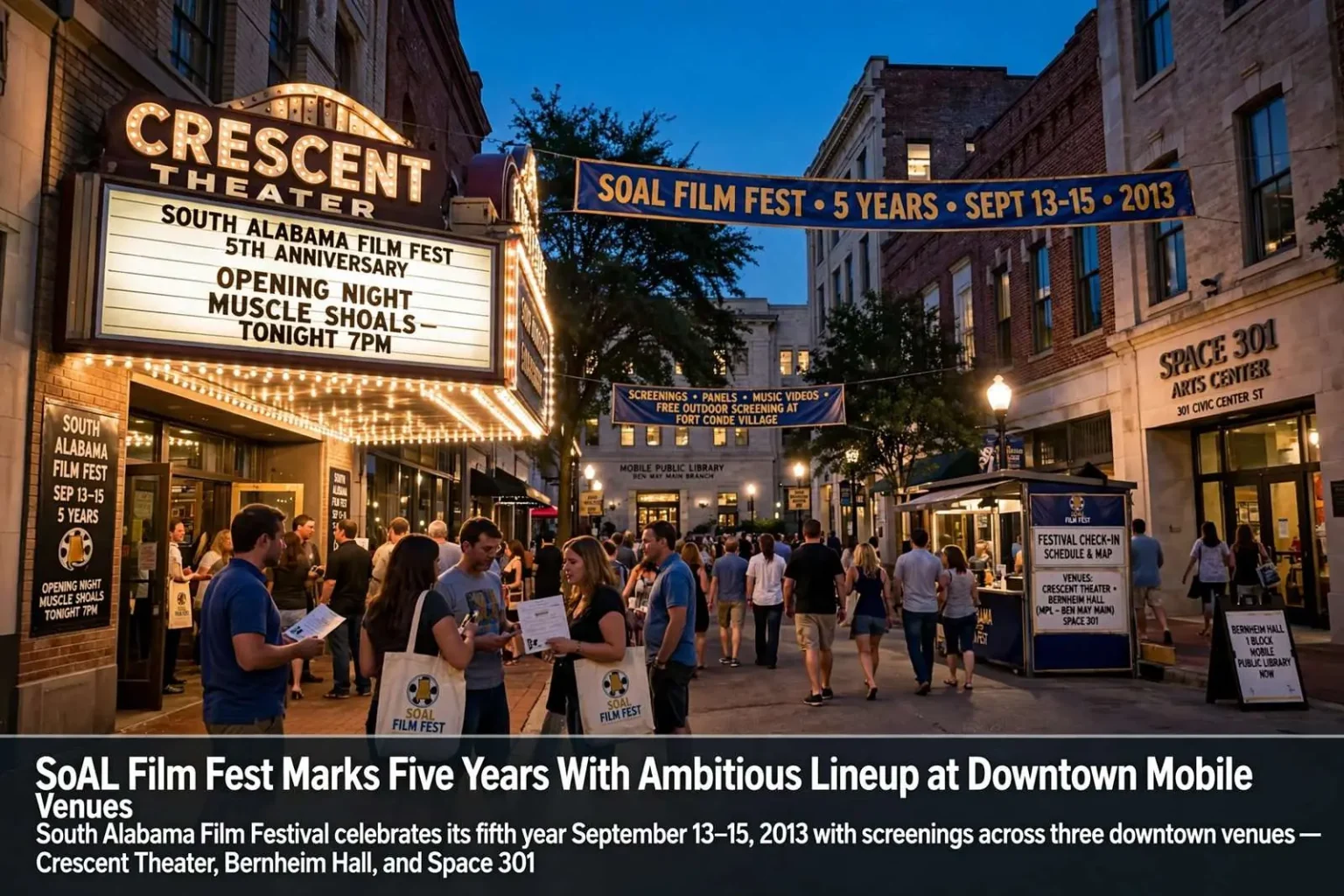
MOBILE, Alabama — The South Alabama Film Festival is preparing to celebrate a milestone fifth year with an expanded three-day program running September 13 through 15, 2013, at multiple venues across downtown Mobile. The festival, recognized as south Alabama’s first dedicated film event, will screen selections from Mobile Bay area filmmakers alongside regional projects rooted in Southern storytelling.
An expanded footprint downtown
Screenings are scheduled at the Crescent Theater, Bernheim Hall at the Mobile Public Library’s Ben May Main Branch, and the Space 301 arts center. The spread across three venues marks the festival’s growth from its early days, when a single screen and a handful of showtimes made up the whole program.
The Crescent Theater, the intimate art-house cinema tucked into Dauphin Street’s entertainment district, has been a natural home for the festival since its founding. Bernheim Hall offers the acoustics and seating of a proper auditorium inside the library’s main branch on Government Street, while Space 301 — the contemporary arts center operated in the former Press-Register building on Civic Center Street — gives the festival gallery space to pair with its screenings.
Festival organizers have positioned the event as both a showcase and a gathering place: a weekend when the Gulf Coast’s film community, which spends most of the year scattered between day jobs and personal projects, can sit in the same rooms and watch each other’s work on real screens with real audiences.
Opening night: the Muscle Shoals sound
Friday’s opening feature is “Muscle Shoals,” a documentary chronicling the remarkable musical legacy of FAME Studios in rural Colbert County. The film traces how founder Rick Hall built an unassuming recording studio into a destination for artists ranging from Aretha Franklin to the Rolling Stones, creating one of the most influential sounds in American music history.
The story the documentary tells is improbable on its face: a small studio in a small Alabama river town, far from the industry centers of New York, Los Angeles and Memphis, producing records that defined an era. The answer, as the film explores, lay in the studio musicians Hall assembled — players whose sound became so distinctive that the biggest names in music traveled to them.
The documentary was also selected for the Sundance Film Festival, giving it the kind of national platform that independent films about the South rarely receive. Its selection as the Mobile festival’s opening feature ties the event to one of Alabama’s best-known cultural stories.
Following the screening, the festival will present two dozen music videos submitted by artists from across the Southeast, including entries from Georgia, Tennessee, Mississippi, Louisiana, and Alabama. Public voting on the submissions was set to run through August 30, with top-rated videos to be announced during the Friday night program.
Saturday night: Close Encounters comes home
Saturday evening at the Crescent Theater brings “Who Are You People?,” a documentary exploring the behind-the-scenes story of Steven Spielberg’s “Close Encounters of the Third Kind.” The classic science fiction film was shot at a Mobile aircraft hangar that at the time ranked as the largest sound stage in Hollywood history.
The documentary features interviews with dozens of people who worked on or appeared in Spielberg’s follow-up to “Jaws,” gathering the recollections of cast, crew and locals who found themselves part of a production that briefly turned Mobile into a moviemaking hub. For the people who were there, the shoot remains a defining memory of the city’s brush with blockbuster history.
After the screening, audiences are invited to Fort Conde Village for a free outdoor showing of “Close Encounters” under the stars. The pairing gives festivalgoers both the story of the film and the film itself, in an open-air setting within sight of the city where part of it was made.
The outdoor screening continues a format festivals around the region have embraced: free, family-friendly showings that draw crowds who might never buy a ticket to an indoor festival screening, seeding the event with new audiences every year.
A full weekend of screenings
Between the headlining events, the festival fills its three days with the shorter films and regional work that form its backbone — narrative shorts, documentaries and student projects from filmmakers across the Gulf Coast. Blocks of short films are the traditional currency of regional festivals, letting a single session introduce audiences to a dozen different voices.
For Mobile Bay filmmakers, the festival’s fifth anniversary carries particular weight. A dedicated film event gives local directors a hometown premiere venue, and it gives audiences a reason to see work they would otherwise encounter only by accident. Each year’s slate has drawn on a mix of returning filmmakers and first-timers testing their work in front of a crowd.
The festival’s regional identity — Southern stories, Southern settings, Southern storytellers — has been its calling card since the beginning. Organizers have framed the event as evidence that the film community along the Gulf Coast is real and growing, and that the stories worth telling here do not need to leave the region to find an audience.
Why the venues matter
The festival’s three venues trace a walking route through the heart of downtown Mobile, close enough together that festivalgoers can move between screenings on foot along Dauphin Street and Government Street. That walkability is part of the event’s design, turning a day at the festival into a tour of the city’s cultural district.
The Crescent Theater has long served as downtown Mobile’s home for independent and art-house film, surviving more than once on community support when its future looked uncertain. Its continued operation has made it the anchor venue for film events across the city, and its small screening rooms create the kind of close-quarters audience that independent filmmakers say they remember.
Bernheim Hall, inside the Ben May Main Branch of the Mobile Public Library, offers a different setting: a formal auditorium with a stage and generous seating, suited to the festival’s larger presentations and post-screening discussions. The library’s involvement reflects the role public institutions have played in sustaining the festival since its first year.
Space 301 rounds out the trio. Housed in a landmark former newspaper building, the arts center’s galleries and event spaces have hosted exhibitions, performances and community gatherings, and its partnership with the festival extends the event beyond pure screenings into the visual culture that surrounds filmmaking.
Five years of building an audience
Reaching a fifth year is a milestone for any regional festival. Independent film events live on thin margins, dependent on sponsors, volunteers and the loyalty of a core audience, and festivals across the country fold in their early years when the founding energy runs out before a tradition takes hold.
The South Alabama Film Festival’s survival and growth suggest the opposite has happened in Mobile: the event has become part of the city’s fall calendar, alongside the arts happenings and downtown festivals that fill the season. Each added venue and each expanded program is a bet that the audience exists to support them.
For downtown businesses — restaurants, bars and shops along Dauphin Street — a three-day festival brings exactly the kind of foot traffic the entertainment district was revived to capture. Festival crowds linger between screenings, and the event’s scheduling across an evening and a full weekend maximizes the time visitors spend downtown.
The 2013 program’s blend of a Sundance-selected documentary, a Hollywood behind-the-scenes story rooted in Mobile’s own history, and homegrown regional film gives the festival’s fifth year a scope its founders could scarcely have promised. From the opening night at the Crescent to the closing credits under the stars at Fort Conde Village, the weekend is built to argue that film culture on the Gulf Coast has arrived — and that it plans to stay.
Planning a festival weekend
Festivalgoers planning the full three days will need to pick their priorities in advance. With screenings split across the Crescent, Bernheim Hall and Space 301, the schedule leaves gaps between venues and session times — enough to walk between buildings, but not enough to see everything without choosing.
The Friday night opening is the natural entry point for first-time attendees: the Sundance pedigree of “Muscle Shoals” makes it the festival’s most anticipated screening, and the music video announcements that follow give the evening a second act beyond a single feature. Attendees who voted on the video submissions online will learn the results along with the filmmakers.
Saturday belongs to “Close Encounters.” The double feature — the documentary at the Crescent, the original film outdoors at Fort Conde Village — makes for a long evening, but the outdoor showing is free, which keeps it open to families and to anyone who wants to sample the festival without buying a pass.
Sunday’s programming leans on the short-film blocks and regional showcases that make up the festival’s core. For filmmakers, Sunday is when the room fills with peers rather than curious audiences; for regular festivalgoers, it is the day to catch the work most likely never to screen in Mobile again.
Organizers expect the anniversary year to draw the festival’s largest crowds yet, and the expanded three-venue format is built for them. Whether the weekend becomes an annual fixture on the scale of the city’s other downtown festivals depends on the next five years — but the fifth anniversary program makes the case that south Alabama’s film community has earned the stage.