SoAl Film Festival Showcases Southern Short Films at Mobile Venues
The South Alabama Film Festival screened short films by Southern filmmakers at Ben May Library and Space 301 in downtown Mobile.
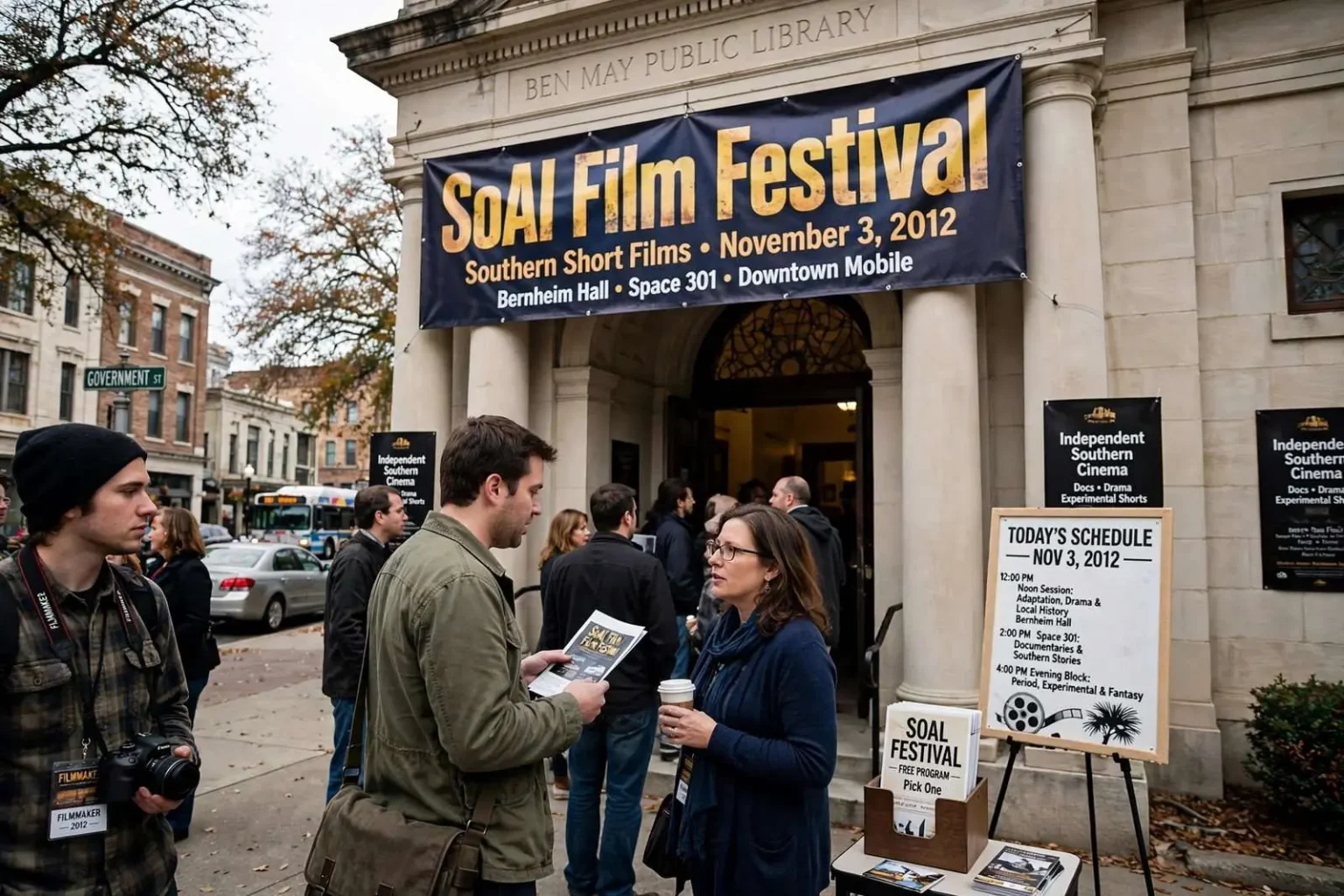
Downtown Mobile played host to a full day of independent Southern cinema on Saturday, November 3, 2012, as the South Alabama Film Festival spread a lineup of documentaries, dramas and experimental shorts across two of the city’s cultural venues. Screenings ran from noon into the evening at Bernheim Hall in the Ben May Public Library and at Space 301, and many of the filmmakers whose work appeared on the slate were on hand in person to introduce their films.
The programming followed a deliberate arc: documentary and drama anchored the daylight hours, while the afternoon and evening blocks gave way to experimental, period and fantasy work. Blocks of shorts were grouped by tone and runtime, letting moviegoers sample the short-film form — a format almost never seen on commercial screens — in curated sittings rather than a single marathon.
The Noon Session: Adaptation, Drama and Local History
The day’s first block began at noon in Bernheim Hall, where three films spanned adaptation, family drama, and local history. Sodric Dira’s “Colors of Sin,” a 17-minute adaptation of “The Pardoner’s Tale” from Chaucer’s “Canterbury Tales,” reimagined the classic story of greed as three men search for “Death” and find more than they bargained for. Joel Knain’s seven-minute film “Listen” told the story of a runaway teenage girl who phones home in the middle of the night to pour out her heart to her mother — or so she thinks.
The morning session’s centerpiece was Luke Buckley’s 23-minute documentary “The Future is in Your Hands,” which traced the history of civil rights and voting rights in Mobile beginning with the landmark legislation of 1965. The film featured interviews with notable local figures including Mobile’s first African American mayor, Sam Jones; Prichard’s first African American mayor, A.J. Cooper; and County Commissioner Merceria Ludgood.
The documentary’s local subject matter gave the morning block particular weight for a Mobile audience. The history of voting rights organizing in Mobile and Prichard spans courthouse battles, political breakthroughs and generations of activism across the county, and the film’s interviewees were among the people who lived and shaped that history. Seeing that story told through the voices of the city’s first African American mayor, Prichard’s first, and a longtime county commissioner connected the festival’s artistic programming directly to the community around it.
Space 301 Takes Over at 2 p.m.
At 2 p.m., the afternoon block shifted to Space 301, opening with Joe Brown’s nine-minute documentary “Blighted Beauty.” The short explored the aesthetics of urban decay through the lens of urban explorer Naaman Fletcher as he ventured through an abandoned hotel in Birmingham, finding visual poetry in a derelict structure and following a photographic subculture — urban exploration — that had grown rapidly in the digital era.
James Hughes presented his 32-minute observational documentary “Cotton Hills Farm,” part of his dissertation on Southern community and commerce. The film used visual ethnography to explore the relationship between culture, space, and place on a working Southern family farm, letting daily labor and family rhythms tell the story of how a working farm binds a community together.
David Lee and Rex New’s “Indian Santa” followed Thomas Dardar and his family as they delivered toys to children in coastal Louisiana communities still recovering from the effects of the BP oil spill. The film documented the Gulf Coast’s slow recovery from the 2010 spill, when oil washing ashore damaged fisheries, closed waters and upended economies in coastal parishes and communities across the region, through the lens of one family’s holiday outreach.
Camilla Ann Aikin’s 34-minute documentary “We Didn’t Get Famous” chronicled the Southern music underground from 1978 to 1990, spotlighting influential indie bands including Let’s Active, the Windbreakers, Pylon, the dB’s, and others who blended punk rock and new wave with Southern traditions. The film’s subject — bands that built loyal followings without mainstream stardom — echoed the festival’s own spirit of celebrating work made outside the industry mainstream.
Bernheim Hall, the auditorium inside the Ben May Public Library’s main branch on Government Street, gave the morning block a setting appropriate to its most literary offering. A Chaucer adaptation screening a short walk from the library’s book stacks suited the festival’s mix of old stories and new mediums, and the hall’s seating allowed festivalgoers to settle in for the day’s longest single sitting.
The 4 p.m. Block: Drama, Zombies and a Lost Star
The 4 p.m. block at Space 301 featured Jim Haverkamp’s “When Walt Whitman was a Little Girl,” a 12-minute film combining drama, dance, puppetry, and humor to explore growing up as a sensitive child. The short’s blend of performance styles exemplified the experimental edge the festival reserved for its later programming, when the screenings shifted from documentary toward work that played with form itself.
Joshua Matthews’ period drama “Dawn” was set in 1864 Kentucky, where a suicidal carpenter mistakes a runaway fugitive for his deceased wife and feels compelled to protect her from a pursuing bounty hunter. The Civil War-era setting placed the festival’s only outright period piece in the evening block, and its themes of grief, protection and pursuit gave the Saturday lineup a dramatic counterweight to the documentary-heavy afternoon.
Robert Clay and Becky Beamer of Birmingham brought “Z.A.R.S.,” a six-minute comedic documentary in which people answered the question of what they would do during a zombie apocalypse. The short’s street-interview format and comedic premise offered festivalgoers a breather between heavier films, and its Birmingham roots continued the festival’s showcase of Alabama-based filmmakers alongside visitors from across the region.
Mobile filmmakers Trey Lane and Timothy Dixon closed the festival with “Found: Star,” a 12-minute fantasy about a young woman who encounters strange characters while wandering dark streets on a quest to find the owner of a lost star. Ending the night with a homegrown fantasy gave the festival a fitting send-off: a story about searching for something precious in the dark, made by two Mobilians and screened a few blocks from where it was dreamed up.
Walking Between the Screens
The festival’s geography was part of its charm. Bernheim Hall and Space 301 sit within blocks of each other in downtown Mobile, close enough that attendees could walk between sessions, with the streets of the city’s historic core in between. Space 301, the gallery and arts space associated with the Centre for the Living Arts on Joachim Street near Cathedral Square, provided a contemporary gallery setting whose open rooms and white walls doubled as an unconventional screening venue.
Programming across two venues allowed the festival to run longer blocks without fatigue, splitting documentaries from drama and letting each space develop its own audience. It also spotlighted the downtown cultural district itself, at a moment when Mobile’s civic leadership was actively working to draw residents and visitors back into the city center after hours through arts programming.
A Stage for the Region’s Filmmakers
Festivals like the South Alabama Film Festival fill a practical gap for working filmmakers across the region. Short films rarely secure commercial distribution, so their audiences are built through festivals, where directors can watch alongside strangers and trade notes with peers. Many of the filmmakers represented on the Saturday slate attended in person, introducing their films before the lights went down.
The 2012 slate’s mix — Chaucer adaptations and zombie comedy, civil rights history and lost stars — reflected the breadth of the Southern short-film scene at the time, from graduate-student ethnography to weekend fiction projects. Mobile’s own contributors, including the filmmakers behind “Found: Star,” shared the program with out-of-town directors from Birmingham and beyond, underscoring the festival’s role as a connector for a regional community.
For attendees, the day offered a full sweep of what short films do best: tell a complete story or capture a particular place in less time than a feature, then move on. By the time the last credits rolled at Space 301, the festival had confirmed that Southern storytelling on screen was thriving well outside the studio system.
The Short Film in the Digital Era
The festival arrived at a moment when the tools of filmmaking had never been more accessible. Affordable digital cameras and desktop editing software had, by 2012, lowered the cost of making a polished short to within reach of students, hobbyists and working professionals alike, and regional festivals became the natural proving ground for that wave of new work. The variety on display in Mobile — ethnographic documentary, literary adaptation, puppetry and fantasy shot on downtown streets — reflected an art form whose barriers to entry had collapsed while its need for audiences remained as strong as ever.
That access cut both ways. With more films being made than any single venue could screen, festivals served as filters, curating slates that gave each short its best chance at an attentive crowd. A slot in a festival lineup, a printed program listing and a room full of viewers who chose to attend could matter as much to a short film’s life as any award, since shorts depend on word of mouth and programmer relationships to travel from city to city.
Why It Mattered for Mobile
For Mobile, the event added to a growing calendar of downtown cultural offerings built around the city’s museums, galleries, historic venues and annual celebrations. Screenings at the public library and the arts space reinforced the idea that the city center could host a full evening’s entertainment outside the usual concert and restaurant circuit, and they put local history — as in the civil rights documentary — on the same bill as pure fantasy.
The festival also gave film fans along the Gulf Coast something increasingly rare: the chance to see new Southern work the way it was intended, on a screen, with an audience, in the company of the people who made it. As the lights came up on the final short, the filmmakers in the room — from Mobile, Birmingham and beyond — had shown what the region’s independent scene could do, one short film at a time.