
Some Passengers Turned Away From Mobile Cruise Over New Coronavirus Health Screening
Carnival turned away passengers with chronic conditions from the Carnival Fantasy in Mobile as new coronavirus health screening rules took effect in March.
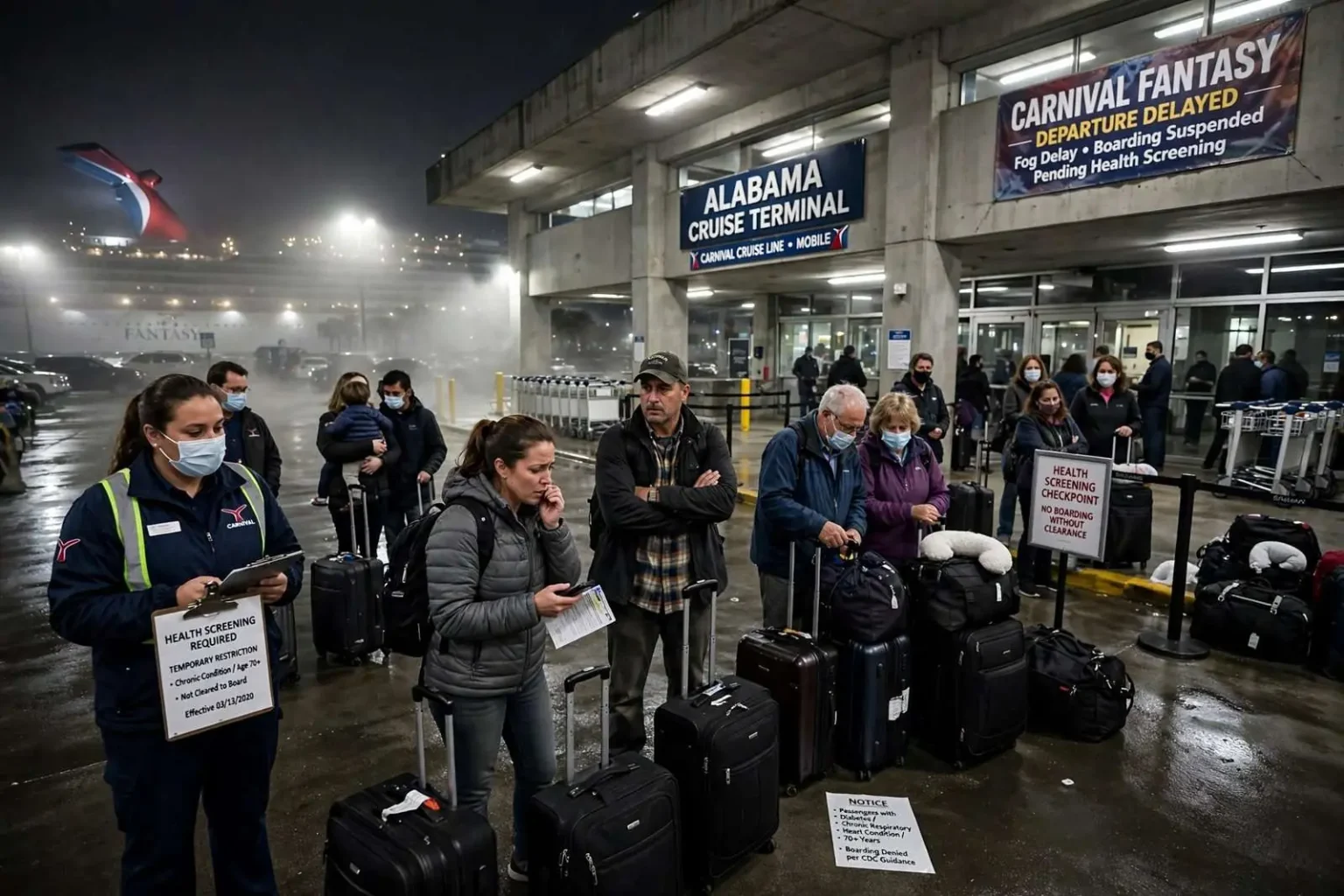
Dozens of would-be cruisers were left on the dock in Mobile in mid-March 2020 after Carnival Cruise Line rolled out stricter health screening rules tied to the coronavirus outbreak, blocking guests with certain chronic conditions from sailing. The Carnival Fantasy finally departed the Alabama Cruise Terminal after midnight Friday, delayed for hours by fog. But some travelers — many of whom had flown in from other states — learned late in the evening that they would not be allowed to board at all.
The departures came at one of the most uncertain moments in the modern history of the cruise industry. The coronavirus outbreak was accelerating across the United States that week, and cruise ships — already linked to early outbreaks at sea — had become a national focus of concern. In response, Carnival and other lines were tightening their boarding requirements in real time, sometimes changing the rules faster than passengers could learn about them, and Mobile’s cruise terminal became one small window into that upheaval.
‘They tagged 80 passengers’
Ashley Maynor, who traveled from Illinois with a group of six to sail out of Mobile, said her party was not informed until about 9:30 p.m. that four members could not cruise because one person in the group had diabetes, a condition now covered by the new rules. She said the group waited roughly seven hours before being provided a hotel room, and that two relatives who did board tried unsuccessfully to get off the ship because of long lines at guest services.
“We did typical protocol, got our luggage out, went through security, everything was good to go,” Maynor said. “Come to find out that they tagged 80 passengers on the boat and they knew from this morning or yesterday morning that those passengers were not going to be allowed to board.”
Her account captured the frustration shared by many of the turned-away travelers: the screening that excluded them had been applied at the pier, after they had already arranged flights, taken time off work and paid for the voyage. For passengers who had flown in, the exclusion meant rebooking travel home on short notice from a city none of them had planned to stay in — at the exact moment airlines nationwide were cutting schedules and hotels were absorbing waves of stranded guests.
New fleetwide screening questions
In a statement, Carnival confirmed it had added new questions to the health screening form completed by all embarking guests fleetwide, consistent with industry discussions with federal officials. Guests are now asked whether they are 70 or older, have been hospitalized in the past two months, or have a history of chronic or severe medical conditions such as diabetes, heart, kidney or lung disease.
The line said guests with chronic or severe conditions would not be allowed to sail, and that for that weekend’s departures, guests 70 and older needed a physician’s letter confirming they were fit to travel. The rules were designed to keep the medically fragile off ships that might have limited ability to get them advanced care — a calculation that grew more urgent by the day as hospitals nationwide braced for the spread of the virus and ports began closing their doors to cruise traffic.
“We apologize for the disappointment of our guests,” the statement read. “These are extraordinary times and the requirements placed on us are changing by the hour and advance notice isn’t always possible.”
That acknowledgment cut both ways. It confirmed what passengers like Maynor had concluded — that the line knew who would be screened out before they reached the pier — while pleading the practical chaos of the moment. Cruise operations depend on hundreds of moving pieces, and in mid-March 2020 those pieces were being rearranged daily by federal health guidance, port closures and the spreading outbreak itself. Passengers caught in the gap between the old rules and the new ones bore the cost of that confusion.
Mobile’s Cruise Terminal in a Changing Industry
The Alabama Cruise Terminal sits on the Mobile River downtown, and the Carnival Fantasy had been the ship calling the port home, sailing short cruises to Mexico that drew passengers from across the Southeast. Mobile had spent years building its cruise business back up after an earlier interruption, and the Fantasy’s four- and five-night itineraries had made the terminal a fixture of the downtown waterfront, filling hotels and restaurants on sailing days.
Those sailing days were about to end. Within days of the Fantasy’s late-night departure, federal authorities would halt cruise operations from U.S. ports nationwide as the pandemic took hold, beginning a shutdown that stretched on for many months. The mid-March sailings out of Mobile turned out to be among the last, and the passengers turned away at the pier were, in a sense, witnessing the end of an era — the final nights of an industry operating on the assumption that such voyages could continue at all.
Maynor said she understood why Carnival made the changes but felt there should have been more notice before the policy took effect. Instead of a voyage to Mexico, her group headed back home to Illinois.
What the Screening Rules Meant
The new screening questions reflected the early medical understanding of the coronavirus, which posed the gravest danger to older adults and people with chronic conditions such as diabetes, heart disease, kidney disease and lung disease. Cruise lines, whose ships carry medical facilities but limited capacity for serious cases, had particular reason to be cautious: evacuating a seriously ill passenger from a ship at sea is difficult under normal circumstances, and in March 2020, with hospitals stretching and ports refusing entry, the calculus tilted sharply toward exclusion rather than risk.
For the industry, the fleetwide screening represented an unprecedented peacetime restriction on who could travel. Cruising had always asked guests to certify their fitness in general terms; the new questions named conditions and ages specifically and enforced the answers at the gangway. The policy meant that even passengers who had booked months earlier, in a world without the virus, could find their plans voided by a questionnaire — with refunds or credits as the remedy, and disappointment as the experience.
The seven hours Maynor’s group spent at the terminal underscored the operational strain of that moment. Between the fog that held the ship offshore and the screening that held dozens of passengers ashore, the terminal’s staff were managing a departure that had gone sideways in multiple directions at once. Hotel rooms eventually materialized, but not before turned-away travelers had spent most of a night with their luggage, their plans and their travel companions in limbo.
The story of that Friday night at the Alabama Cruise Terminal became, in miniature, the story of the pandemic’s early weeks: rules changing faster than they could be communicated, institutions apologizing for confusion they could not fully control, and travelers — dozens of them, from Mobile to Illinois — finding their plans dissolved not by their own choices but by a global emergency arriving in real time.
The passenger experience at the terminal that night also revealed how boarding procedures had become the bottleneck for communicating the new policy. In ordinary times, check-in moves thousands of guests through security, documentation and health questionnaires in a steady stream, and changes to requirements are announced by email in the days before sailing. On this night, the screening questions were being applied as guests stood in line, meaning travelers learned their fate in front of a crowd rather than in the privacy of an email inbox — and after their baggage was already checked through.
For the relatives who boarded and then tried to leave the ship, guest services became the choke point. Lines at the desk stretched long enough that the would-be disembarkers gave up before reaching the front, a detail that illustrated how a ship preparing for departure has limited flexibility to reverse decisions once guests are aboard. Passengers in that position face a blunt choice: sail as planned, or attempt to fight their way off against a queue of everyone else’s questions.
Travel insurance rarely softened the blow in cases like this. Policies sold alongside cruises typically cover medical cancellations and some operator-caused interruptions, but a carrier’s refusal to board under a new health policy falls into a gray zone many travelers discovered only when they reviewed their coverage. Carnival’s own remedies — future cruise credits or refunds processed after the fact — did nothing for a family standing in a terminal at 10 p.m. with no room, no car and an early flight to rebook.
A Port and a City Watching the Industry Stall
For Mobile, the timing was especially stark. The city had invested in its cruise terminal as part of the downtown waterfront’s revival, and sailing days had become small festivals in their own right — luggage carts on the esplanade, parking decks full, restaurants along the street below picking up the afternoon trade. The abrupt national shutdown of cruising that followed within days emptied the terminal for what would become an extended, uncertain period, and the local businesses that depended on sailing-day traffic felt the loss immediately.
The wider industry’s meltdown in March 2020 was swift and comprehensive. Ships already at sea scrambled to find ports willing to accept them; some spent weeks anchored offshore while crews and passengers waited out quarantine rules; and the major lines suspended sailings entirely as federal health authorities extended no-sail orders month after month. The Carnival Fantasy’s midnight departure from Mobile, completed under fog and new rules, would prove to be a threshold moment — the last full night of ordinary cruise operations at a port that had made them part of its identity.
When cruising eventually resumed, it did so under an entirely different regime: pre-boarding testing, vaccination requirements, capacity limits and onboard protocols that made the March 2020 screening questions look like a first draft of a much longer document. Passengers who sailed in later years encountered health procedures at the terminal that dwarfed anything the Fantasy’s guests had experienced — but by then, the rules were published well in advance, and nobody learned they could not cruise while standing in line with their suitcase in hand.
Maynor and her group missed their voyage to Mexico, but their account of that night — the tagged passengers, the seven hours, the guest services line — became part of the record of how the pandemic’s first weeks actually felt on the ground: improvised, apologetic and, for the travelers caught in the middle, expensive and disappointing in ways no cruise line’s statement could fully address.


