
Son Shot Father at Grand Bay Home on Old Pascagoula Road, Deputies Say
MCSO investigated a Sunday evening shooting on Old Pascagoula Road in Grand Bay; deputies say a son shot his father, who survived.
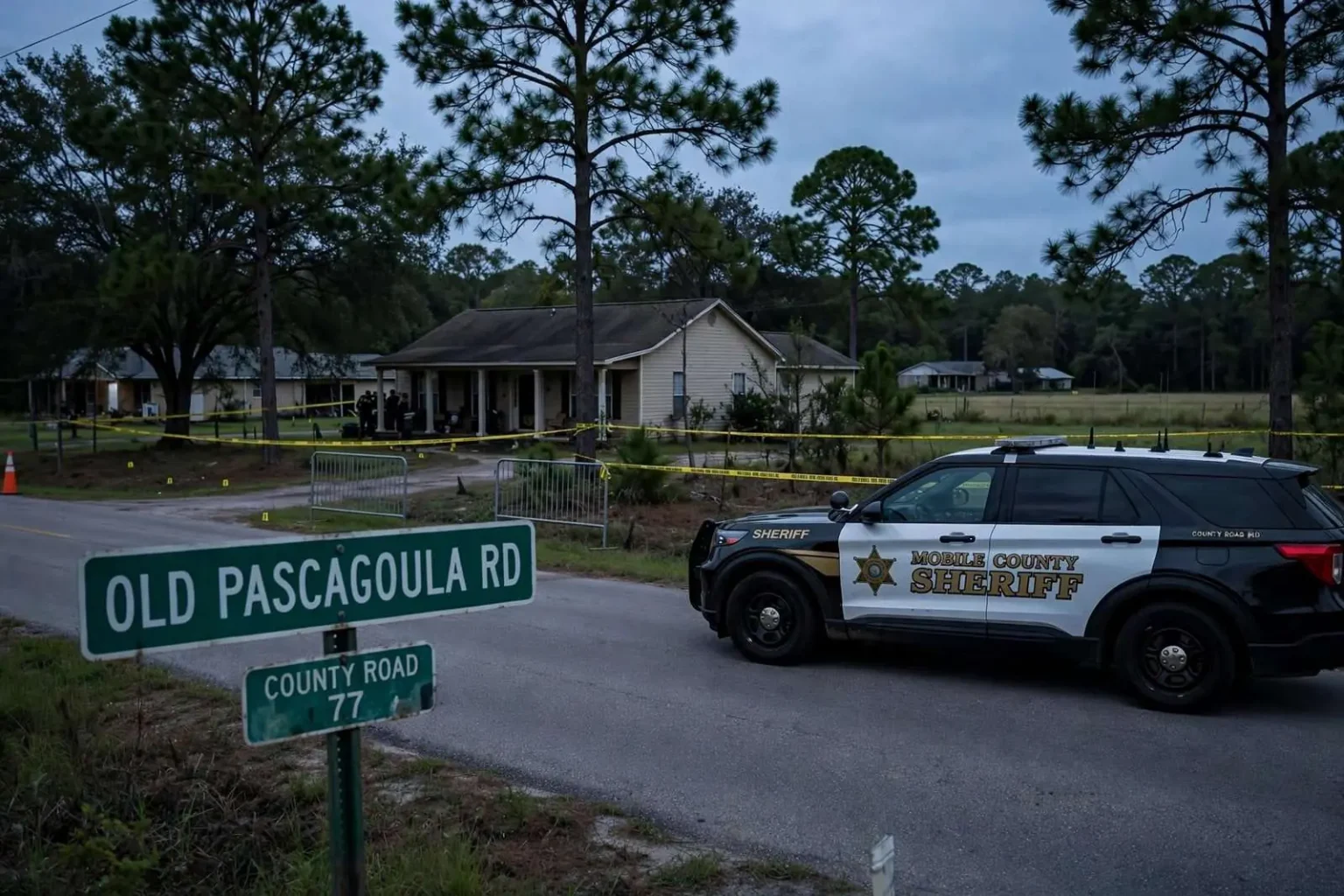
The Mobile County Sheriff’s Office is investigating a Sunday evening shooting at a home in Grand Bay in which deputies say a son shot his father. The incident, reported at a residence on Old Pascagoula Road, brought deputies to a quiet stretch of one of the community’s main thoroughfares at a time when most of the rural neighborhood was settling into the end of a weekend.
According to the sheriff’s office, deputies were called around 6 p.m. to a residence on Old Pascagoula Road. Authorities later said the victim was shot by his son and that his injuries were not life-threatening. The reassurance about the father’s condition stands out in a category of calls where outcomes are frequently far worse, and it shaped the investigation that followed into a family-violence inquiry rather than a homicide case.
Grand Bay sits in the southwestern corner of Mobile County, near the Mississippi line, a community of farms, subdivisions, and long rural roads where sheriff’s deputies, rather than a municipal police force, provide primary law enforcement. Old Pascagoula Road runs through the heart of that community, lined with homes set back from the pavement and spaced far enough apart that an evening disturbance at one residence draws little immediate attention from neighbors.
The response and the scene
Details about what led to the shooting were not immediately available, and the case remained a developing story as deputies worked the scene. In domestic shootings, investigators move carefully and deliberately: securing the residence, separating the people present, tending to the victim’s medical transport first, and then beginning the slow work of establishing a timeline inside a household where every witness has a relationship to every other.
The shooting was first documented through the MCSO crime mapping system before the agency confirmed the family relationship between shooter and victim. The crime mapping system, which the sheriff’s office uses to publish calls for service across the county, gave residents near-real-time notice that deputies were handling a reported shooting in the area, hours before any official narrative emerged. That sequence, a blip on a public map that later becomes a confirmed family shooting, has become a familiar rhythm for followers of south Alabama law enforcement reporting.
No arrests had been announced as of Sunday evening. That absence of an arrest in the initial hours of a domestic shooting investigation is not unusual: if the suspected shooter remained at the scene or was otherwise known to deputies, investigators may take additional time to consult prosecutors before any charge, particularly where the facts of the encounter, self-defense claims, or the shooter’s own injuries must be sorted out first. The sheriff’s office provided no indication of which circumstances applied.
The victim’s injuries being described as not life-threatening changed the practical stakes of the investigation, but not its seriousness. Alabama’s domestic violence statutes treat an assault by a family or household member as an aggravating classification, with enhanced charges and procedures that differ from a shooting between strangers, including mandatory arrest provisions in certain circumstances and protective-order mechanisms that come into play after the criminal case moves.
Mobile County has worked in recent years to build dedicated capacity around family violence, with specialized units inside the sheriff’s office and prosecutor’s office that handle domestic cases, connect victims with services, and manage the follow-up, protective orders, safety planning, and monitoring, that reduces repeat violence. A case like Sunday’s shooting, once filed, would flow through that machinery rather than the general criminal docket.
Domestic shootings in rural communities
Deputies in Grand Bay respond to a kind of call profile different from their city counterparts: fewer incidents overall, but longer distances, fewer witnesses, and a heavier share of family and neighbor disputes. Rural domestic violence is consistently identified by advocates as more dangerous in part because of isolation, the nearest neighbor is often beyond shouting distance, and the firearms that are common fixtures of rural households raise the stakes of every confrontation.
That context does not determine what happened in any particular case, and the sheriff’s office has released no account of the moments before the shooting. What it explains is the response pattern: a substantial deputy presence on a Sunday evening, the treatment of the scene as an active investigation rather than a settled matter, and the careful wording of the agency’s public statements while the family relationships and the sequence of events are verified.
Old Pascagoula Road itself is one of Grand Bay’s best-known corridors, running parallel to and south of Highway 90 toward the Mississippi line. Homes along the road back up to fields and woods, and the community’s civic life, its churches, schools, and volunteer organizations, is tightly knit. A confirmed shooting within a family there is the kind of news that travels by Sunday-night phone calls ahead of any news report.
Anyone with information was encouraged to contact the Mobile County Sheriff’s Office. In family-violence investigations, tips from people outside the household, neighbors who heard an argument, relatives with knowledge of prior threats, can materially shape how prosecutors read the evidence, and sheriff’s investigators treat that outside knowledge as a meaningful part of the file.
The Sunday evening timing of the Grand Bay shooting is one of the patterns investigators and researchers note in domestic violence data. Weekend evenings concentrate the conditions, alcohol, family members at home, accumulated tensions, and the end of a weekend’s closeness, that statistically accompany family-violence calls, and law enforcement agencies across the Gulf Coast staff accordingly, though no staffing level changes what happens inside a residence before a call is made.
For the sheriff’s office, the case will now turn on the ordinary machinery of evidence: the victim’s account once he is treated, physical evidence from the scene and the weapon, the statements of anyone else inside or near the home, and whatever history exists between the father and son in prior calls for service. Domestic cases are among the few where investigators often know before they start that there is a documented past, and MCSO’s own records will be part of the review.
What the sheriff’s office has confirmed is narrow: a Sunday evening call around 6 p.m., a residence on Old Pascagoula Road in Grand Bay, a father shot by his son, injuries that are not life-threatening, and an investigation that remained open with no announced arrests as of Sunday night. Everything beyond those facts, the weapon, the motive, the sequence, whether any charge will be filed and what it will be, waits on the investigation the agency has underway.
As the case develops, it will be tracked through the same channels that first recorded it: the crime mapping system that flagged the shooting for the community while deputies were still on the scene, and the sheriff’s office’s public statements as investigators close out their work. For now, the community of Grand Bay is left with the unsettling outline of a family ruptured by gunfire in its midst, and a father expected to recover from wounds his son is alleged to have inflicted.
Grand Bay has seen the sheriff’s office respond to serious incidents before, and the community’s relationship with the agency reflects the realities of rural policing. Deputies patrol a vast unincorporated area stretching from the Dog River watershed to the Mississippi line, and response times along the outer corridors are measured in minutes that city residents rarely think about. Residents there rely on the crime mapping system and the agency’s social media notices for information that a city police department’s public affairs operation would often deliver differently, and the Grand Bay community has learned to read those signals carefully.
The distinction between an unincorporated community and a municipality shapes the aftermath of a case like this as well. Grand Bay has no municipal court, no city council, and no local ordinance enforcement; the legal process that follows a shooting on Old Pascagoula Road runs entirely through Mobile County institutions, from the sheriff’s investigators to the district attorney’s office downtown to the county’s court system. For families involved, that means every step, from the first deputy on the scene to any eventual charge, happens under the same county roof.
Advocates note that the hours right after a family shooting are when safety planning matters most, and county victim services officers are typically assigned to such cases from the outset, regardless of whether an arrest has been made. The victim’s recovery, the household’s immediate arrangement, and any protective measures all get sorted in the days following the incident, while the criminal investigation proceeds on its own track.
Sunday night’s scene on Old Pascagoula Road was cleared by deputies after the initial investigation, but the case file will remain active long after the tape comes down. Whether it ends in an arrest, a charge of first- or second-degree domestic violence assault, or some other disposition depends on evidence still being gathered, and the sheriff’s office has asked anyone with information to come forward directly as that work continues.


