Sonny Bama Headlines Midnight Rodeo Homecoming Show with AllGetOut Reunion
Sonny Bama headlines Midnight Rodeo in Mobile with AllGetOut reforming for one night. Show details, tickets and band history here.
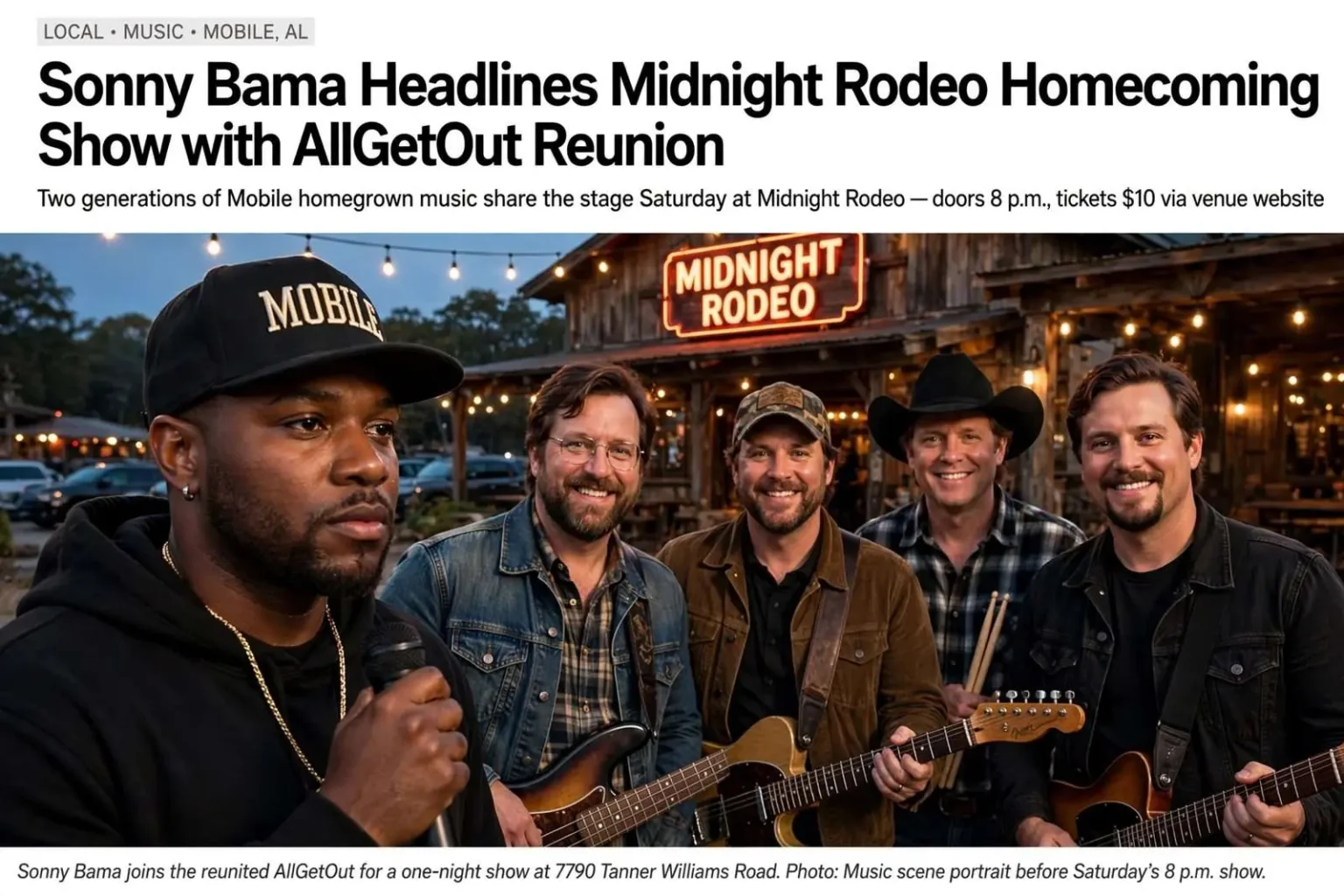
Two generations of Mobile homegrown music will share one stage this Saturday night when rapper Sonny Bama headlines a show at Midnight Rodeo, 7790 Tanner Williams Road, with reformed alt-country outfit AllGetOut opening. Music starts at 8 p.m., and tickets are $10 through the venue’s website — an accessible price point for a bill that spans two distinct eras of the Port City’s homegrown sound.
The pairing is a study in Mobile’s musical range. On one side stands a hometown hip-hop stalwart with a catalog steeped in references to his own city; on the other, an alt-country band that helped define the area’s twang-flavored rock scene back when the genre still lived up to its “alternative” label. Midnight Rodeo, which regularly books both camps, provides the neutral ground where the two audiences can meet.
Sonny Bama: A Hometown Voice
Sonny Bama has long been a hometown hero among Mobile hip-hop fans, known for a smooth baritone flow and lyrics steeped in Mobile references. In a regional rap landscape where artists often chase national trends, his work has consistently looked inward, drawing on the streets, neighborhoods, and culture of the city that raised him — a quality that has kept his local following loyal across the years.
His single “From the Bottom,” a collaboration with singer Ryan Balthrop, found a wide local audience and remains one of the songs most associated with his name. The track captures the blend that defines his style: grounded, recognizable verses carried by a chorus with genuine melodic appeal, the kind of record that moves naturally from club sets to radio rotation to tailgates.
For the Midnight Rodeo date, Bama is backing himself with a full live band featuring drummer Gregg Fells, giving his catalog a punchier, concert-scale treatment than the usual track-based sets. Live-band hip-hop shows change the dynamic in the room — verses hit harder, transitions breathe, and longtime fans get to hear familiar songs reworked with the energy of a stage full of musicians rather than a DJ booth.
That approach also speaks to Bama’s standing in the local scene. After years of recording and performing around the Gulf Coast, he is among the artists whose name alone can anchor a venue’s calendar for a Saturday night, and presenting his material at full concert scale is a statement about where he sees the music going.
AllGetOut Returns with a Special Guest
Before the headliner, the crowd gets a reunion of sorts: AllGetOut, the Azalea City band that helped define the area’s alt-country scene back when the genre still lived up to its “alternative” label. In the years when the band was most active, a wave of groups across the South were fusing country songwriting with the energy and attitude of independent rock, and AllGetOut built a following by playing that style with unmistakable Gulf Coast accent.
The group’s full-length album “Southern Business” blended Southern-fried rock with classic country and rockabilly overtones, a mix that gave the band a foot in honky-tonk tradition and bar-rock muscle at the same time. For fans of that era of Mobile music, the record remains a touchstone of what the local scene sounded like when alt-country was still a newer word.
Founding members Charlie Alexander on bass and vocals, Mark Loftin on guitar, and Albert Robinson on drums are reuniting for the night and bringing in guitarist P.T. Marston as a special guest. Marston’s resumé includes stints with local acts Turbo Crab and Johnny No, giving the reunion lineup an added layer of local-scene pedigree across the front of the stage.
Two Sounds, One Stage
The pairing makes Saturday’s bill a cross-section of two distinct Mobile sounds — contemporary hometown hip-hop on one side, twang-flavored rock on the other — at a venue that regularly books both. For the audience, that means an evening that moves from roaring guitars to boom-bap drums and back again, with neither act asked to bend toward the other’s style.
Crossover bills like this one have become a quietly effective format for local venues. They draw two overlapping but distinct crowds, give opening bands a chance to reach listeners who might never seek them out, and remind audiences that a city’s music scene is broader than any single genre. Mobile’s history supports the idea: the Port City has long produced artists across country, rock, hip-hop, blues, and gospel, often with the same family names appearing in different lineups.
The reunion framing adds another layer. Local bands that step away for years tend to return with a built-in audience of old friends, former regulars, and curious younger listeners who knew the band only by reputation. A single-night reunion concentrates all of that into one show — no tour, no long-term plans, just one evening to play the songs again.
The Venue and the Details
Midnight Rodeo sits at 7790 Tanner Williams Road, west of the city, and has established itself as a reliable stage for both traveling acts and Mobile’s own. Venues on the western side of Mobile County serve a broad draw that includes communities stretching toward the Mississippi line, and Saturday crowds there often mix die-hard music fans with neighbors looking for a night out close to home.
Doors-style details for the show are simple: music starts at 8 p.m., and tickets are $10 through the venue’s website. At that price, the show positions itself as one of the more affordable full-evening options in the area’s weekend market — a deliberate contrast to ticketed tours passing through larger rooms downtown, and part of what keeps local venues like this one busy in a streaming-era economy.
Tickets and details are available through Midnight Rodeo’s website, and organizers encourage early purchase given the combination of a headline act, a reunion, and a modest ticket price. For fans of either act — or of Mobile music generally — the night amounts to a rare local double feature: one of the city’s defining hip-hop voices at full band strength, and an alt-country favorite stepping back onto a stage together for the first time in a while.
Why Local Bills Matter
Shows like Saturday’s are the infrastructure beneath any regional music scene. National tours pass through major cities; it is the neighborhood venues and the homegrown artists that keep a scene alive between them, providing stages where the next generation of players learns their craft and where long-established favorites stay connected to the audience that first supported them.
Mobile has supplied both in recent decades — rappers who name-check their hometown in every verse, and rock and country acts that came up through local rooms before broader audiences ever heard them. A $10 ticket at Midnight Rodeo buys a place in that continuing story, with two of its chapters sharing a stage on the same night.
The Artists Behind the Names
For listeners less familiar with the bill, a quick orientation helps explain why this show carries weight locally. Sonny Bama built his reputation the slow way — through mixtapes, club dates, and collaborations with other Gulf Coast artists — and the city references woven through his music have made him a kind of sonic documentarian of Mobile street life. Collaborations like “From the Bottom” with Ryan Balthrop show the range that has kept him relevant: while his foundation is hip-hop, his willingness to work with singers and songwriters from other genres reflects the same boundary-crossing instinct that puts him on a bill with an alt-country reunion.
AllGetOut’s story runs on a parallel track from the rock side. Bands that emerged from Mobile’s bar and club circuit in the alt-country era leaned on songwriting first — verses about work, roads, and small-town gravity set over guitars that could swing from rockabilly twang to full-volume rock. “Southern Business” documented that approach, and the band’s live shows built a following the old-fashioned way: one Friday night at a time, room by room, across the Gulf Coast.
The addition of P.T. Marston deepens the local connections. His time with Turbo Crab and Johnny No placed him inside two other chapters of Mobile’s independent music history, and his guitar work gives the reunited AllGetOut lineup four players instead of three — extra texture for songs that were written for a three-piece and an audience that will remember every one of them.
A Saturday Night Built for Both Crowds
The practical details make the show easy to say yes to. The early 8 p.m. start means both acts get full sets before the night runs late, a scheduling choice that suits the venue’s west Mobile location, where many in the crowd are driving in from surrounding neighborhoods rather than walking from downtown bars. The $10 ticket removes the usual hesitation about trying an unfamiliar opener: at that price, arriving at 8 and discovering AllGetOut is a feature, not a risk.
For the bands, the stakes are simpler and more human. A headliner with a full band is showcasing a new dimension of his live show; a reunited trio is finding out how the old songs sit after the years between. Both outcomes happen in front of the one audience guaranteed to care — the hometown one.
That is the quiet case for nights like this one. Streaming has made every recording instantly available, but it cannot reproduce the specific thing that happens when a Mobile crowd hears a Mobile artist say the city’s name from a local stage. Saturday at Midnight Rodeo offers that twice, back to back, for the price of a movie ticket. Fans of the city’s music — past and present tense both — have their evening planned.