University of South Alabama Mobile
South Alabama 9/11 Stair Climb Honors First Responders at Hancock Whitney Stadium
The University of South Alabama held its annual 9/11 stair climb at Hancock Whitney Stadium, with participants ascending the equivalent of the 2,071 steps first responders faced inside the World Trade Center on Sept. 11, 2001.
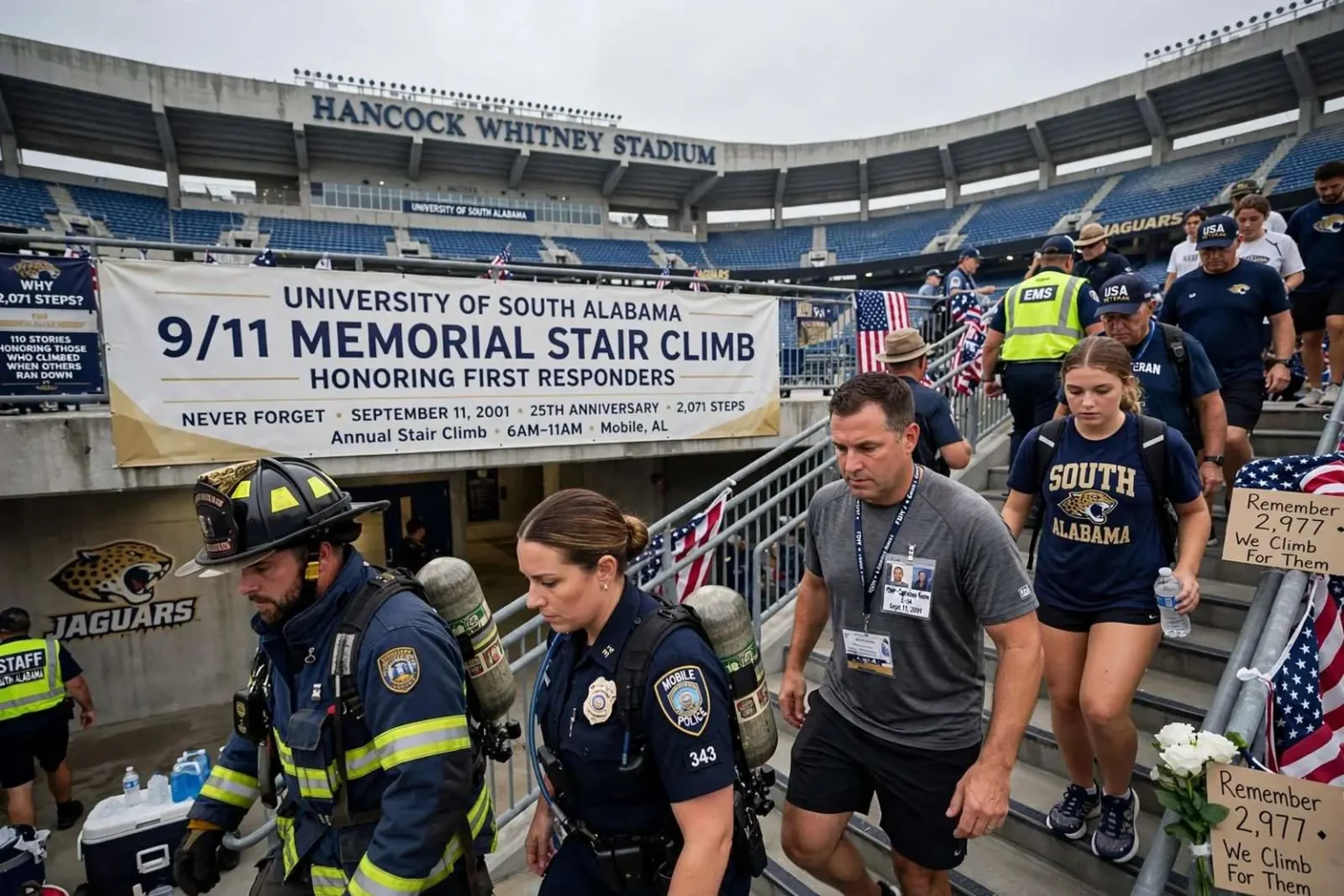
The University of South Alabama marked the anniversary of the Sept. 11, 2001, terrorist attacks with its annual 9/11 stair climb at Hancock Whitney Stadium, an event in which participants ascend the equivalent of the 2,071 stairs that firefighters and other first responders faced inside the World Trade Center.
The climb was scheduled to begin at 6 a.m. Friday and continue until 11 a.m. at the stadium on the university’s Mobile campus. The event is held every year, and people from several organizations take part, climbing the stadium’s concourse stairs over and over until they reach the equivalent of what responders confronted in Lower Manhattan a quarter-century ago.
There is no finish-line spectacle to it, and that is largely the point. A memorial stair climb is deliberately repetitive and deliberately physical. Participants do not race one another. They simply keep going until the count is complete, in an exercise designed to put a body under the same kind of sustained strain, if not the same danger, that the men and women of the New York City Fire Department accepted the moment they started up those stairwells.
Why the Number Is 2,071
The figure that anchors the event has become a kind of shorthand in the fire service. The twin towers of the World Trade Center each rose 110 stories, and the stairwells that ran their full height are commonly counted at 2,071 steps. That number is the standard used by memorial climbs across the country, and it is the number the South Alabama event is built around.
Stadiums, office towers, parking decks and hotel stairwells all get pressed into service for these events because almost nowhere in an average American city is there a single staircase 110 stories tall. Climbers instead complete laps. A stadium like Hancock Whitney Stadium offers long, uniform runs of concrete steps in the seating bowl and on the concourses, plus enough space for a large group to move without bottlenecking, which is why sports venues have become a common host for the format.
Done at a steady pace, the full 110-story equivalent takes most participants well over an hour, and many take considerably longer. Firefighters who climb in gear add a substantial burden to that — turnout coats, pants, boots, helmet and a self-contained breathing apparatus together weigh a significant amount, and the heat that builds up inside the gear is a large part of the challenge. The five-hour window at the South Alabama event, from 6 a.m. to 11 a.m., gives climbers room to start when they are ready and finish at their own pace rather than in a mass wave.
How Memorial Stair Climbs Became a National Ritual
Memorial stair climbs grew out of the fire service itself in the years after the attacks. The best known national version is the 9/11 Memorial Stair Climb associated with the National Fallen Firefighters Foundation, which began in Colorado in the mid-2000s with a small group of firefighters who wanted a physical way to mark the day. The idea spread quickly, and by the middle of the following decade climbs were being staged in dozens of states each September, in high-rises, ballparks, arenas and college stadiums.
The format has stayed remarkably consistent wherever it travels. Climbers ascend the 110-story equivalent. Many carry a photograph or a name badge of one of the 343 New York City firefighters who died on Sept. 11, and at some events a climber will read that name aloud at the top before beginning again. Some climbs ring a bell at intervals. Others observe a moment of silence at the times the planes struck and the towers fell.
The intent behind all of it is to convert an abstraction into something a person can feel. The number 2,977 — the total killed that day in New York, at the Pentagon and in a field near Shanksville, Pennsylvania — is difficult to hold in the mind. Two thousand and seventy-one steps, taken one at a time on a September morning with burning legs, is not.
The Responders the Climb Honors
The stair climb is aimed squarely at the emergency services side of the Sept. 11 story. The New York City Fire Department lost 343 members that morning, the worst single-day loss in the history of the American fire service. The New York City Police Department and the Port Authority Police Department also suffered heavy losses, and paramedics, court officers and civilian building staff died alongside them.
What made the stairwells themselves such a powerful symbol is what was happening inside them. As tens of thousands of office workers streamed down, firefighters carrying tools, hose, spare air bottles and rescue equipment were pushing up in the opposite direction, floor after floor, in buildings with no working elevators above the impact zones. Survivors’ accounts of passing those crews on the stairs — and of the crews stepping aside to let civilians by — became some of the most widely retold details of the day.
The toll did not stop on Sept. 11 itself. In the years since, thousands of responders and recovery workers who spent time at Ground Zero have developed respiratory illnesses, cancers and other conditions linked to the dust and smoke that hung over Lower Manhattan for months. Congress eventually created the World Trade Center Health Program and the September 11th Victim Compensation Fund to provide monitoring, treatment and compensation for that population. Memorial climbs increasingly acknowledge those later deaths alongside the ones that occurred on the day, and the fire service now treats the illnesses as part of the same event rather than as a separate story.
That is the moment a memorial stair climb reenacts, in a controlled and safe setting, and it is why the events are so often organized and attended by firefighters, police officers, paramedics, dispatchers, military members and the families connected to them, along with civilians who simply want to participate.
Hancock Whitney Stadium and the University’s Role
Hancock Whitney Stadium sits on the University of South Alabama’s main campus in west Mobile and is the home of the South Alabama Jaguars football program. The venue opened in 2020, ending years in which the Jaguars played their home games off campus at Ladd-Peebles Stadium across town. Its arrival gave the university a large outdoor gathering place of its own, and in the years since it has hosted more than football — commencement-style gatherings, community events and, in September, the stair climb.
South Alabama is the largest university in the region and a significant part of Mobile’s civic infrastructure, with a medical school, a large health system and academic programs that feed directly into local emergency services, nursing and public safety careers. That makes the campus a logical setting for a Sept. 11 observance oriented around first responders. Many of the people who will staff Mobile’s ambulances, emergency departments and fire houses over the next generation are currently students there.
For students in particular, the anniversary now sits fully outside living memory. A traditional-age undergraduate in 2026 was not yet born on Sept. 11, 2001. Everything they know about that morning has come secondhand — from documentary footage, from classrooms, from parents and from events like this one. An early-morning climb up a stadium’s stairs is one of the few ways that history gets transmitted through the body rather than through a screen.
A Quarter-Century Mark
This year’s observance carried the weight of a round number. Twenty-five years is the point at which an event tends to shift from recent history into settled history, when the people who responded begin retiring in numbers and when the institutions built in the attacks’ aftermath — the Department of Homeland Security, the Transportation Security Administration, the reorganized federal emergency response system — have been in place longer than many of the people working inside them have been alive.
Across Mobile, Friday’s anniversary drew a range of observances, from ceremonies to volunteer service projects to tributes for first responders. The stair climb is among the most physically demanding of them, and among the least ceremonial. There are no speeches required to make its meaning legible. The staircase does the work.
What to Know for Next Year
Because the South Alabama climb is an annual tradition, it is reasonable for anyone who missed it to plan around a similar window in future Septembers. Participants in memorial climbs generally find a few things worth knowing in advance.
- Pacing matters more than speed. The 110-story equivalent is a long effort, and most experienced climbers treat it as a steady march rather than a workout to be attacked.
- Footwear and hydration are the two most common problems. Even in the cooler early-morning hours, Gulf Coast humidity in September is significant.
- Climbing in full turnout gear is a considerably harder undertaking than climbing in athletic clothing, and firefighters who do it typically train for it.
- Early start times exist for a reason. A 6 a.m. start puts the bulk of the effort in before the day’s heat builds.
Anyone interested in taking part in a future University of South Alabama stair climb, or in confirming the details of this year’s event, should contact the university directly for information on organizers, participating groups and how to sign up. Details for annual events of this kind are typically announced in the weeks leading up to Sept. 11.