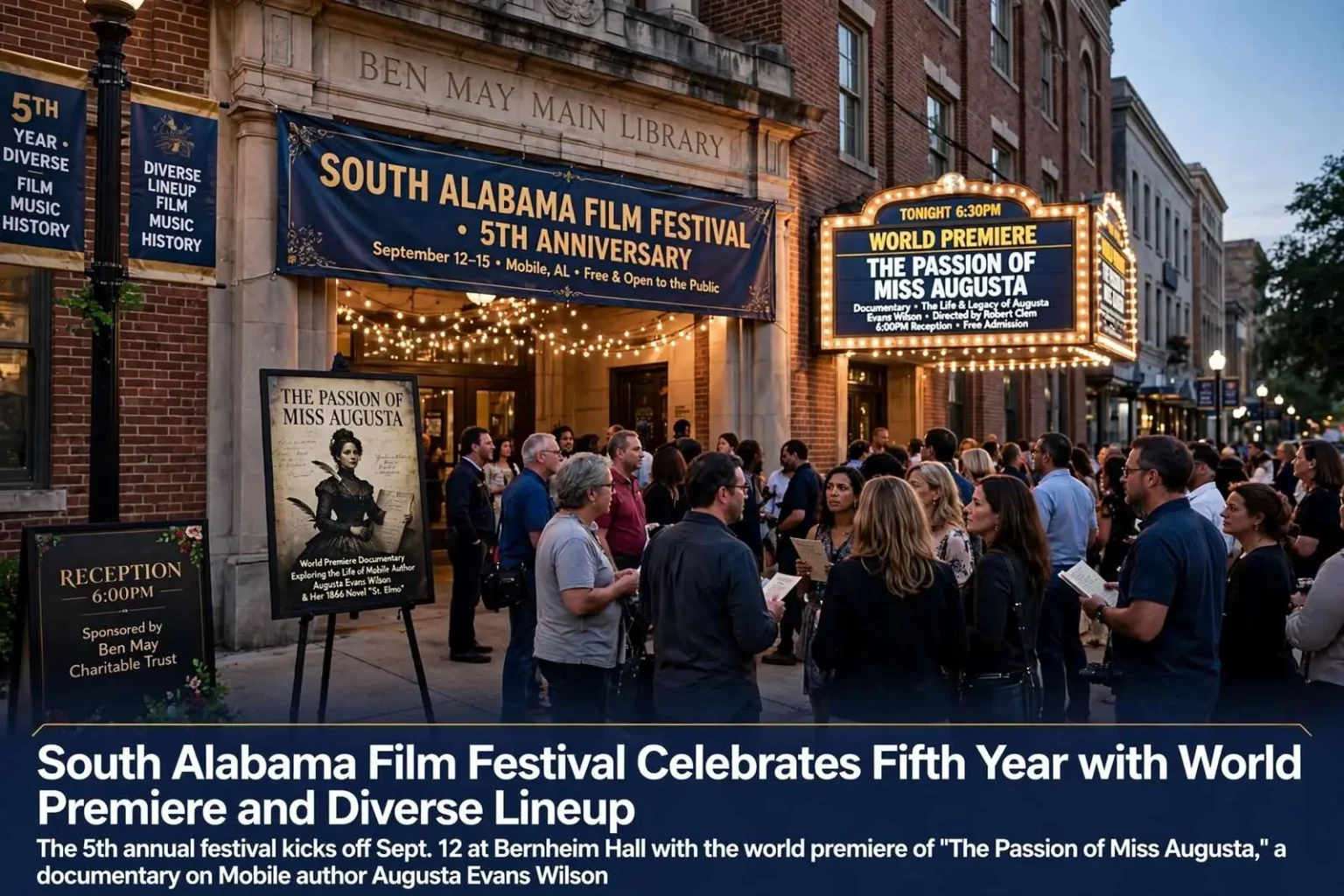
The South Alabama Film Festival marks its fifth anniversary with a weekend of screenings, premieres, and special events beginning September 12 in Mobile. The festival’s highlight is the world premiere of “The Passion of Miss Augusta,” a documentary exploring the life and legacy of Mobile author Augusta Evans Wilson and her 1866 blockbuster novel “St. Elmo.” For a festival that has grown steadily since its founding, opening its fifth year with a world premiere about one of Mobile’s most celebrated literary figures is a statement about the city’s place in American cultural history.
Directed by Alabama filmmaker Robert Clem, whose previous documentaries have examined writer Eugene Walter and novelist William March, the film will debut at Bernheim Hall in Mobile on Thursday, September 12 at 6:30 p.m. The screening will be preceded by a reception at 6 p.m. sponsored by the Ben May Charitable Trust. Admission is free. Bernheim Hall, the auditorium at the Ben May Main Library downtown, offers a fitting stage for the premiere: the building stands at the center of the public library system that grew out of the same philanthropic tradition that shaped Mobile’s civic and cultural institutions for more than a century.
Augusta Evans Wilson’s legacy comes to screen
Wilson was among the most successful American novelists of the nineteenth century. “St. Elmo” achieved phenomenal success and was adapted into several films after her death. Published in 1866, the novel sold at a pace rivaling the biggest literary phenomena of its era, turning its Mobile-born author into one of the first American women to earn a fortune from fiction. Readers named towns, children and even a Texas community after the book, and its hero’s name entered the national vocabulary as a byword for brooding intensity.
Lacking visual material for the documentary — only a handful of photographs of Wilson are known to survive — Clem dramatized sections of the novel, which is based on Wilson’s own life. The story follows a young woman of modest means and high principle who pursues a career as a writer, hoping to serve as an example to other young women of her time. That choice let the film show audiences what readers of the 1860s saw in their imaginations, staging key scenes from a book that has never had a faithful screen treatment. The dramatizations also allow the documentary to explore the autobiographical thread scholars have long identified in the novel, drawing parallels between Wilson’s life and that of her heroine.
The same actress, Yale-educated Marnye Young, plays both Augusta and the heroine of “St. Elmo,” Edna Earl. The dual casting underlines the connection between author and character that the film examines — Edna Earl, like Wilson, is a determined Southern woman who rises through intellect and will in a world that offers few openings. The role of the book’s hero, St. Elmo Murray, is played by actor Jason Downs, who also portrays James Spaulding, the New York publisher whose engagement to Augusta ended in 1860 and who is widely believed to have inspired the Murray character.
Literary scholar Nina Baym believes Wilson’s books are the forerunner of Southern Gothic literature. That argument places the Mobile author in a lineage that runs through William Faulkner, Flannery O’Connor and other writers whose work mined the strangeness, decay and obsession beneath the surface of Southern respectability. For a region whose literary reputation was built largely by writers a century later, the suggestion that a Mobile novelist got there first is a provocative one — and central to what the film sets out to establish.
The film imagines “St. Elmo” as both the silent movie it became and a Hollywood production in the Southern Gothic style of the 1950s. That layered approach lets viewers see the novel the way each generation saw it: first as a silent-era romance, then as the moody, heat-soaked melodrama that mid-century Hollywood made of Southern stories. The device turns the documentary into a film about how stories are retold as much as a film about the woman who wrote one of them.
Clem has said the approach lets him test Baym’s theory while probing how much the constraints placed on women had really changed between 1866 and the 1950s, the era when Southern Gothic adaptations of William Faulkner and Tennessee Williams defined Hollywood’s version of the South.
A festival with a diverse lineup
The festival also features a documentary about the making of “Close Encounters of the Third Kind” in Mobile from late May to early September 1976, as told by locals who experienced the production. Steven Spielberg’s science fiction landmark filmed extensively in the Mobile area, transforming an Alabama coastline into the landscape of an alien encounter and leaving residents with stories of night shoots, road closures and Hollywood arriving in their neighborhoods. A documentary assembled from those firsthand accounts preserves a piece of film history that exists nowhere else.
Other screenings include “Muscle Shoals,” exploring the Alabama town that became a breeding ground for American music, and various independent films. The documentary traces the studio producer Rick Hall built along the Tennessee River and how Hall, working through personal hardship and the racial tensions of the era, brought Black and white musicians together to create the “Muscle Shoals Sound,” drawing artists such as Mick Jagger, Percy Sledge and Etta James. The Muscle Shoals documentary chronicles how a small Tennessee River town produced some of the most influential recordings in American popular music, drawing artists from around the world to a studio far from the industry’s coastal capitals. Its inclusion pairs naturally with the festival’s theme of Alabama places that shaped national culture.
The independent selections include a science-fiction thriller centered on a government climate-weapons program, an absurdist comedy about a detective investigating a boy’s mysterious disappearance from his own home, and a coming-of-age short about a teenager who retreats into a soundscape built from field recordings.
As part of a new partnership with the SouthSounds music festival, organizers have also been collecting online votes for a Southern Video Music Block; the top 10 vote-getters will screen for a live audience during the festival, which will then pick its own favorites.
The independent film selections round out a lineup designed to balance the festival’s historical programming with new work. Festivals of this size typically serve two audiences at once: cinephiles looking for films they cannot see anywhere else, and working filmmakers seeking an audience and a well-run venue. Over five years the South Alabama Film Festival has built its reputation on exactly that mix, screening documentaries and narratives with Alabama connections alongside films from farther afield.
An online museum and a public conversation
An online museum examining Wilson’s life and legacy will launch on September 12, featuring video interviews with scholars including Baym and John Sledge. Sledge, a Mobile-based historian and author whose work on the Gulf Coast’s literary and architectural history is widely cited, joins national scholars in assessing what Wilson meant in her own time and what remains of her reputation today. The digital museum makes that scholarship available to readers and teachers well beyond the festival weekend.
Following the premiere, director Robert Clem and Victorian scholar Susan Reynolds will lead a discussion. Post-screening conversations have become a signature of the festival, giving audiences direct access to the filmmakers and scholars behind the work. For a premiere built around a novelist whose reputation has swung from superstardom to near-oblivion and back toward scholarly recovery, the discussion promises to dig into the questions the film raises about taste, memory and the fortunes of Southern literature.
For information, contact Nancy Anlage, special events coordinator at the Mobile Public Library, at (251) 208-7097 or [email protected]. Visit southalabamafilmfestival.org for screening locations, times, and weekend pass information. Organizers encourage attendees to plan ahead, since the festival’s most anticipated screenings — the world premiere chief among them — traditionally draw the largest crowds of the weekend.
The choice of Wilson as the festival’s centerpiece reflects a broader effort to connect Mobile’s present-day cultural scene with its deeper history. Long before the city was known for Mardi Gras parades and port commerce, it produced one of the best-selling novelists in American history, and her mansion and grave remain points of literary pilgrimage. A festival that puts her story on screen — in the city where she lived and wrote — closes a loop between Mobile’s past and its creative present.
For the filmmakers and scholars involved, the premiere also serves as a test of how much appetite remains for Wilson’s work. Her novels were fixtures in American households for half a century after “St. Elmo,” then faded as literary fashion turned against sentimentality. Recent decades have brought renewed academic interest in nineteenth-century women writers, and the film arrives amid that reconsideration, arguing that the author Mobile remembers deserves a wider audience.
The festival’s fifth-anniversary weekend, anchored by the September 12 premiere at Bernheim Hall, offers Mobile audiences a rare combination: a world premiere, a piece of the city’s own history, and a weekend of films that trace Alabama’s imprint on American culture from Muscle Shoals to the 1976 “Close Encounters” shoot. Admission to the premiere is free, and full weekend passes and screening schedules are available through the festival’s website.
Bernheim Hall itself carries a history that fits the evening. The auditorium inside the Ben May Main Library has hosted generations of Mobile lectures, concerts and civic gatherings, and its association with the library system gives the Wilson premiere a natural home. Augusta Evans Wilson was a fierce advocate for literacy and education in her own lifetime, and staging the debut of a film about her inside one of Mobile’s great public library buildings links the author’s cause with the institution that carries it forward.
The Ben May Charitable Trust’s sponsorship of the opening reception continues a pattern of philanthropic support for cultural programming that bears the name of one of Mobile’s notable benefactors. Community foundations and family trusts across the Gulf Coast underwrite exactly this kind of event — free to the public, tied to local history and built to draw a broad audience — and their backing is a large part of why a mid-size city can sustain a film festival for five consecutive years.
Wilson’s story is also inseparable from the city that shaped her. Born in Mobile and raised in the heart of the antebellum South’s cotton economy, she began publishing as a teenager and wrote her early novels while supporting her family. Her mobility between Mobile, the Texas frontier and the great publishing houses of New York mirrored the paths of a young nation, and her letters and later writings returned again and again to the Gulf Coast landscapes of her childhood.
The timing of the premiere, coming at the start of the festival weekend, gives the rest of the lineup a thematic runway. A city that once sold hundreds of thousands of copies of a single novel is the same city that hosted the shooting of a Hollywood blockbuster in 1976 and helped send Muscle Shoals records up the charts. The festival’s programming asks audiences to see those threads as one continuous story of Alabama’s contribution to American popular culture, on screen and off.
Organizers expect the free premiere to draw a full house, and early interest in the documentary has come from an unlikely coalition of fans: literary scholars, local historians, library supporters and filmgoers curious to see how a nineteenth-century bestseller translates to the screen. Whatever the verdict on Wilson’s prose, “The Passion of Miss Augusta” ensures that Mobile’s first great literary celebrity gets the modern treatment her career — five years of festival history and a world premiere in her hometown — has finally set up.