University of South Alabama Mobile
South Alabama Names Daniel McCarthy New Athletic Director
<p>The University of South Alabama has named longtime deputy athletics director Daniel W. McCarthy as its new athletic director, following nearly two decades with the Jaguars' athletics program.</p>
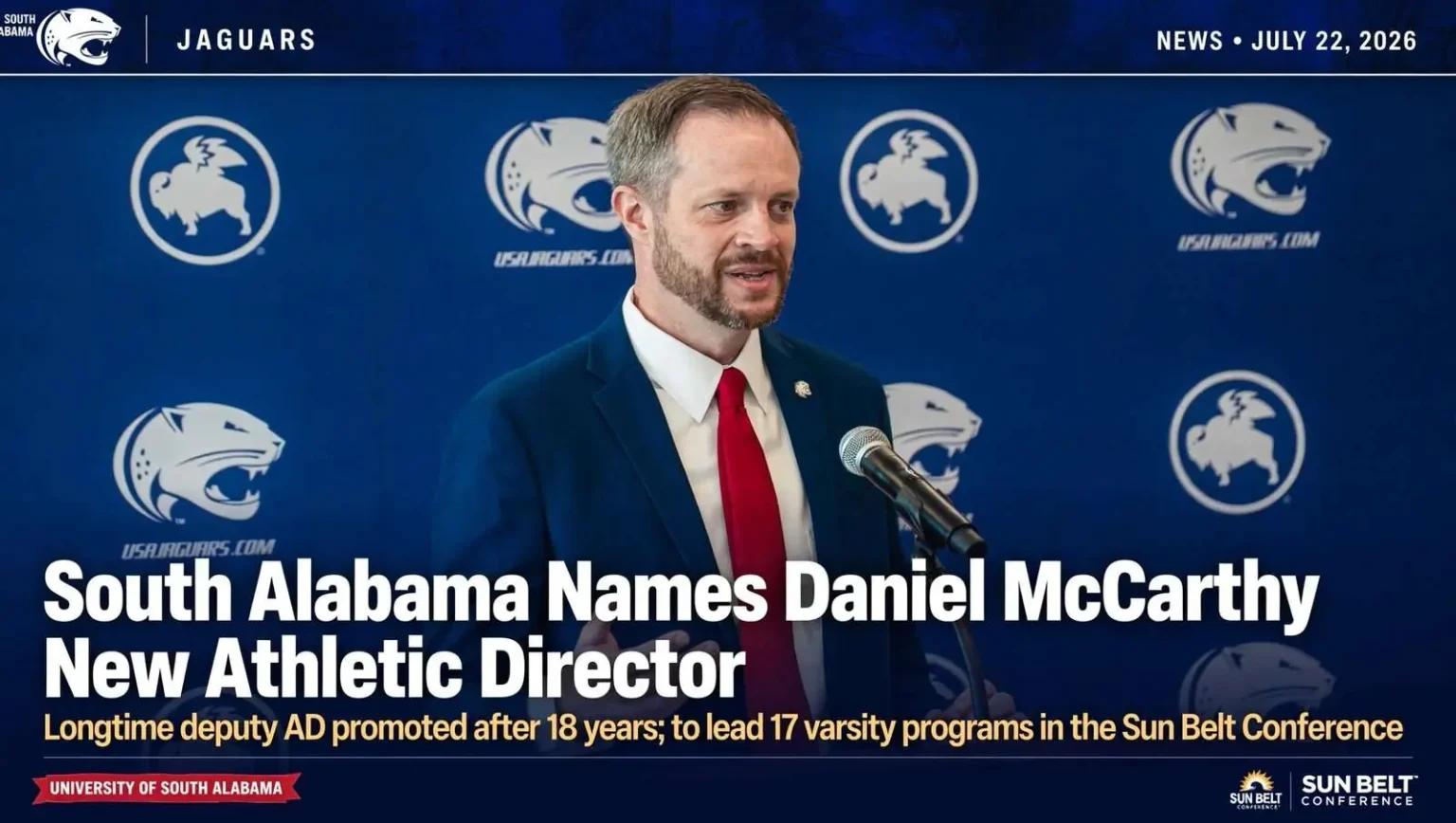
The University of South Alabama has promoted Daniel W. McCarthy to athletic director, elevating the longtime administrator after nearly two decades with the Jaguars’ athletics program, according to a university news release.
McCarthy had served as deputy athletics director since 2017 and joined the university’s athletics staff in 2008. University officials said his experience across nearly every corner of the department made him the clear choice to lead the program going forward.
“When we looked at the future of Jaguar Athletics, it became abundantly clear that the best person to lead us forward was already a member of the University of South Alabama family,” USA President Jo Bonner said in the release. “The feedback we received from stakeholders confirmed that Dr. McCarthy’s dedication to our University and his exceptional impact at South make him uniquely qualified for this role.”
The promotion places McCarthy atop a department that fields 17 varsity programs competing in the Sun Belt Conference, the league South Alabama joined in the early 2000s and where the Jaguars have built rivalries with coastal and regional schools from Texas to the Carolinas. The athletic director’s chair at a mid-major program like South Alabama demands equal parts fundraiser, facilities manager, coach supervisor and campus diplomat — a job description McCarthy, by his own history, has been assembling for 18 years.
A Career Built at Three Universities
Before arriving at South Alabama, McCarthy worked as an assistant director of athletics at the University of Richmond and as a compliance coordinator at Mercer University. He holds a bachelor’s degree in business administration from Huntingdon College, a master’s degree in physical education and sports studies from the University of Georgia, and a doctorate in educational leadership from the University of South Alabama. He is also a graduate of the university’s Leadership South and Leadership Fellows programs.
His path through smaller colleges before Mobile gave him the compliance-heavy grounding that modern athletic administration requires. Rules compliance — recruiting calendars, eligibility certification, financial aid limits — is the invisible infrastructure of any athletic department, and administrators who rise from that world tend to carry a detail-first approach into bigger jobs. McCarthy’s doctorate, earned while working full-time in the department he now leads, reflects the route many working administrators take: studying higher education leadership in the evening while running athletic operations by day.
The Richmond and Mercer stops also gave him a window into two very different models of college athletics. Richmond competes at the championship level of the Football Championship Subdivision and in the Atlantic 10, a program built on academic selectivity and targeted investment; Mercer, in Macon, Georgia, has poured resources into a broad-based athletic rise of its own. Administrators who have watched programs grow from the inside — budgets, hiring, facilities — carry those playbooks with them, and McCarthy’s resume suggests a career spent collecting them.
Huntingdon College, his undergraduate home in Montgomery, and his graduate work at Georgia gave him ties across the state’s collegiate landscape, but his scholarly and professional life since 2008 has been entirely South Alabama’s. Colleagues described an administrator who knows the department’s budget line by line and its coaches by their families’ names — the kind of institutional memory that survives leadership transitions intact.
The Leadership South and Leadership Fellows programs he completed are the university’s internal pipelines for developing administrators who understand the institution beyond their own offices — cohorts that study enrollment, finance, student life and the university’s place in the Gulf Coast economy. Graduates of those programs tend to surface later in senior campus roles, and McCarthy’s progression through them tracked with each step up the athletics ladder.
What He Oversaw as Deputy
As deputy athletics director, McCarthy oversaw the department’s external operations and provided direct oversight of several sports programs, including football, baseball and softball. According to the release, he has supervised nearly every office within the athletics department and has served as the primary liaison between athletics and other university departments.
External operations — the umbrella that covers marketing, ticket sales, media relations, sponsorships and development — is where an athletic department earns and tells its story, and McCarthy’s tenure there coincided with the most ambitious building stretch in South Alabama athletics history. Serving as the department’s liaison to the rest of the university meant he was the voice athletics brought to the president’s cabinet, the student affairs table and the academic councils that decide how a growing university shares its space and priorities.
South Alabama itself has grown dramatically across McCarthy’s 18 years on staff. The university, founded in the 1960s and now one of the largest employers in Mobile, has expanded its health sciences footprint, its enrollment and its campus — growth that athletics both feeds and depends on. A winning football team fills hotel rooms on fall weekends; a university with new academic buildings recruits the students who fill the student sections. McCarthy’s liaison role put him at that intersection, and university officials cited it as central to his preparation for the top job.
The baseball and softball programs he directly supervised rank among the department’s most consistent Sun Belt performers, with baseball in particular carrying a long postseason tradition and a ballpark at the heart of the campus athletic district. Softball has built its own conference pedigree in the same stretch, giving the new director a base of programs with proven winning habits as he takes on the full portfolio.
During his tenure, South Alabama’s athletics program has captured 19 Sun Belt Conference championships and made 14 NCAA postseason appearances. McCarthy also helped oversee more than $90 million in capital projects, including construction of Hancock Whitney Stadium and the Jaguar Training Center.
The stadium project stands as the defining development of that era. For years South Alabama’s football program, which took the field in 2009 and climbed quickly to the Football Bowl Subdivision, played in Ladd-Peebles Stadium, the aging municipal venue across town. Moving the Jaguars onto campus — into a stadium bearing the name of its lead corporate donor, with the surrounding facilities built around student-athlete training — reshaped the program’s identity and gameday experience, and the Jaguar Training Center consolidated the strength, sports medicine and team operations space that campus-adjacent football demands.
The $90 million in capital projects represents more than construction; it reflects the department’s ability to persuade donors, bankers and university trustees to invest in athletics during a period when every college program was competing for the same philanthropic dollars. Naming-rights partnerships, seat-license campaigns and phased financing became the standard tools of that era, and McCarthy’s external operations shop executed them in Mobile’s market — a city whose business community has long rallied around the university as both an employer and a point of civic pride.
The academic numbers carry their own weight in the department’s story. More than 1,600 academic all-conference honorees means the average Sun Belt team has sent a rolling crowd of scholar-athletes to the podium every year of McCarthy’s tenure, and nine Academic All-Americans — a national award that weighs performance in the classroom with play on the field — put South Alabama student-athletes among the best in the country at combining both. Athletic departments increasingly market those numbers to parents and recruits as proof that a program develops the whole student, and South’s totals gave that pitch real evidence behind it.
Taking the Helm
“Being a part of this University and this community for the past 18 years has been such a blessing for me and my family,” McCarthy said. “I’m excited to lock arms with our coaches, staff, student-athletes, alumni, fans and friends as we pursue a bold and ambitious future.”
McCarthy takes over at a moment of churn across college athletics. Name, image and likeness rules, the transfer portal and conference realignment have rewritten the rules every athletic director must manage, regardless of division. For a Sun Belt program, the questions are acute: how to keep homegrown rosters together, how to fund competitive NIL opportunities in a Mobile market, and how to position the program within a league whose geography has stretched across the eastern half of the country. Administrators who have spent nearly two decades inside one department argue that institutional relationships — with coaches, faculty, donors and the port city’s business community — are the asset that outlasts any single rule change.
The university has not announced specific fundraising targets or facilities plans under McCarthy’s leadership, but the trajectory he inherits is visible from the stadium’s stands: a football program with a decade of FBS experience, basketball playing in the on-campus Mitchell Center, and a department whose championship count has climbed through the Sun Belt’s most competitive years. University officials said a formal introduction and the department’s goals under the new director would be laid out in the coming weeks, with McCarthy formally assuming duties as the transition from his predecessor completes.
For a department that chose continuity over a national search, the message from Bonner’s office was deliberate: the future of Jaguar Athletics belongs to someone who has spent his career learning where every door in the building leads.