Southern Exposure Film Fellowship Brings Alabama Environmental Stories to Fairhope
Fairhope audiences get the coast's first look at the 2016 Southern Exposure Film Fellowship's Alabama environmental stories, free at USA-Baldwin County.
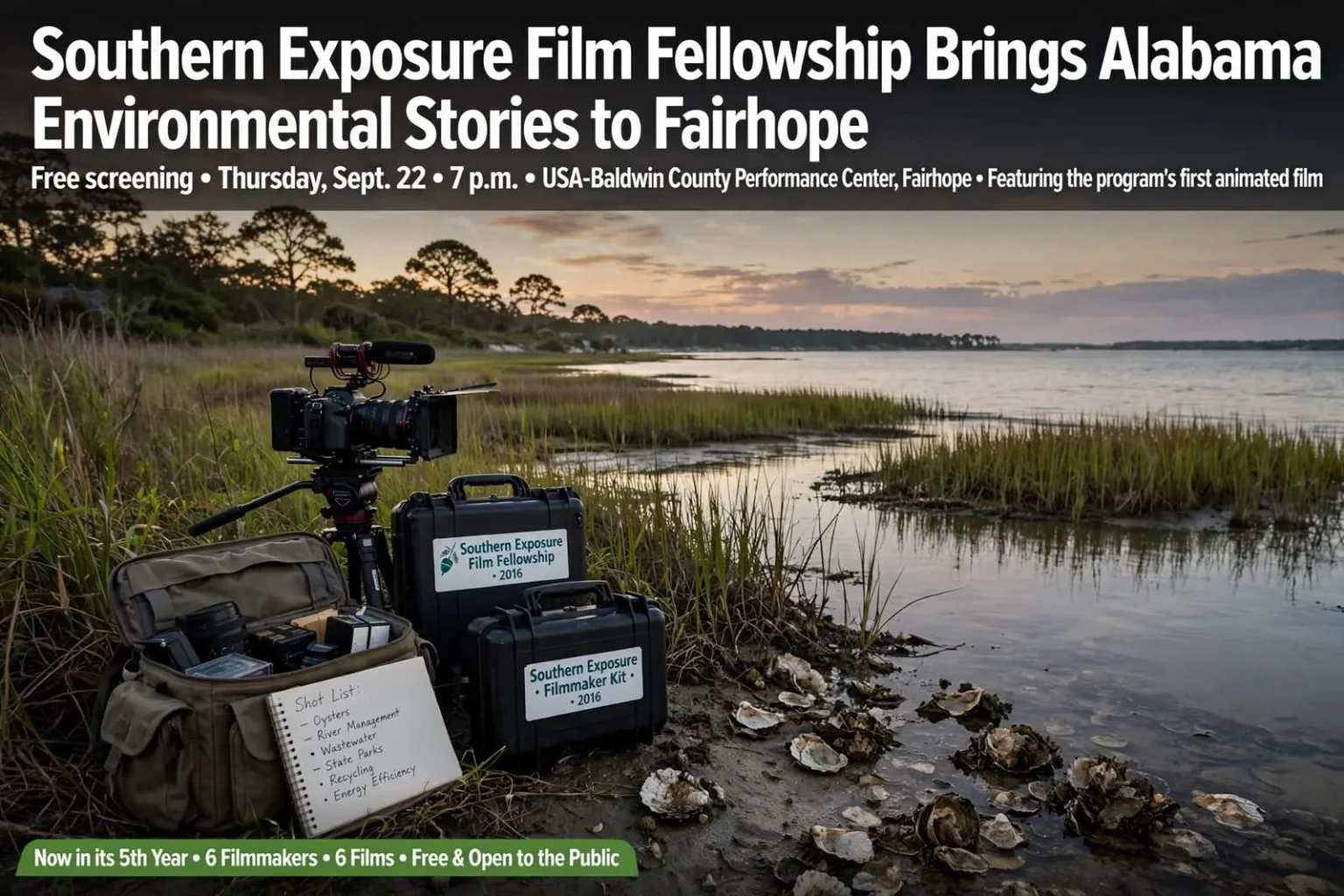
Fairhope audiences get the coast’s first look at the 2016 Southern Exposure Film Fellowship films, a collection of stories about Alabama’s environment that includes the program’s first animated film. The screening, hosted by USA-Baldwin County, takes place Thursday, Sept. 22 at 7 p.m. at the USA-Baldwin County Performance Center and is free and open to the public.
Each summer the fellowship brings emerging filmmakers to Birmingham to learn about Alabama’s environmental issues and meet the people and organizations working to protect them. Over six weeks this summer, six filmmakers traveled the state, producing films on topics from river management and state parks to recycling, oysters, energy efficiency and failing wastewater infrastructure.
A Fellowship With a Mission
Now in its fifth year, the fellowship has produced more than 30 films. Sponsored by the Southern Environmental Law Center, it has highlighted both successes — such as the movement to restore the Forever Wild Land Trust — and urgent challenges facing Alabama’s natural wonders. The program’s premise is simple and effective: give talented young filmmakers a summer assignment in Alabama, connect them with the scientists, advocates and citizens who know the issues firsthand, and let the camera do the persuading.
The filmmakers arrive in Birmingham at the start of the summer and fan out across the state from there. Their subjects take them into the field — rivers, state parks, coastal waters, small towns with aging infrastructure — and into conversations with Alabamians whose daily lives intersect with environmental policy. The finished shorts, typically a handful of minutes each, are designed for exactly the kind of public screening that Fairhope will host: an audience of neighbors, a projector and a discussion worth staying for.
The 2016 collection’s range reflects the breadth of Alabama’s environmental story. River management speaks to the state’s unmatched wealth of flowing water; the state parks film touches on the funding and stewardship questions that face public lands; oysters connect to the delicate economics and ecology of Mobile Bay; and the wastewater infrastructure film takes on a quiet crisis that affects rural communities across the state.
Why These Stories Matter on the Coast
For a Baldwin County audience, several of the films land close to home. The health of Mobile Bay and its tributaries shapes the coast’s economy — its seafood industry, its tourism, its property values — and the oyster story is, in miniature, the story of the bay itself. Wastewater infrastructure failures upstream eventually flow downstream, and coastal residents have a stake in how the state manages its rivers from the fall line to the Gulf.
Alabama’s environmental profile is often summarized by superlatives: more species of freshwater fish, turtles, mussels and snails than nearly anywhere in the country, anchored by river systems that drain much of the Southeast. Yet the state has historically spent less per capita on environmental protection and land conservation than many of its neighbors, a gap that advocacy organizations — and films like these — work to close by making the issues visible.
The screening format puts the films in front of the people who can act on them. Past Southern Exposure screenings across the state have drawn local officials, students, conservation group members and curious neighbors, and the discussions that follow the films often continue in city councils, classrooms and civic clubs long after the projector is packed up.
The Southern Environmental Law Center’s Role
The fellowship’s sponsor, the Southern Environmental Law Center, is the largest nonprofit environmental legal organization in the Southeast, with offices across the region and a long history of involvement in Alabama issues. Its Alabama work has ranged from protecting water resources to defending the Forever Wild Land Trust, the state program that uses dedicated funding to purchase land for conservation and public recreation.
Forever Wild is one of the success stories the fellowship has highlighted. Created in 1992, the program has protected hundreds of thousands of acres across Alabama, from coastal tracts on the Gulf to mountain land in the north, and its reauthorization required a sustained public campaign — the kind of movement the fellowship’s films have documented. For land-hungry Baldwin County, where development pressure meets some of the coast’s most sensitive habitat, the program’s future is more than an abstraction.
By sponsoring the fellowship, the law center invests in something beyond litigation: public narrative. Environmental policy fights are won or lost in courtrooms, but they are argued in living rooms and auditoriums, and a well-made film reaches audiences that a legal brief never will. Five years and more than 30 films in, Southern Exposure has built a library of exactly those arguments, told through the voices of Alabamians themselves.
The Screening in Fairhope
The Sept. 22 screening at the USA-Baldwin County Performance Center begins at 7 p.m., and admission is free. Hosted by USA-Baldwin County, the University of South Alabama’s campus in Fairhope, the event brings the films to an audience that includes students, coastal residents and members of the conservation community from both sides of Mobile Bay.
The Performance Center has served as a cultural venue for the Eastern Shore, hosting lectures, performances and community events, and its partnership with the film fellowship fits the university’s public-service role. For students at USA-Baldwin County, the screening doubles as a look at a career path — environmental filmmaking — that combines storytelling with public impact, and a reminder that the state’s biggest environmental stories are happening in their own backyard.
The inclusion of the program’s first animated film in the 2016 collection adds a novelty for returning audiences. Animation allows filmmakers to show what a camera cannot — past conditions, future scenarios, processes happening underground or underwater — and its debut marks the fellowship’s willingness to expand its toolkit as it matures.
Alabama’s Environmental Story on Film
The six topics in the 2016 collection read like a syllabus for the state’s environmental present. River management concerns how Alabama’s waters are allocated and protected, a question with direct consequences for Mobile Bay. State parks are both recreation and economics, drawing visitors whose dollars support rural communities. Recycling addresses consumption habits in a state with modest diversion rates. Oysters tell the story of a fishery and a restoration effort. Energy efficiency touches household budgets as much as power plants. And failing wastewater infrastructure, invisible until it isn’t, poses public health risks in communities that can least afford repairs.
What unites the films is their Alabama setting — a state whose natural wealth, from the Appalachian foothills to the Gulf beaches, is matched by the intensity of the debates over how to use it. The filmmakers’ job over their six weeks in Birmingham and on the road is to render those debates in human terms: the landowner, the scientist, the waterman, the mayor.
Fairhope, with its history as an artist colony and its location on the bluffs of Mobile Bay, is a fitting place for the coast’s first look at the 2016 films. The free screening at 7 p.m. on Thursday, Sept. 22 invites anyone with an interest in Alabama’s rivers, parks, seafood and landscapes to spend an evening with the state’s newest environmental storytellers — and to see, in six short films, why the fellowship’s work has earned five years and counting.
The Filmmakers’ Summer
For the six filmmakers selected each year, the fellowship functions as both an education and a professional launch. Arriving in Birmingham at the start of summer, they receive briefings on the issues, connections to the experts and advocates who know them best, and the freedom to shape their own approach to each story. The six-week timeline is demanding — research, travel, shooting and editing all compressed into a season — and the finished films carry the urgency of that schedule.
The fellowship’s alumni have gone on to work in documentary film, journalism and environmental communications, and the program’s reputation has grown with each annual class. For Alabama, the returns are durable: a growing library of films that document the state’s environmental condition year by year, told by a rotating cast of fresh voices who arrive as outsiders and leave as people who know the state’s rivers, coasts and forests intimately.
Screenings across the state have taken the films to venues large and small — theaters, university halls, conservation group meetings — and the Fairhope event follows that tradition of putting the work directly in front of the public. The films are built for exactly this setting: short enough to screen several in an evening, accessible enough for an audience with no prior knowledge, and specific enough to send viewers home with something concrete to think about.
A Coastal Audience, a Statewide Story
Baldwin County may be the fastest-growing county in Alabama, and growth is itself an environmental subject. The pressures of new development on the coast — habitat loss, stormwater, wastewater capacity — echo the same themes the 2016 films explore in their statewide frame. An audience in Fairhope watches the oyster film and thinks of Mobile Bay; watches the wastewater film and thinks of the septic systems scattered through the county’s low country; watches the parks film and thinks of the Gulf State Park just down the highway.
That resonance is the fellowship’s strategy in miniature: tell the whole state’s story, and every community will find itself somewhere in it. The Sept. 22 screening gives the Eastern Shore its turn, free of charge, at the USA-Baldwin County Performance Center — an evening of Alabama’s environment, rendered in film, on the coast where so much of it ultimately flows.