SouthSounds 2016 Spotlight: Bantam Foxes on New Orleans, Festivals, and Fuzzy Bass
Among the busiest stages of SouthSounds 2016 was the Blind Mule, and one of its Friday-night headliners was Bantam Foxes - a group well known to Mobilians.
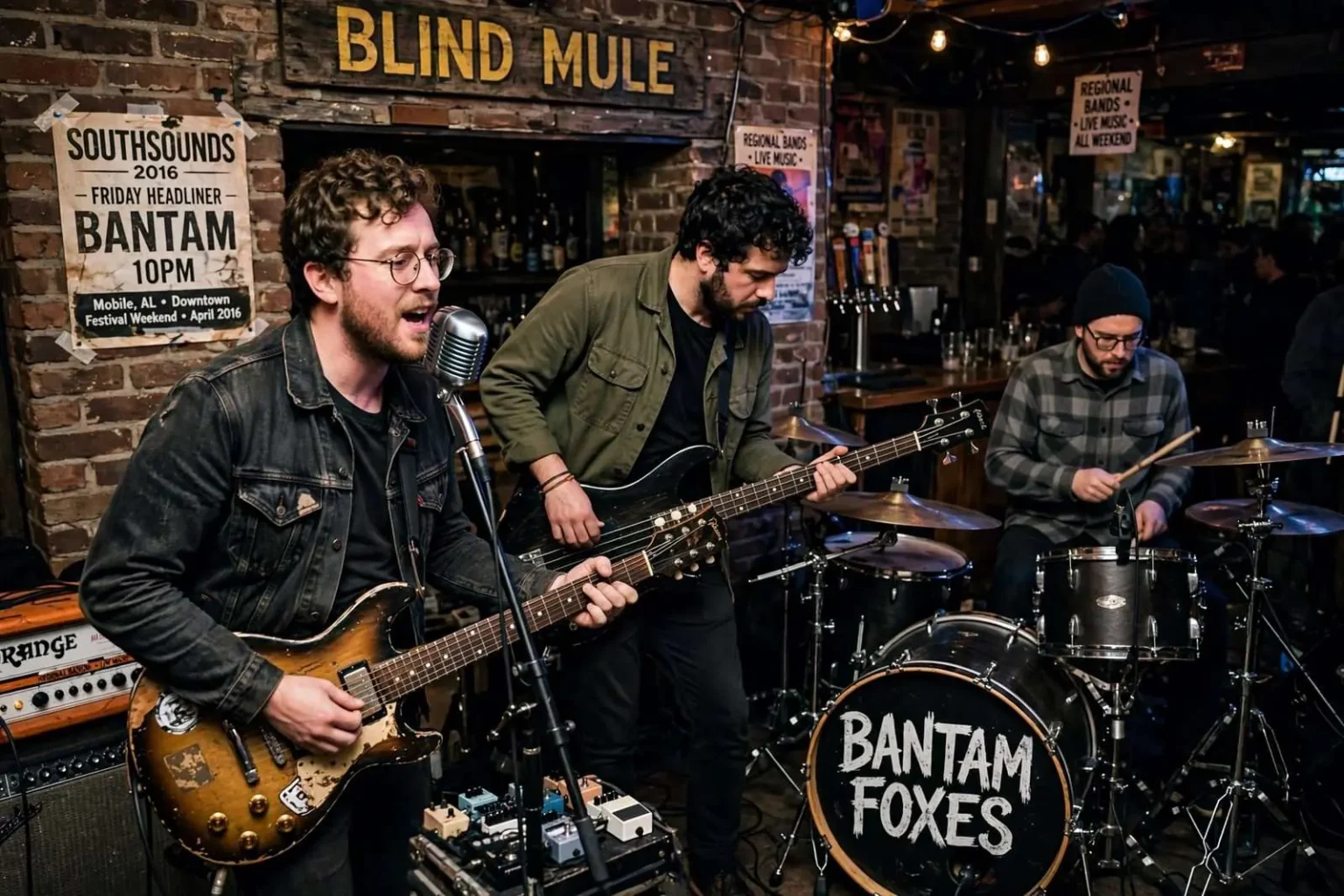
Among the busiest stages of SouthSounds 2016 was the Blind Mule, and one of its Friday-night headliners was Bantam Foxes – a group well known to Mobilians from repeated downtown appearances. The New Orleans band has made the short trip across the state line often enough that its shows in Mobile feel less like a visiting act and more like a hometown band returning, and the festival slot gave the trio one of the weekend’s most reliable rooms in front of exactly that kind of crowd. We caught up with the band during the festival weekend.
SouthSounds has built its identity around that idea: stack a handful of downtown Mobile venues with regional acts on their way up, spread the shows across a long weekend, and let audiences wander between rooms. The Blind Mule, tucked into the downtown grid a few blocks from Dauphin Street’s main drag, has been one of the festival’s workhorse venues, hosting back-to-back sets all weekend for crowds that fill the room and spill toward the bar. A Friday headlining slot there is a meaningful piece of real estate for a band from out of town.
Standing out in New Orleans
Guitarist and vocalist Sam McCabe admitted New Orleans is tough, packed with musicians in every room on any given night. The city’s reputation as one of the great music towns in America cuts both ways for the people actually trying to make a living there. On any Friday, a band can be competing not just with the other rock acts on its circuit but with brass bands, jazz groups, singer-songwriters and traditional jazz outfits filling clubs from Frenchmen Street to Uptown. Audiences in New Orleans can be forgiven for taking live music for granted — it is everywhere, at nearly every hour.
The band loves getting out of town, McCabe said, noting that Alabama and Texas keep rock and roll alive and well. It is a telling pair of states to name. New Orleans sits at the edge of a Gulf Coast corridor that runs through Baton Rouge, Lafayette, the Mississippi Gulf Coast, Mobile and Pensacola, and the touring acts that work that circuit often find that rooms outside the big city are hungrier for guitar-driven rock than the clubs back home. Texas, with its own dense web of independent venues, offers the same thing at a larger scale.
For a band based in New Orleans, Mobile is a natural stop. The drive is only a few hours, the downtown is walkable, and the festival scene has grown to the point where SouthSounds each spring and the club circuit the rest of the year give touring acts a reliable landing. Bantam Foxes’ repeated appearances downtown are a product of that geography — a band close enough to make the trip regularly, good enough to be asked back.
Smaller festivals like SouthSounds, McCabe added, are “killer” for regional scenes because they put lesser-known bands in front of larger audiences and build community. The point gets at what distinguishes a multi-venue festival from a single club show. A fan who buys a weekend pass to see one band ends up discovering three or four others, simply because the rooms are close together and the schedule makes wandering easy. Bands that would struggle to draw a crowd on their own name end up playing to full rooms, and the audiences carry those discoveries home with them.
The case for the regional festival
The community argument matters as much as the exposure one. Multi-venue festivals put musicians from different cities in the same buildings for a weekend — watching each other’s sets, sharing gear, comparing notes on rooms and bookers along the Gulf Coast. Those connections outlast the festival itself, in the form of shared bills, tours booked together and a regional scene that stops being a set of isolated cities and starts acting like a network. McCabe’s word for it was community, and by that measure SouthSounds’ model is doing the thing smaller festivals exist to do.
A fuzzy, gritty sound
McCabe described Bantam Foxes’ influences as 1990s songs listeners forgot they knew – name-checking Spacehog, Supergrass, and Fountains of Wayne – rendered with fuzzy, heavy bass and gritty guitar. It is a precise way to describe a particular strain of 1990s pop-rock: songs with huge hooks buried under distorted guitars, melodic enough to stick after one listen but loud enough to never be mistaken for pure pop. Spacehog’s glam-tinged riffing, Supergrass’s energetic Britpop attack and Fountains of Wayne’s gift for melody all point to the same combination the band aims for — songs that are catchy first and heavy second, without either quality canceling the other out.
The phrase “songs you forgot you knew” says something about why that era translates so well to a 2016 stage. The 1990s produced a decade of radio rock whose choruses were absorbed by an entire generation — music heard in cars and on MTV that nobody consciously memorized but everybody can sing. A band that mines that material honestly, writing new songs with the same instincts rather than covering the originals, gets the benefit of the audience’s half-buried memory. A fuzzy bass and gritty guitar are the vehicle; the hook is the cargo.
The sound also sets the band apart within its own scene. New Orleans’ national identity, musically, is rooted in funk, jazz and brass traditions, and the city’s rock bands often go overlooked by visitors who assume the whole town plays second line. A power-pop-leaning rock trio with heavy distortion and a fondness for 1990s melody is exactly the kind of act that benefits from getting out of that context and playing rooms where the guitar is the main event — rooms like the Blind Mule on a festival Friday night.
The joy of the live set
The band prizes the joy of live performance, from rehearsal laughs to flubbed notes between songs. It is a modest-sounding quality that turns out to be the thing audiences notice most. Bands that treat a show as a perfect reproduction of a recording tend to stiffen; bands that treat it as the reason the songs exist tend to loosen up, and the looseness reads from the back of the room. Flubbed notes, in that framing, are not failures but evidence that the thing on stage is being played by people in real time.
That attitude starts in the practice room, and the mention of rehearsal laughs is more than a throwaway. A band that enjoys its own rehearsals is a band that rehearses, and a band that rehearses is the one that can recover when a festival set goes sideways — when a monitor cuts out, a string breaks or the changeover schedule slips twenty minutes. Festival stages punish unprepared acts and reward tight ones, which is why the bands with the reputations for being fun to watch are almost always the ones that put the work in before they get to the venue.
For a Friday-night headlining slot, the band’s chemistry does the selling. The Blind Mule’s room rewards acts that can sustain energy across a full set — it is a bar-room stage in the truest sense, close to the crowd, with the audience packed shoulder to shoulder by the time a headliner starts. Bantam Foxes’ familiarity with the room, earned over repeated downtown appearances, means fewer surprises and a set paced by a band that knows what works there.
Why the Blind Mule’s weekend mattered
For SouthSounds regulars, the set was a reminder of why the Blind Mule’s long weekend lineup was worth camping out at. The venue’s festival schedule packs acts into marathon blocks, and the attendees who commit to a full night — rather than drifting between stages — are the ones who get the payoff: the deep cuts, the between-song banter, the sense of a room that has been building all evening. A Friday headliner carries the weight of opening that stretch, setting the standard the rest of the weekend’s acts will be measured against.
The band’s own history in Mobile makes the slot a two-way affair. Audiences that have seen a band several times arrive with expectations, and the band arrives knowing which songs the room responds to. That familiarity shortens the distance between stage and floor, and it is part of why out-of-town acts work so hard to build repeat business in nearby cities. A band can survive on one-time festival crowds, but the acts that endure on the Gulf Coast circuit are the ones that turn a first visit into a standing relationship.
McCabe’s comments about Alabama and Texas keeping rock and roll alive and well will read as a compliment to exactly the people who filled the Blind Mule on Friday. Scenes are built from the floor up — by bookers willing to put unsigned and touring acts on weekend bills, by venue owners who keep doors open in a hard business, and by crowds that show up for bands they have never heard of. The festival’s weekend schedule is a concentrated version of that work, and the New Orleans acts that keep coming back are evidence that the effort registers across the state line.
There is a broader lesson in the band’s choice of influences, too. The 1990s artists McCabe named were themselves students of earlier eras — glam, power pop, new wave — who repackaged what they loved for their own decade. Bands that follow the same path, digging through catalog music and folding it into new songs, keep those lineages moving. A festival like SouthSounds, which exists to surface bands in exactly that stage of development, is where that process happens in public: an audience hears a young band work out what it sounds like, and occasionally hears it happen in real time.
The fuzzy bass and gritty guitar that define the band’s sound are also, not incidentally, well suited to rooms like the Blind Mule. Big, distorted low end fills a small space in a way that clinical precision never does, and melody rides on top of it for an audience standing a few feet from the stage. The 1990s records that inspired the band were made for arenas and radios, but the sound translates down to club level almost perfectly — one reason the fuzzy, gritty school of guitar rock has remained the reliable currency of the regional club circuit for two decades.
By the time the band left the stage, the Friday night at the Blind Mule had delivered what the festival promises its regulars: a New Orleans act with a growing reputation, a room full of people who came early and stayed late, and a set that treated the material — the 1990s instincts, the fuzz, the hooks — as something worth playing hard rather than as nostalgia. The weekend had two more days and a stack of venues still to go, but the standard for the long weekend’s lineup was set in that room, by a band that drove in from a few hours west and treated a Mobile stage like home.