SouthSounds 2016 Spotlight: Callaghan’s Irish Social Club and Its New Orleans Guests
Callaghan's Irish Social Club has long been one of the anchors of the SouthSounds Music Festival in downtown Mobile.
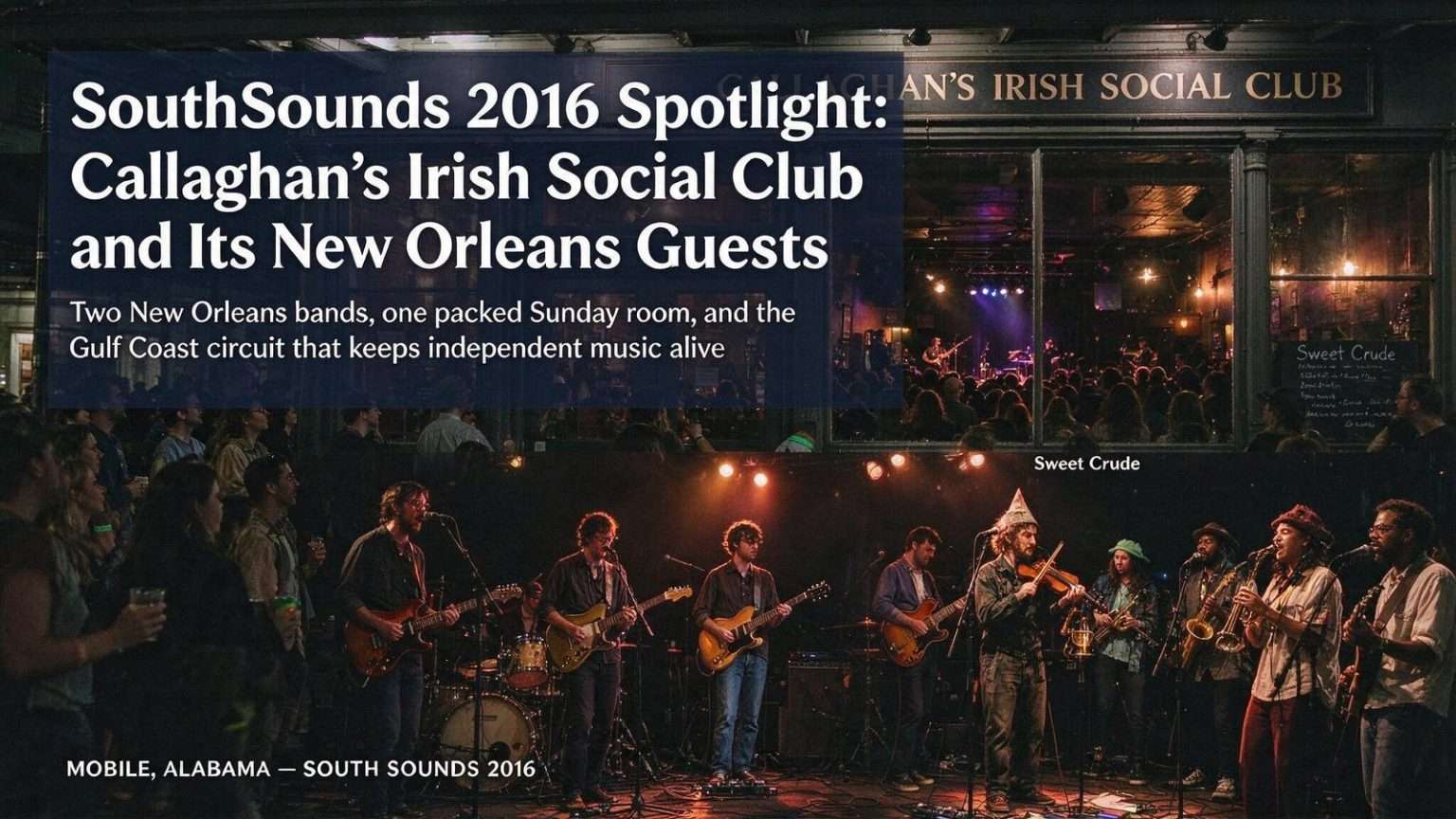
Callaghan’s Irish Social Club has long been one of the anchors of the SouthSounds Music Festival in downtown Mobile, and during the 2016 edition of the festival it once again showed why the modest neighborhood bar carries such outsized weight on the city’s music calendar. Tucked at 916 Charleston St. in the Oakleigh Garden Historic District, the bar and restaurant is as beloved for its food — including an award-winning hamburger that has drawn diners well beyond the neighborhood — as it is for the touring and regional acts that pass through its doors.
The room itself is part of the appeal. Its large windows let listeners enjoy the music from the sidewalk, spilling sound onto Charleston Street during festival sets, and its reputation for treating performers well keeps artists coming back on subsequent tours. Musicians who pass through Mobile routinely put Callaghan’s on their list of favorite stops, a status built over years of attentive booking and an audience that actually listens.
For the 2016 festival, Callaghan’s hosted a pair of New Orleans-area bands, Motel Radio and Sweet Crude, drawing a packed house of independent-music fans on Sunday evening. The pairing made sense on paper and better in practice: both bands traffic in songs rooted in their home city, and both arrived at SouthSounds with growing reputations in the Gulf Coast club circuit. After their sets, both groups sat down for a conversation about their music, their cities, and why festivals like SouthSounds matter to working bands.
Motel Radio on the road and in the studio
Motel Radio, led by guitarist and vocalist Ian Wellman, described the rewards of touring and meeting fellow musicians who become lasting friends. For a young band logging highway miles between gigs, those connections are part of the currency of the road — shared stages, shared bills and shared advice that help a group grow from a local act into a regional one.
The band’s recorded output tells a similar story of steady, resourceful progress. Motel Radio recorded its early “Days & Nights” EP on a tiny budget at a friend’s studio, a common path for emerging acts learning how they want to sound. The band later tracked “Gimme Your Love” with an engineer at Dockside Studio in Maurice, Louisiana, chasing a classic 1970s sound — the warm, analog-flavored aesthetic of the era when a band recorded live in a room together rather than assembling songs piece by piece.
That studio choice says a great deal about the band’s ambitions. Dockside Studio has hosted a long line of Louisiana recordings, and for a young group to book time there reflects the pride Gulf Coast musicians take in the region’s own recording history. Rather than traveling to a distant music capital, Motel Radio put its songs down close to home, in a room built for the kind of full-band, human-scale sound it was after.
Sweet Crude’s Louisiana French pop
Sweet Crude vocalist and fiddle player Sam Craft explained the band’s unusual niche: pop music sung in Louisiana French. In a state where the French language of the Acadian settlers and their descendants has survived in pockets across south Louisiana, hearing it carry a modern pop song is both a musical statement and a cultural one — a way of treating a regional tradition as a living thing rather than a museum piece.
The group proudly flies the New Orleans flag while weaving brass-band tradition, rhythm and blues, modern pop, world music, and new wave into what Craft calls a gumbo of influences. The description fits the city as much as the band: New Orleans music has always absorbed everything around it, from Congo Square through funk, and Sweet Crude’s blend of old language and new sound slots squarely into that lineage.
For festival audiences in Mobile, the band offered something rarely heard on a club stage — fiddle-driven songs in a language many listeners could not parse, delivered with hooks and energy that made the words beside the point. The packed room at Callaghan’s suggested that the pitch translates without translation.
Why small rooms matter
Both bands stressed that independent rooms like Callaghan’s and events like SouthSounds give unknown but promising artists a stage in front of open-minded listeners — the kind of support that lets regional scenes grow. Headliners play arenas, but every arena act once played a room the size of Callaghan’s, and the pipeline from club stage to festival main stage runs directly through weekends like the one the two bands spent in Mobile.
The economics reinforce the point. Small venues pay what they can, book on faith as often as on draw, and survive on regulars who come for the room as much as the band. Festivals like SouthSounds, which scatter dozens of acts across multiple downtown venues over a single weekend, multiply the exposure those rooms can offer — a fan who arrives for one band can discover three more before the night ends.
SouthSounds has built its identity around exactly that discovery model. Rather than chasing headline acts with national followings, the festival concentrates on emerging artists — bands on their first tours, regional favorites crossing state lines, and acts testing new material in front of audiences that have never heard of them. For the musicians, a festival slot is a chance to win over an entire city in one weekend; for the fans, it is a chance to say they saw a band before everyone else did.
Callaghan’s role in that ecosystem is hard to overstate. Its Sunday evening slot during the 2016 festival was one of the weekend’s most crowded bookings, and the bar’s blend of good food, tight quarters and attentive listeners makes it a natural showcase room. Bands that play well there tend to remember it, and the venue’s consistency from one festival to the next has made it one of the stops touring acts ask about by name.
The 2016 edition also demonstrated the cultural crossover that south Louisiana and south Alabama share along the Gulf Coast. New Orleans bands work the Mobile circuit regularly, and Mobile audiences — close enough to catch the brass-band influence in their own church and parade traditions — have long been receptive to what comes out of the Crescent City. Motel Radio and Sweet Crude arrived not as strangers but as the latest wave of a musical conversation that runs constantly between the two cities.
For the members of both bands, the visit was also a working stop in careers built the old-fashioned way: record an EP on whatever budget allows, tour as hard as the calendar permits, and treat every room — from a friend’s studio to a storied bar on Charleston Street — as the next rung. The conversations they sat down for after their sets made clear they understand exactly what rooms like Callaghan’s give them, and why the future of regional music depends on keeping places like it full.
As the festival weekend wound down, the picture that lingered was the one Callaghan’s has offered for years: a full room, a sidewalk full of listeners at the windows, two New Orleans bands trading in French pop and 1970s-flavored rock, and a Mobile audience proving once again that it will show up for music it has never heard — provided the music is good and the room is honest about what it books. That formula has made the bar an anchor of SouthSounds and one of the most dependable stages on the upper Gulf Coast.
The festival’s Sunday lineup has traditionally carried a relaxed, wind-down feel after a full weekend of music across downtown, and the 2016 bill at Callaghan’s fit that mold. Fans drifted in and out between other venues, filling the room steadily as the evening went on, and by the time the New Orleans acts finished, the bar had played host to one of the festival’s fullest rooms.
The conversation the two bands sat down for after their sets gave the audience a look behind the songs. Both groups talked about the practical realities of building a band in the Gulf South: rehearsal spaces that double as garages, tours booked city by city, and the steady work of writing and recording between trips. Both also returned to the same theme — that the region’s audiences are closer than the map suggests, and that a band can now build a following across New Orleans, Mobile and the Panhandle without ever signing anything or leaving the coast.
That regional circuit is itself a quiet success story. Venues within a few hours’ drive of each other effectively share audiences through traveling fans and touring bands, and festivals like SouthSounds formalize the exchange once a year by importing a weekend’s worth of out-of-town acts into Mobile’s rooms. For Motel Radio and Sweet Crude, the festival was both a showcase and a homecoming of sorts — a chance to play for listeners who share their musical geography, even if they had never heard the songs before.
What the evening ultimately demonstrated is the model that keeps venues like Callaghan’s and festivals like SouthSounds paired year after year. The bar supplies the atmosphere and the audience; the festival supplies the discoveries; and the bands supply the reason anyone came. When all three align — as they did on that packed Sunday in 2016 — the result is exactly the kind of night that keeps independent music alive on the Gulf Coast: two young bands, one small room, and a crowd that showed up for music it had never heard and left as fans.