SouthSounds Preview: Birmingham-Bred Banditos Bring High-Energy Rock to Mobile
Birmingham-bred, Nashville-based Banditos bring high-energy rock to SouthSounds Festival 2014 in downtown Mobile as returning festival veterans.
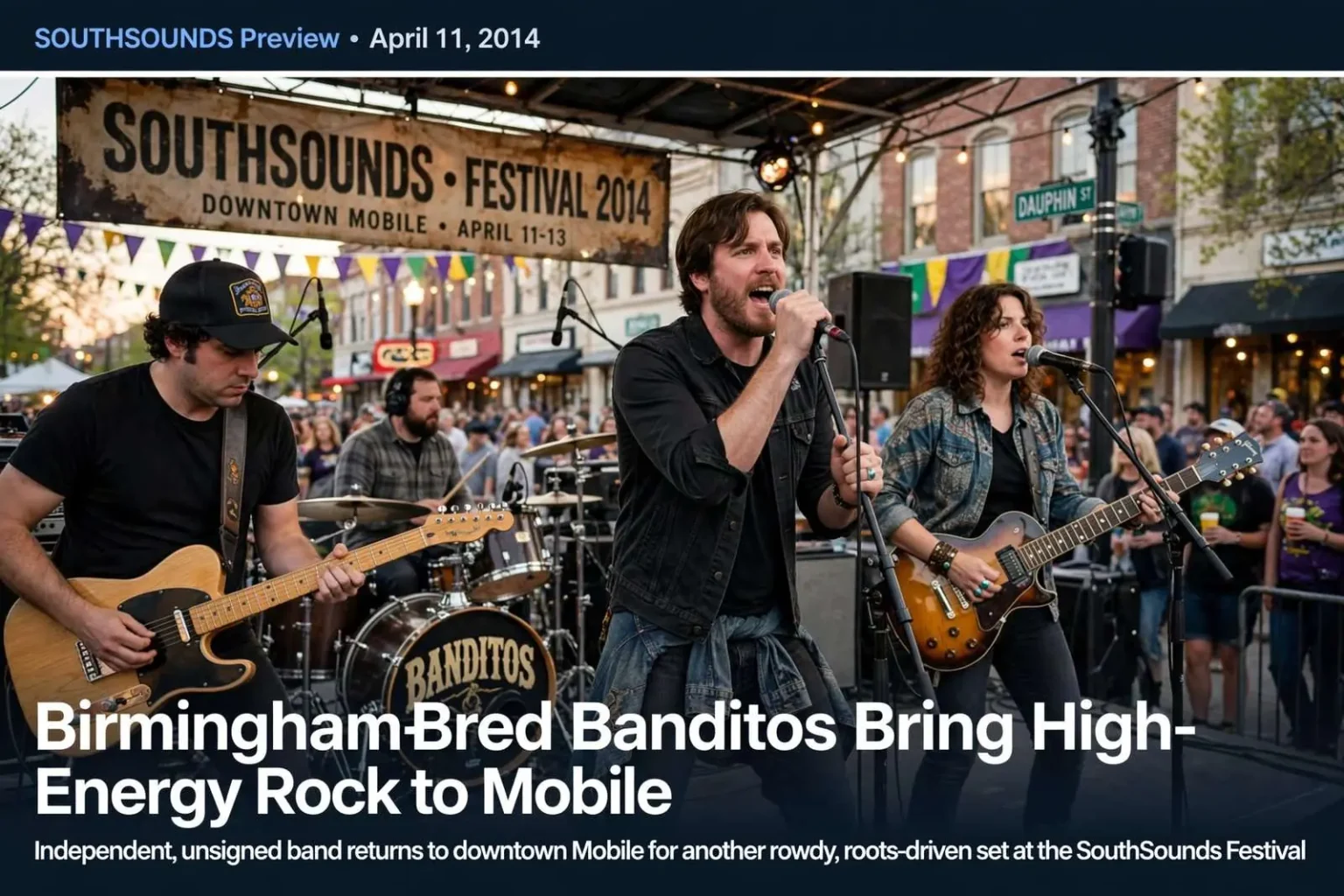
Banditos are SouthSounds veterans, and the Birmingham-bred, Nashville-based band brings the kind of high-energy stage presence that has made them a festival favorite in Mobile. The group is an independent, unsigned act proud to represent the Southeast. Originally from Birmingham, Alabama, the band now calls Nashville, Tennessee home, but its members remain closely tied to the regional music scene. SouthSounds Festival 2014 marks another appearance for the band, which has performed the event multiple years in a row. Expect an energetic set from a group that blends country, rock and folk influences. The festival brings dozens of acts to downtown Mobile each spring.
Return engagements at a festival are the clearest signal a band can send, and Banditos’ repeated appearances at SouthSounds speak to how well their rowdy, roots-driven live show fits the event’s character. The festival, which spread dozens of acts across downtown Mobile’s venues each spring, built its identity on discovery — audiences moving between clubs, patios and street stages sampling bands they had never heard of. In that setting, a band with the boot-stomping, harmony-heavy energy that Banditos brought had an unfair advantage: even passersby who came for a different act ended up in the room, and the room stayed.
The band’s roots trace to Birmingham, where the members came up through a music scene with deep traditions in southern rock, gospel, country and soul. Birmingham has produced a disproportionately rich share of Alabama’s musical talent over the decades, from the Muscle Shoals-adjacent soul tradition to the city’s own vibrant club circuit, and the band absorbed that mixture before relocating to Nashville, the industry hub where touring bands gravitate for songwriting connections and booking infrastructure. The move made practical sense; the identity stayed southern. As an independent, unsigned act, Banditos built their following the traditional way — vans, small clubs, festival stages and word of mouth — and their pride in representing the Southeast was part of their appeal everywhere they played.
A Sound Built on Southern Traditions
Describing Banditos’ music requires a longer list of influences than most genre labels allow. The band’s catalog blended country storytelling, rock drive and folk textures — vintage soul harmonies stacked over bar-band guitars, songs that swung between porch-friendly restraint and full-tilt amplification. That breadth reflected both the members’ varied backgrounds and the southern musical landscape they came from, where country, blues, rock and soul have always borrowed from one another. Live, the mixture translated into shows that built from laid-back grooves to raucous, full-band finales, with vocal harmonies and slide guitar as signature elements.
That sound found a natural home on festival stages. Club gigs reward subtlety; festivals reward immediacy, and SouthSounds audiences encountered Banditos in the format where the band excelled. Musicians who tour the Southeast festival circuit learn quickly that each town has its own character — Mobile’s audiences, warmed by the city’s Mardi Gras heritage and its centuries-old appetite for celebration, greeted high-energy roots rock with particular enthusiasm. Multiple return invitations to SouthSounds confirmed what the first one suggested: Mobile had adopted the band.
The 2014 edition of the festival found SouthSounds in growth mode. Launched as a showcase event in the years prior, it had quickly become a fixture of downtown Mobile’s spring calendar, pairing regional and national independent acts across venues clustered around Dauphin Street. The festival’s timing — spring, when Mobile’s weather cooperates and its streets are already in festival mode — made it a natural stop for touring bands working their way along the Gulf Coast between New Orleans and the Florida Panhandle. For Birmingham and Nashville bands, Mobile was an easy drive and an eager audience, a combination that gave the festival its distinctly regional flavor.
Downtown Mobile as a Music Destination
The festival’s geography mattered as much as its lineup. SouthSounds unfolded across the walkable core of downtown Mobile, with Dauphin Street as the spine and venues within a few blocks of one another, letting audiences build their own lineups out of the dozens of acts performing. That club-crawl format, borrowed from successful showcase festivals in other cities, turned the whole downtown into the venue — bars, theaters and outdoor stages trading audiences all weekend. Local businesses felt the wave: restaurants filled before set times, and hotels booked out as music fans drove in from across the Gulf Coast.
For the city, festivals like SouthSounds represented the continuation of the downtown revival that transformed Mobile in the 2000s and 2010s. Investment in historic buildings, the growth of the entertainment district along Dauphin Street, and events that drew regional visitors all fed the same goal: making downtown a destination after dark. Music festivals were a key ingredient because they showcased local venues to outside bands and outside fans simultaneously, creating relationships that outlasted the weekend. A band that played a great show at a Mobile club in April would route through the city again in the fall — and might bring other bands with them.
For the artists, a SouthSounds slot carried practical value beyond the performance. The festival drew industry observers, booking agents and festival programmers from across the region, all scouting the same stages. An unsigned band like Banditos could leave Mobile with new contacts, better routing offers and momentum toward larger festival bookings. The showcase format also let bands test new material on attentive, unfamiliar audiences — the most honest feedback a working group can get.
What to Expect from a Banditos Set
Audiences catching the band’s SouthSounds 2014 appearance could count on the qualities that had made them repeat visitors: volume, harmony and momentum. The band’s sets ran on an engine of dual lead vocals and guitars rooted in southern rock tradition, with a rhythm section that leaned country and songs that shifted between electric charge and quieter, folk-tinged passages. Festival crowds encountering them cold tended to convert quickly — the band’s energy did the persuading, and their genuine delight in playing did the rest. Veterans of the regional circuit, they treated a hometown-adjacent crowd like a family reunion with amplifiers.
Independent bands in the Southeast face a specific set of challenges and advantages: vast distances between cities, generous festival cultures, and audiences raised on generations of southern music who can spot authenticity instantly. Banditos’ path — Birmingham origins, Nashville base, unsigned status, regional festival credentials — described a working model that many of their peers followed: build the live show first, let the festivals compound the reputation, and keep the songs honest enough to sustain a decade of touring. Their repeated SouthSounds bookings placed them among the acts the festival trusted to deliver a crowd-pleasing set every year.
For Mobile audiences in the spring of 2014, the promise was simple: dozens of bands across downtown, one weekend, and a Birmingham-born, Nashville-based group of SouthSounds veterans bringing the kind of country-rock-folk rave-up that had earned them their return trips. In a festival built on discovery, Banditos were the known quantity — the band people brought their friends to see. That is what veterans of any festival scene earn, and it is exactly what they delivered on the stages of downtown Mobile.
Their continued ties to Alabama gave every home-state appearance a little extra charge. Bands that leave the Southeast for Nashville often drift from their regional fans, but Banditos kept the Gulf Coast and Birmingham circuits in regular rotation, playing the clubs and festivals that first put them on stage. Mobile’s festival crowds, in turn, kept claiming them as their own — a mutual adoption that repeated SouthSounds invitations made official, year after year, on the stages of downtown.
The Road Between Birmingham and Nashville
The Interstate 65 corridor between Birmingham and Nashville has become one of the important highways in American roots music, and Banditos’ relocation along it followed a well-worn path. Birmingham offers a band its origins — cheap practice spaces, loyal hometown crowds, a scene that mixes southern rock heritage with punk energy and soul tradition — but a band with touring ambitions eventually needs Nashville’s infrastructure: songwriters’ rounds, publishing connections, rehearsal compounds and a booking ecosystem that funnels bands onto national routes. Keeping the Birmingham identity while working the Nashville industry was the balance every Alabama band in Music City tried to strike, and audiences in both cities watched to see how the band handled it.
The Southeast’s festival network made that double identity workable. Within a day’s drive of Nashville, a band can reach Atlanta, Birmingham, Huntsville, Chattanooga, Memphis, New Orleans, Mobile and the Florida festival towns — a dense circuit of stages and audiences that rewards bands willing to grind. Independent groups with no label support live or die by that circuit, and the bands that endure are the ones that treat every market, from a 200-cap club to a festival main stage, as equally worth the drive. Multiple years of SouthSounds appearances put Banditos squarely in that category: the festival had become an anchor date in their regional routing, the spring appearance that Mobile audiences could count on.
The decision to stay independent also shaped what kind of career the band was building. Unsigned groups control their recordings, their booking and their identity, but they shoulder the costs — vans, trailers, merch inventory, hotel rooms split six ways. The tradeoff rewards bands whose live reputation carries them, because word of mouth is free and festival stages multiply it. A strong SouthSounds set reached hundreds of new listeners in one afternoon, each of whom might stream the songs, buy a record at the merch table or tell a friend in another city. For a Southeast band without industry backing, that compounding effect was the entire business model.
Festival Weekends and the Downtown Economy
Festival weekends measurably change downtown Mobile. Venues that normally operate on a bar-night rhythm run ticketed, back-to-back lineups; restaurants and food trucks extend hours; and the crowds that fill Dauphin Street spill into the businesses that surround the stages. City officials and downtown merchants have long tracked the impact of such events, which concentrate months of foot traffic into a single weekend and showcase the walkable core to visitors who may not have been downtown in years. A festival that brings dozens of acts and thousands of fans is, in effect, a weekend-long advertisement for the district itself.
The showcase model also built relationships between Mobile and the wider Southeast music scene. Venues that hosted SouthSounds acts added regional bands to their regular calendars; local opening slots introduced Mobile musicians to touring counterparts; and the festival’s reputation made it easier for Mobile to attract other events. Over the years, the festival’s alumni list grew into a map of the region’s independent music — and bands like Banditos, who returned annually, became the through-lines that gave each year’s lineup continuity and credibility.
For the audience, the value of a veteran band’s return was predictability amid discovery. Festival goers could build an afternoon around one sure thing and spend the rest of the day experimenting among unfamiliar names. Banditos filled that role for many Mobile fans: the band to see with friends, the set that guaranteed a sing-along, the act that justified the drive from across the bay. When the 2014 lineup appeared and their name was on it, longtime festival goers knew exactly which stage to stand in front of, and newcomers found out why the band kept coming back.
In the end, the pairing of band and festival made sense from every angle: a regional act with Birmingham roots and Nashville polish, a downtown that had rebuilt itself around entertainment and hospitality, and a spring weekend that brought them together year after year. SouthSounds gave Banditos a stage that matched their energy; Banditos gave SouthSounds a reliable spark of Alabama pride. Both sides of that exchange showed in the 2014 festival — and in every packed downtown room where a Birmingham-born band played its Gulf Coast homecoming.