SS United States Leaves Mobile on Final Voyage as Okaloosa County Moves Sinking Up to Wednesday
Tugboats towed the SS United States out of Mobile on Nov. 9 as spectators said goodbye. Okaloosa County moved the sinking up to Wednesday, Nov. 11, because of forecast high winds.
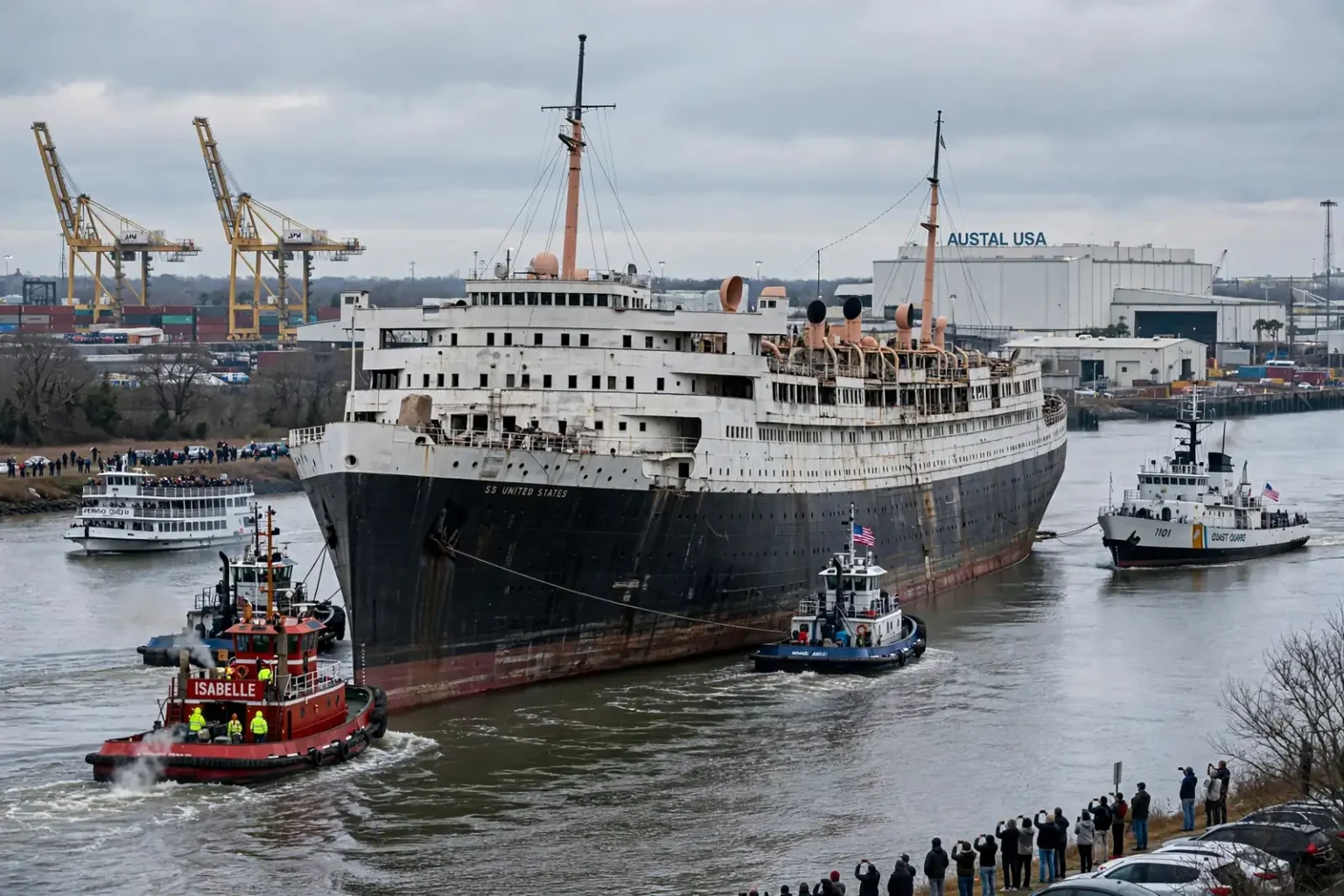
MOBILE, Ala. — For months, people along the waterfront wondered what the day would look like when the SS United States leaves Mobile. They found out Monday morning, Nov. 9, as a small fleet of tugboats eased the retired ocean liner away from the Mobile River dock where it had spent the past 20 months, turned it around and pointed it down Mobile Bay toward the Gulf. Waiting for it off the Florida Panhandle is its planned final role as what Okaloosa County, Fla., calls the world’s largest artificial reef.
The departure came with a late schedule change at the other end of the trip. Okaloosa County said it has moved the sinking up a day, from Thursday to Wednesday, Nov. 11, because forecasts called for heavy winds and unsafe conditions on Thursday. Deployment operations are now scheduled to begin at 1 p.m. Central time Wednesday, and the public sendoff ceremony that had been planned for 1:30 p.m. that day has been canceled.
Back in Mobile, Monday was a day for goodbyes. Spectators gathered along the riverfront and the shore of the bay, dozens more followed the liner aboard a riverboat, and some people who simply happened to be in town found themselves watching a piece of maritime history slip away.
An hour to turn a 990-foot ship
Getting the ship under way was a slow and careful job. From the moment its tall prow began to pull away from the dock, it took a full hour for the tugs to get the vessel headed downriver. They swung the liner off its mooring, where it had become a landmark visible from Interstate 10, and out into the current of the Mobile River.
From there the tugs backed the ship down the river, past military vessels in for maintenance at a shipyard across the water, past the tall cranes of the APM Terminals Mobile container terminal and past the large new building where Austal USA builds sections of nuclear submarines. At the turning basin at Choctaw Pass, there was finally enough room to spin the 990-foot hull around without blocking the entire river.
Once the turn was complete, the lead tug, the Isabelle, was able to open up its engines. The SS United States picked up speed. It was nothing like the pace of its record-setting days, but enough to start the trip to its final destination. The U.S. Coast Guard cutter Daniel Tarr and several law enforcement boats kept watch over the convoy.
Farewells from the water and the shore
Several dozen people watched the departure from the Perdido Queen Riverboat. Many had shown up at 5:30 a.m. after a last-minute alert that the timetable had been moved up by a couple of hours. As the tugs went to work, passengers crowded the forward rails, and Capt. Willie Jones slowly swung the riverboat from side to side over the next hour so that everyone got a good look.
Some of those aboard had sailed on the liner themselves. Pam Paflas of Foley was 11 when her family took a winter cruise to the Bahamas on the SS United States. While the ship was docked in Mobile, she regularly brought her memorabilia aboard the Perdido Queen during sightseeing trips. On Monday, the last of those trips, she said the best part had been meeting the thousands of people who came to see the liner after it arrived in Mobile in early 2025.
Pam Paflas said it has been fun because talking to people who were on the SS United States helps her remember; they share memories and get excited when she shows them pictures.
Warren Jones, a member of the board of directors of the SS United States Conservancy, also had a family history with the ship. In the early 1960s, when he was 8 years old, his family sailed to Europe and back on it.
He said they had the run of the ship, explaining that classes were enforced for adults but not for kids, so he could go places adults couldn’t.
He described the moment as unforgettable: when tugs pushed the ship out of Pier 86 in New York, oriented it down the Hudson, and the engines started, giving a feeling of being under power that he never forgot.
He said it was a mix of emotions, recounting that a reporter asked whether he felt happy, sad, frustrated, or relieved, and he replied that it was all of them.
He acknowledged feeling bad but said it feels good the ship won’t be scrapped, noting that an even worse alternative would be the ship deteriorating at the pier, which would leave a negative memory.
Jones said it was emotional, noting the ship still has beautiful lines despite the missing funnels, lines that gave her speed and power throughout her service.
Visitors from near and far
On land, onlookers lined the riverfront and the shore of Mobile Bay. Kevin Sanchez traveled from Tustin, California, to see the ship leave. His fascination with ocean liners began with the movie “Titanic,” and he first saw the SS United States in person in Philadelphia in 2018.
He said he wanted to be part of history because seeing an ocean liner sink is a once-in-a-lifetime event; though sad about the fate, he still wants to witness it, calling it unbelievable to be part of history and see an ocean liner moving across the ocean.
Mobile resident John Schneider, who has visited the ship many times, took it in one last time, urging people to enjoy it while they can because it will soon be sunk and never seen again.
Benjamin Sonier, a Louisiana resident in Mobile for his mother-in-law’s birthday, had read about the ship but didn’t know it was in the Port City until Monday; he happened to arrive as they were hooking everything up and watched it go, calling it a once-in-a-lifetime thing that you won’t see unless you come and see it.
Denise George, a former Birmingham resident now living in Gulf Shores, said she has made a point of seeing the liner each time she visits friends in Mobile, noting they’ve come about 25 times to see the miraculous ship and are now watching the tugboat Isabelle bring it out.
Gwen Ainsworth, whose photo of the ship hangs in the Lupercalia Art Society in downtown Mobile, watched from Bayfront Park, saying it’s grand to see it and she feels compelled to be there to say goodbye.
Mixed feelings about the reef plan
Not everyone agreed with sinking the ship; Mobile resident Claude Thomas said you can walk on it and see historical artifacts, and he thinks preserving it would have been better than sinking it.
Sanchez said he would have preferred preservation but considers the reef a better alternative to scrapping; at least the ship will remain for future generations to dive, which is on his bucket list as he wants to learn scuba diving.
The plan has faced organized opposition as well. Preservationists, environmental advocates and members of the New York City Council have argued that sinking the ship poses environmental risks and that a vessel of its historic importance deserved to be restored and opened for tours rather than stripped of its funnels and placed on the seafloor. Okaloosa County leaders have said the ship was too deteriorated, after years sitting at a pier in Philadelphia, for restoration to be practical, and that the reef will give it a new life.
Last week, the preservation foundation that sued to stop the project filed two separate legal challenges, and a federal judge in Florida turned away its efforts again over the weekend. As South AL News reported, U.S. District Judge M. Casey Rodgers denied the group’s first request for an emergency restraining order on Friday, Nov. 6, finding it lacked the sworn evidence the court requires. The case centers on zinc chromate paint left on the ship and on the U.S. Army Corps of Engineers’ review of the project; the county has said it followed all state and federal guidelines.
From Mobile to the Gulf floor
The ship’s route out of Alabama waters took it down Mobile Bay and through the pass between Fort Morgan and Fort Gaines, the same way it came in. On March 3, 2025, more than 150 people gathered at sunrise on the eastern tip of the Fort Morgan peninsula to watch the liner come through the pass around 7:30 a.m., at the end of an 1,800-mile tow from Philadelphia.
Planners had said the tow to the reef site, about 22 nautical miles southwest of Destin-Fort Walton Beach, would take most of a day, followed by about two days of preparation before the ship is sent to the bottom. Okaloosa County has said the ship is expected to rest in about 180 feet of water, with its upper decks roughly 55 to 60 feet below the surface, a depth meant to work for both recreational and technical divers. County officials have said the sinking itself should take about 45 minutes.
Boaters who want to watch need to keep their distance. The U.S. Coast Guard is enforcing a 100-yard moving safety zone around the liner and its tow vessels, and has asked spectators to stay at least one nautical mile away, both during the transit and at the sinking site until the operation is complete. Boaters should follow instructions from Coast Guard crews and monitor VHF Channel 16 for updates.
Because the deployment has moved to Wednesday, people planning to watch a livestream or attend a viewing event should check Okaloosa County’s official announcements for updated times and links.
A ship’s story that continues on shore
The SS United States was built in Newport News, Va., and made its maiden voyage in 1952. On that trip it set a trans-Atlantic speed record for a passenger liner that still stands, crossing in three days, 10 hours and 40 minutes at an average of more than 35 knots. It remains the largest ocean liner ever built in the United States. The ship left passenger service in 1969 and spent decades laid up, much of that time in Philadelphia, as a series of owners and preservation groups looked for a future for it.
Okaloosa County bought the ship from the SS United States Conservancy in 2024 for $1 million and spent about $10 million to move it to the Gulf Coast. At Modern American Recycling and Repair Services in Mobile, crews removed about 120 fuel tanks, all of the ship’s windows, large amounts of paint and the two 65-foot smokestacks. The smokestacks are being kept for a planned land-based museum in the Destin-Fort Walton Beach area.
Jones said he is excited about that museum, planned for Fort Walton Beach. It is still in the early planning stages, but organizers have already gathered about 10,000 objects from the ship, including its 38,000-pound stem anchor.
For Mobile, the ship’s departure ends an unusual chapter on the waterfront. During its stay, the liner became a tourist draw of its own, with harbor cruises and excursions carrying thousands of sightseers past it. The river will not stay quiet for long: the decommissioned aircraft carrier ex-USS Enterprise is on its way from Virginia to be dismantled in Mobile and is expected to arrive around Nov. 13.
Latest Developments: Forecast, Viewing Party and Safety Zone
Okaloosa County announced the schedule change late Monday, after National Weather Service forecasts pointed to deteriorating marine conditions on Thursday both west and east of the county’s waters.
Wednesday’s forecast called for winds of 5 to 10 knots and seas of 1 foot or less. By contrast, Thursday was expected to bring winds of 15 to 20 knots, gusts as high as 25 knots and seas of 2 to 3 feet, with waters farther west forecast to build to as much as 6 feet in the afternoon.
The county said safety is its top priority and that shifting the date avoids needless risk while allowing the deployment to proceed safely and smoothly. County leaders also noted that the new date falls on Veterans Day, calling it a fitting moment to honor both the nation’s veterans and a ship that carries the country’s name.
Where to watch
With the sendoff ceremony canceled, the county is hosting a public viewing party at AJ’s Seafood and Oyster Bar in Destin starting at noon Wednesday, where a live feed from the deployment site will be shown on a large screen ahead of the 1 p.m. start of operations at sea.
Boater rules at the site
The county has published the proposed deployment coordinates as 30° 07.148′ N, 86° 46.755′ W, and said it expects the event could draw hundreds of vessels. It is working with safety and security partners and expects spectators to follow directions from safety boats on scene.
The U.S. Coast Guard has said it will enforce a one-nautical-mile stand-off zone around the sinking. Unauthorized boats that come too close may be boarded, and their operators could face civil penalties or other enforcement action.