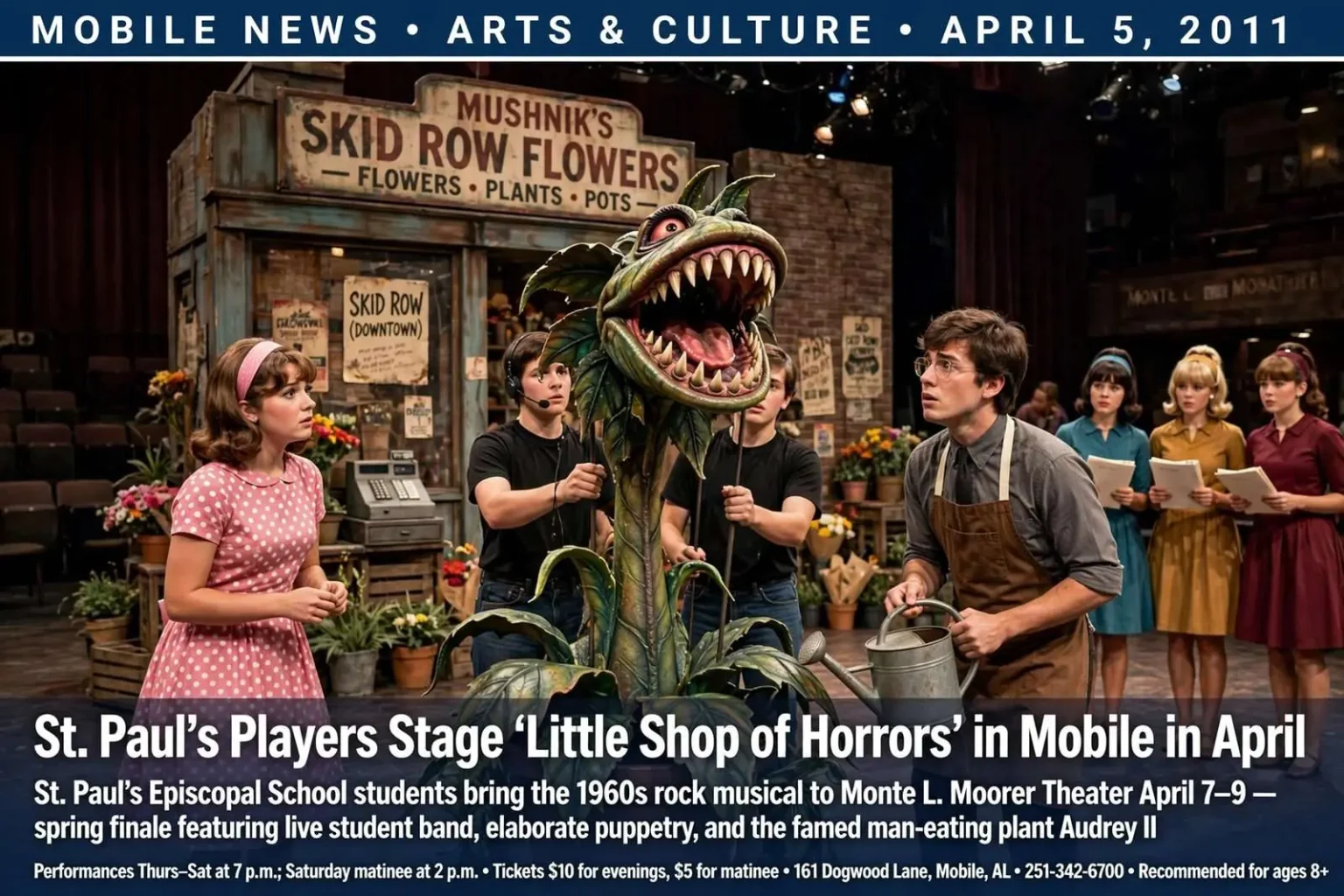
St. Paul’s Players, the theater program at St. Paul’s Episcopal School in Mobile, will close out its 2011 spring season with the rock musical Little Shop of Horrors. Performances run Thursday through Saturday, April 7-9, at 7 p.m., with a Saturday matinee at 2 p.m. The production gives student performers a full-scale musical to carry, complete with a live band’s worth of period-flavored songs, elaborate puppetry and one of the most beloved comic scores in the American musical theater canon.
The show follows Seymour, a hapless clerk at a Skid Row flower shop who raises an unusual plant with a taste for human blood — and the complications that follow when the plant makes him famous. Seymour’s rise from mistreated shop assistant to celebrity horticulturist drives the story, as the ever-growing plant, Audrey II, demands more than potting soil can provide and Seymour weighs how much of his soul he is willing to trade for success. The story’s blend of horror-movie spoof and show-business satire has made it a favorite of school and community stages for decades.
The rock musical, with music by Alan Menken and book and lyrics by Howard Ashman, grew out of Roger Corman’s 1960 cult film of the same name. Ashman and Menken’s stage adaptation premiered off-Broadway in 1982 and ran for more than five years, launching a run of film adaptations and revivals. Its score draws on early 1960s rock and roll, doo-wop and early Motown, and includes well-known numbers such as “Skid Row (Downtown),” “Somewhere That’s Green” and “Suddenly, Seymour.” For the student performers, the songs are both a vocal workout and a crash course in the sounds that topped the charts a half-century ago.
Tickets and Performance Details
The production is directed by Jody Powell, with choreography by Tiny McPhillips and Catherine McPhillips and costumes by Cynthia Allen. Tickets are $10 for evening performances and $5 for the matinee, and may be purchased from the cast, St. Paul’s division offices, Jody Powell or the Campus Store. The show is recommended for ages 8 and up, an advisory that reflects the comic — if cartoonish — menace at the center of the plot rather than anything genuinely frightening.
All performances take place at the Monte L. Moorer Theater at St. Paul’s Episcopal School, 161 Dogwood Lane, Mobile, Alabama. For ticket information, call 251-342-6700. Evening shows begin at 7 p.m. Thursday through Saturday, and the added Saturday matinee at 2 p.m. gives families with younger children a daytime option that ends well before bedtime.
St. Paul’s Episcopal School, located in Mobile’s Spring Hill area, has built a reputation for arts education alongside its academic programs, and the Players’ spring musical is a fixture of the school calendar. Productions there draw students from multiple grades into a single company, pairing veteran upperclassmen with younger performers learning the ropes of a full musical run for the first time.
Cast
Grace Williams stars as Audrey opposite Graham Byrd’s Seymour, with Josh Alter as flower-shop owner Mr. Mushnik and T.J. Beeker as the nitrous-oxide-happy dentist Orin. The four lead roles carry the bulk of the show’s singing and comedy, from Audrey’s wistful dreams of a suburban life “Somewhere That’s Green” to Orin’s gleefully sadistic dentist-office number. Casting these parts is the central challenge of any production of the show, since the comedy depends on actors who can play the material straight while the absurdity builds around them.
The street-corner trio parts are split among multiple performers: Chiffon by Elizabeth Kim, Julianna Lambert and Kyle Grace Mills; Crystal by Maria Salas, Ashley Walsh and Sarah Williams; and Ronnette by Aris Taconi, Beth Pickle and Katherine Miles. The three girl-group narrators function as a Greek chorus throughout the show, commenting on the action, delivering exposition in tight three-part harmony and stepping into small character scenes. Splitting each role among several performers spreads the demanding vocal load across the company and gives more students featured stage time.
Rounding out the company are Hunter Collier as Bernstein, Nathan Lucas as Snip, Abbey McNeely as Mrs. Luce and Bryson Webster as Martin, with Josh Buce and Ben Jenkins as the Derelicts and Boykin joining Buce as the radio announcers. Isabel Irvine, Mary Catherine Nall, Cody DiFazio and Sam Jeffers play the shop’s customers. These supporting parts flesh out Skid Row and the media circus that descends on Mushnik’s shop once Seymour’s exotic plant becomes famous, giving the ensemble sharp comic vignettes between the musical numbers.
The Plant and the Chorus
The Audrey II plant puppet is manipulated by Ross Walker and Jamie Woodall, who also appear with the “Dah Do” chorus: Zoe Cullen, Kristine Schroeder, Caitlyn Gaddy, Maggie Ferguson, Jeannie Marshall, Caroline Hall, Harrison Thompson, Dillon Daggett, DiFazio, William Konrad, Steele Holman, Walker and Woodall. Operating Audrey II is the production’s signature technical challenge — the growing plant appears in progressively larger versions across the show, each requiring its own puppetry, timing and coordination with the voice that gives the plant its attitude.
Puppetry work of this kind gives students experience well beyond standard stage acting. The operators must sync mouth movements to recorded or offstage vocals, maneuver mechanisms hidden from the audience and keep the plant’s comic menace believable scene after scene. Stage crews in professional productions treat the Audrey II puppets as a special effects department unto themselves, and the St. Paul’s students tackling the job are learning skills that transfer directly to larger theatrical and film work.
The chorus members rounding out the company provide the vocal and visual texture that makes the show’s 1960s pastiche work. Doo-wop harmonies, Motown-style arrangements and rock and roll numbers all lean on the ensemble’s singing, and the “Dah Do” group anchors the show’s period sound. For many of the students in the chorus, this production is their first experience with close-harmony singing of the era the musical lovingly imitates.
Why Schools Keep Reviving This Show
Little Shop of Horrors has become one of the most frequently produced musicals in American schools and community theaters for practical reasons as much as artistic ones. The show requires a modest band, a single primary set — the flower shop — and a cast that can expand or contract with the size of the program. Its running time and structure suit school schedules, and its mixture of comedy, romance and mild horror gives performers distinct registers to work in over the course of one production.
The material also rewards the specific strengths of young companies. The narrator-like street trio teaches tight harmony singing; the villain roles invite comic timing; and the plant’s escalating demands give technical crews a storyline to solve with engineering and craft. Music teachers prize the score because it introduces students to the song forms of the early 1960s — verse-chorus pop, doo-wop ballads and Motown-style groove numbers — in a context where every song advances the plot.
A Spring Season Finale in Spring Hill
Staging the musical in April positions it as the capstone of St. Paul’s spring arts calendar, coming after months of rehearsals that typically begin well before the semester’s midpoint. Spring musicals across Mobile’s public and private schools draw families, alumni and neighbors into school auditoriums each spring, and they often double as fundraisers and recruiting showcases for the schools’ arts programs. The $10 evening and $5 matinee pricing keeps the shows accessible to the broad audience such productions aim to reach.
The Monte L. Moorer Theater, the school’s on-campus performance hall, gives the Players a permanent home with the stage depth and offstage space a puppet-driven musical requires. Producing on its home stage eliminates the logistics of renting a downtown venue and lets the company run full technical rehearsals in the same space where the shows take place — a luxury many school programs do without.
For the students involved, opening night on April 7 is the payoff for a season of work: lines memorized, harmonies rehearsed, puppets tested and costumes fitted. The weeks leading up to opening are where a school production is truly made, as casts run scenes repeatedly, crews tighten scene changes and directors polish pacing until the show moves as a single piece. Performers who go through that process once tend to return to the stage program year after year, forming the core of the next production’s cast and crew.
Family support networks keep school theater running behind the scenes, from parents who sew costumes and build set pieces to alumni who return to help with lighting and sound. Those volunteer hours multiply what a school arts budget can accomplish, and they bind the program to the broader community it performs for. Each spring’s audiences include families who once performed on the same stage, watching a new generation take on the same challenge.
Audiences attending the April 7-9 run, either at 7 p.m. in the evenings or the 2 p.m. Saturday matinee, will see the result — a Mobile school company taking on a Broadway classic with a full company of homegrown performers. Between the doo-wop narrators, the man-eating plant and the Skid Row setting, the show offers something for both longtime musical fans and first-time theatergoers. Ticket information is available by calling the school at 251-342-6700.