

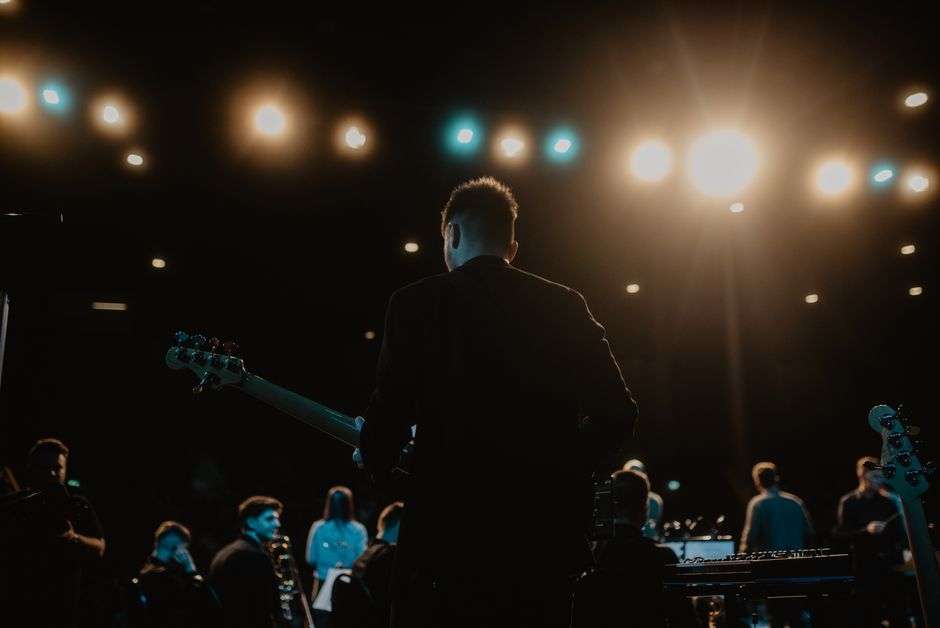
Every Wednesday night at Callahan’s Irish Social Club in Mobile’s Garden District, Stan Foster and Phil Proctor take the small stage and pack the house — a ritual that has now run for more than a decade and made the duo the longest-running act at one of the Gulf Coast’s most storied music rooms. Foster is a singing bass player, one of the rarest and most valuable breeds in club music, and by his own cheerful account he never intended to be either thing.
Starving in Birmingham
Stan Foster was born in Camden, Arkansas, and earned a degree in voice at Southern Arkansas University. His first job out of college put the degree to work in the least glamorous way imaginable: teaching music to junior high students in Birmingham. The economics were brutal. “I was starving,” he says. “I took home $500 a month. My apartment rent was $400. I had $100 for everything else like food and gas. It was awful.” Two years of that was enough.
An escape route appeared through a lie. Nuncie’s Music, a big Birmingham store selling everything from records to keyboards to church sound installations, needed an electronics installer. “They were looking for someone to install electronics. I lied and told them I knew all about it and got the job.” He quit the school job at noon and started at Nuncie’s by one o’clock the same day, in the early 1980s.
The store put him in the path of half the musicians in town — and then fortune and misfortune collided. A bass player in a killer local trio severed a good part of his hand in a bandsaw accident, and the band’s leader, knowing Foster played guitar, came to the store with a question: could Foster play bass and sing? “Sure, I lied again.”
He had never played bass guitar in his life. In a trade that would define his career, he swapped his sister’s valuable vintage clarinet for a bass guitar and an amplifier, then found a teacher: an old hand named Pete who worked the loading dock at Nuncie’s. “You think you can learn to play bass in a week?” Pete asked. Foster — blessed, he notes, with exactly the long arms, long fingers and height the instrument favors — made it work. “I found my thing.” The trio was a hit.
Custer, the Ox, and Jam Grass Before It Had a Name
Birmingham’s music scene of the era was full of talent: Anthony Crawford, who went on to play guitar with Neil Young and now lives on the Gulf Coast performing with his wife in Sugarcane Jane; Pete Nice; and Mark Custer, whose band, appropriately named Custer’s Last Band, hired Foster and became the house band at the Ox, then one of Birmingham’s famous steak restaurants. “I worked at Nuncie’s six days a week and played at the Ox four nights a week. This lasted through the 90s.”
In 1994, Rick Carter — of the band Telluride — came looking for a singing bass player for a new project: bluegrass played with the swagger of the Allman Brothers. “Rocked up country and bluegrass — what would be called Jam Grass today,” Foster says. Rollin’ in the Hay was an immediate success, in its heyday playing 250 gigs a year, and it still performs today.
Donna Hall Said Yes
Around 2000, with the band playing the Flora-Bama, Donna Hall — of Wet Willie fame — showed up to hear them. Not long after, Rick wanted to ask Donna to sing on the band’s second album. Foster was against it. “She’s too good, she’ll make all of us look bad. You go ahead and call her and she will laugh in your face.” To his astonishment, she agreed.
The collaboration outlasted the album. Foster worked up the courage to ask her to lunch at King Neptune’s in Gulf Shores — and sat alone when she never showed. “I’m that guy!” A week later came the redo, and the two married in 2007 at the Five Rivers Delta Resource Center, with Rick Carter officiating on a Sunday chosen, of course, so nobody would miss a gig. The reception lineup included Hank Becker, Mark Farner of Grand Funk Railroad — Donna’s former husband — and her brother, Jimmy Hall of Wet Willie. Today the couple has four grown children and seven grandchildren.
The Discipline of the Craft
Playing beside a world-class singer is a permanent education. “Singing with Donna has made me push to become better,” Foster says. “It comes naturally to her. I have to work on it every day.” He treats his voice like an athlete treats training, working on vocals daily, with what he calls a personal voice coach down the hall. Around Mama Hall’s piano, he, Donna and Jimmy still gather to sing the gospel harmonies that run through the family’s musical DNA.
These days Foster mixes and matches across the Gulf Coast scene: Rollin’ in the Hay, the Marlow Boys, the Selma Boys, the Alabama Troubadours, and gigs with Jimmy and Donna. The Callahan’s Wednesday residency with Proctor — a banter-heavy two-man show they developed after meeting through Ben Jernigan at Jack’s by the Tracks in Ocean Springs — grew from cautious beginnings. “When Phil and I first approached John Thompson about playing, he said Wednesdays were really slow and he couldn’t afford to pay us much. We said, let’s give it a try. That was ten years ago.”
“Being a singing bass player has allowed me to find a niche and has opened lots of doors,” Foster says. “I wouldn’t trade it for anything.” Two honest lies — and a third about knowing electronics — built a life in music.