
Stimpson Names Interim Chief of Staff, Finance Director After Death of Paul Wesch
James Barber becomes interim chief of staff and Celia Sapp interim finance director after the death of Mobile city leader Paul Wesch.
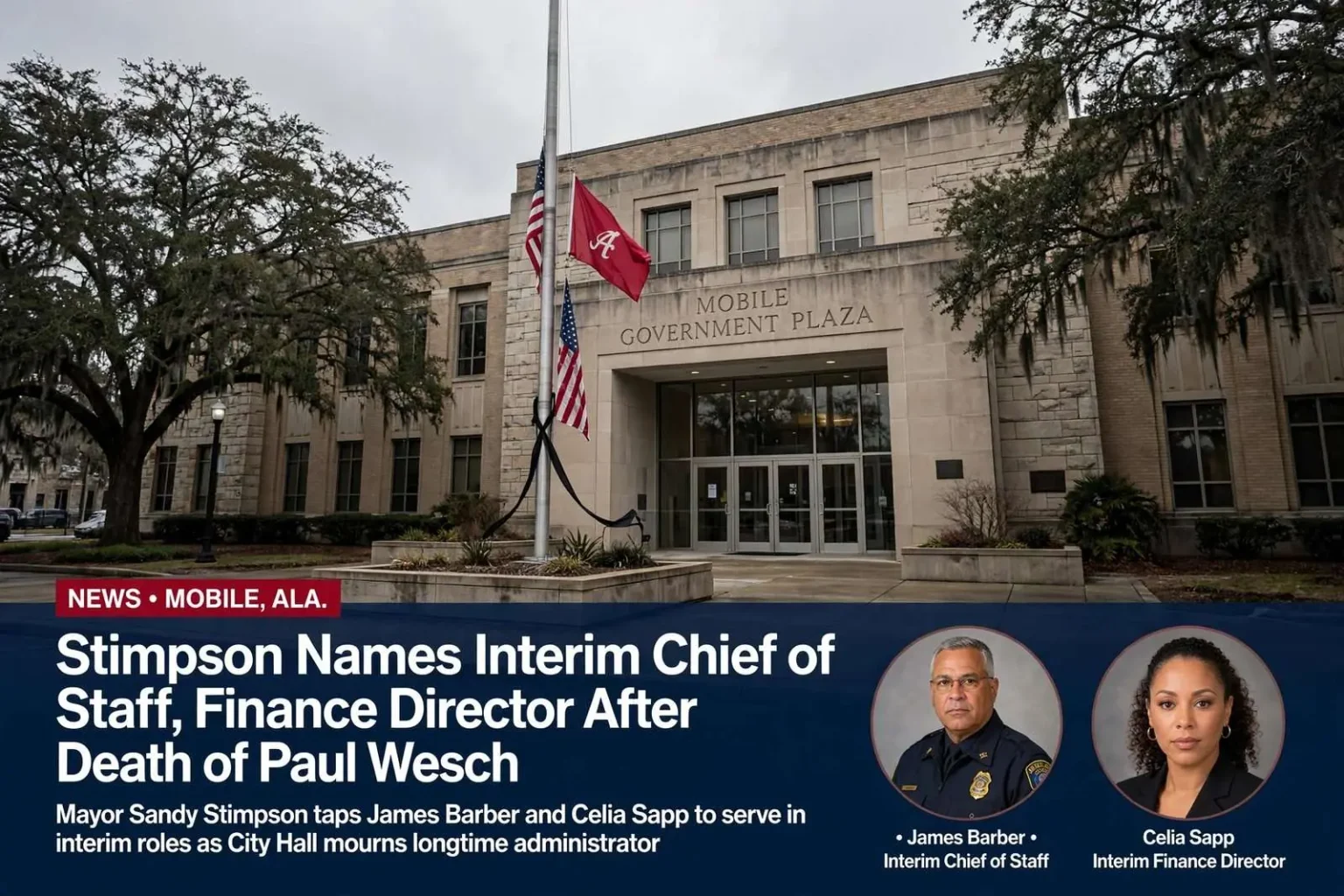
MOBILE, Ala. — Mayor Sandy Stimpson has made two interim appointments to his senior staff following the death of Paul Wesch, the City of Mobile’s Chief of Staff and Executive Director of Finance. The moves come at a moment of grief for City Hall, where Wesch was regarded as one of the administration’s most trusted and knowledgeable figures.
James Barber, who continues as Executive Director of Public Safety, will serve as interim Chief of Staff. Deputy Finance Director Celia Sapp steps in as interim Executive Director of Finance. Barber has been one of the most visible members of the administration, overseeing the police and fire departments and the city’s public safety initiatives, while Sapp has worked inside the finance department that Wesch led, giving her direct command of its operations and budgeting processes.
The moves are designed to maintain continuity while the city mourns a longtime member of its leadership team. Rather than launching an outside search while the city grieves, Stimpson turned to two deputies already steeped in the work, an approach that keeps the mayor’s office and the finance department functioning without interruption during the city’s annual budget cycle — one of the busiest stretches on the municipal calendar.
“While we are still mourning the tragic loss of our friend and colleague Paul Wesch, I have the utmost confidence in James Barber and Celia Sapp,” Stimpson said. “Both have been dedicated City employees for years and both worked closely with Mr. Wesch during his seven years of service to the citizens of Mobile.”
Remembering Wesch’s Service
Wesch, 66, died Dec. 27 in a single-vehicle crash on Bellingrath Road south of Theodore, according to the Alabama Law Enforcement Agency, which reported that the SUV he was driving left the roadway, overturned and struck a tree. Troopers continued to investigate. The crash occurred in south Mobile County, along the rural stretch of Bellingrath Road that runs toward the bay, an area patrolled by ALEA’s highway patrol division.
One of Stimpson’s first administrative appointees, Wesch had spent seven years with the city and was credited by the mayor with an “immeasurable and lasting” impact through his depth of knowledge and experience. He joined the administration early in Stimpson’s first term, taking charge of the city’s finances at a time when Mobile was working to strengthen its reserves and modernize its fiscal operations, and his role later expanded to chief of staff, making him a central figure in nearly every major initiative the city undertook.
The Mobile City Council also paid tribute, calling Wesch an invaluable part of the city’s team as Executive Director of Finance and acting Chief of Staff, and offering condolences to his wife Linda, their children and his many friends across city government. Council members’ remarks reflected the breadth of his reach: as finance director he briefed the council through every budget hearing, and as acting chief of staff he was the administration’s point person on projects the council weighed and funded.
The dual appointments underscore how heavily the administration leaned on Wesch. Holding both the finance directorship and the chief of staff role at once meant he was simultaneously the city’s chief fiscal officer and its top internal manager — the person who both shaped the budget and helped drive the daily operations it paid for. Splitting those duties between Barber and Sapp restores the structure the city ran under before Wesch took on both roles.
What the Interim Leadership Means for the City
For residents, the immediate practical effect should be minimal. Barber’s interim role places him in charge of coordinating department directors and advancing the mayor’s agenda through City Hall, work he has already touched as public safety director through the city’s police and fire operations. Sapp’s interim role keeps the finance department in familiar hands as it manages day-to-day disbursements, debt service and the fiscal reporting the City Council relies on.
The timing matters, too. The appointments were made as the city approached its annual budget work, the process by which the administration proposes a spending plan and the council amends and adopts it. Continuity in the finance director’s chair during that stretch preserves institutional memory of revenue projections, fund balances and multiyear commitments that a new arrival would need months to absorb.
Barber himself came to city government after a long career in law enforcement, serving as Mobile County sheriff before joining the Stimpson administration, and his public safety portfolio has included the city’s response to violent crime, its fire service modernization and emergency management coordination. That background gives him a working relationship with nearly every department director, a useful asset in a coordinating role like chief of staff.
Sapp’s rise through the finance department mirrors a path common in municipal government, where deputy directors absorb the institutional knowledge needed to step into leadership. Her familiarity with the city’s financial systems means the transition should not slow payroll, vendor payments or the monthly financial reports presented to council committees.
Beyond the titles, the appointments speak to how the Stimpson administration has built its bench. The mayor has repeatedly promoted from within when senior posts have opened, favoring aides who know the city’s operations over outside hires who would need time to learn them. The approach trades fresh perspective for stability — a calculus that weighs heavily in a period of mourning, when a disruptive transition would compound the loss of a colleague many employees knew personally.
Wesch’s death also removed one of the administration’s steadier voices at budget time. Colleagues described him as the official who knew where every figure in the city’s books came from and could explain to a skeptical council member why a line item moved from one year to the next. That kind of credibility is difficult to replace quickly, and it is precisely what Stimpson pointed to in crediting Wesch’s depth of knowledge and experience.
The outpouring from across city government — from the mayor’s office to the council floor — reflected the range of relationships Wesch built over seven years. Employees in the finance department worked with him daily; council staff knew him from budget sessions; department directors dealt with him on everything from contracts to capital projects. Those relationships now form the backdrop against which Barber and Sapp will lead.
No timeline has been announced for naming permanent successors to either role. Under the city’s charter and council-mayor structure, the mayor holds the authority to appoint senior administrative officials, and Stimpson may allow the interim arrangements to run for months while the city completes its mourning and its budget work before deciding whether to elevate the interim leaders or search outside.
For now, the city’s message is continuity: the same leadership team, with two of Wesch’s closest collaborators carrying his responsibilities, and a commitment that the work he directed — sound finances, a stable administration and the projects in Mobile’s pipeline — will move forward without interruption.
Funeral arrangements and memorial details were being handled privately by Wesch’s family, and city officials asked residents to keep his wife and children in their thoughts as the community absorbs the loss of a public servant who spent his final seven years shaping the way Mobile is run.
City government observers will also watch what the interim structure means for the council-administration relationship. Wesch was often the administration’s lead negotiator during budget season, the official council members trusted to take a proposed cut or a new expense and walk through its consequences line by line. Barber and Sapp will now split that role, with Sapp handling the fiscal detail and Barber carrying the broader policy conversation — a division of labor that could reshape, at least temporarily, how budget debates unfold in the council chamber.
A Career of Public Service
Wesch’s path to Mobile’s top fiscal job reflected a career spent in and around public administration. Before joining City Hall, he built the finance and management background that Stimpson cited when he brought him aboard among the first wave of administrative hires, and colleagues often noted that he treated the city’s money with the care of someone spending his own. That reputation made him a fixture of the administration’s credibility on fiscal matters, particularly during years when the city worked to rebuild reserves and shore up its bond ratings.
His influence extended beyond spreadsheets. As chief of staff, Wesch coordinated the flow of policy decisions through the mayor’s office, helped steer major capital projects and served as a sounding board for department directors who needed an honest read on how a proposal would land upstairs. Employees across the administration came to rely on that accessibility — a senior official who would take a difficult question directly rather than route it through layers of staff.
The circumstances of his death added to the shock at City Hall. The crash on Bellingrath Road, in a quiet stretch of south Mobile County far from the downtown offices where he spent his days, underscores the unpredictability of the loss that struck the administration in the final days of the year. ALEA’s investigation, standard in fatal crashes on state and county roads, was the formal process through which troopers documented what happened to the SUV he was driving.
For the city’s workforce of thousands, the appointments to succeed him — temporarily at least — mark the transition from mourning to carrying on. The mayor’s tribute paired grief with confidence, and the choice of Barber and Sapp signaled that the administration intends to honor Wesch’s seven years of service not with a prolonged disruption, but with the steady continuation of the work he led.
Residents with questions about city services or the budget process will see no change in how to reach City Hall, and the council’s regular budget calendar is expected to proceed on schedule under the interim leadership arrangement.


