Strickland Youth Center Teens Paint Backdrop for Elizabeth Smart’s Mobile Keynote
Strickland Youth Center teens painted seven boards that will backdrop Elizabeth Smart's keynote at Mobile's 2019 Focus Women's Conference.
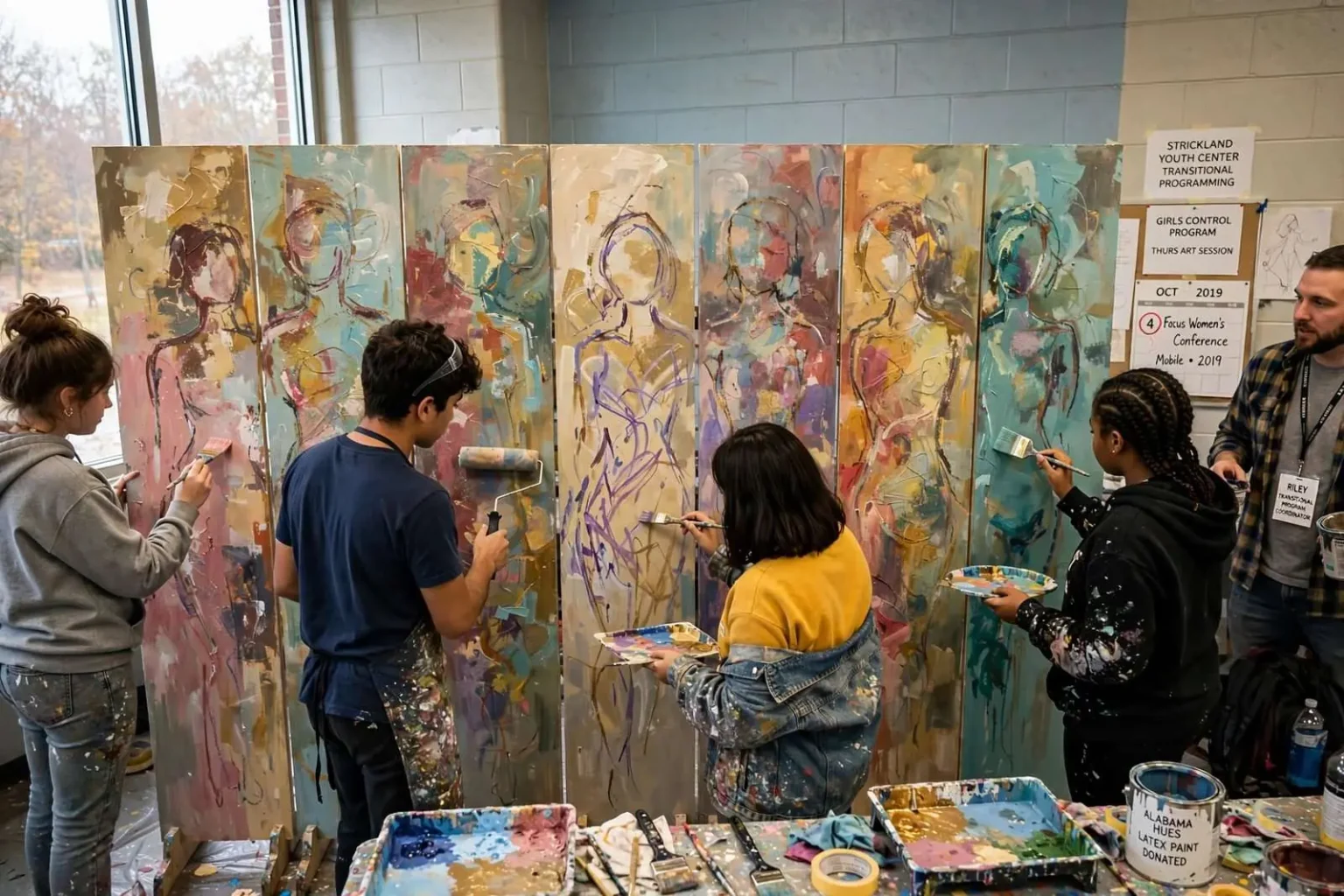
A group of young people at Mobile’s Strickland Youth Center have turned personal survival into public art, creating the painted backdrop that will stand behind abduction survivor Elizabeth Smart when she headlines the 2019 Focus Women’s Conference in Mobile on Oct. 4.
The project began when organizers booked Smart as keynote speaker and Mobile photographer Devin Ford floated an idea toward those who work with local youth in crisis. Riley Brenes, transitional programming coordinator for Strickland Youth Center, saw a connection between Smart’s story and the young people he works with daily.
“We have a lot of kids in the crisis center who may not have the exact story but share similar trauma experiences,” Brenes said. “I wanted to do something to connect them.”
The connection he saw runs deeper than subject matter. Smart, abducted from her Utah home in 2002 at the age of 14 and held for months before her rescue, became one of the most recognizable survivors in America — and built a public life around speaking about what survival requires. The teenagers at Strickland have not lived her story, but many have lived through disruptions of their own that taught them the same hard lesson: that getting through a crisis is itself a skill, and that surviving is not the end of the story but the beginning of rebuilding one.
From paint and boards to a stage backdrop
With paints and eight-foot wooden boards donated by Bill Appling of Alabama Hues, Brenes outlined feminine forms on the panels and put his young artists to work. The result is seven textured, impressionistic images described as expressions of “feminine energy” that will form the stage backdrop for Smart’s address.
The scale of the work is considerable — seven panels, each eight feet tall, together forming a single visual field behind the podium. The impressionistic style leaves interpretation open on purpose. Rather than illustrating any single figure or narrative, the panels work in texture and gesture: layered color, outlined forms, and the accumulated marks of the many hands that moved across them. A backdrop of that kind does its job quietly, giving the stage a human-made presence while letting the speaker hold the room.
For the young painters, the experience of building something at that scale — and of knowing it will stand behind a speaker whose story drew hundreds of conference attendees — carries its own weight. Art projects in institutional settings often end in a hallway display; this one ends on a conference stage, in front of an audience gathered around themes of resilience and recovery that the artists themselves know from the inside.
Who the young artists are
Brenes said the resonance between the keynote speaker and the young painters runs deeper than the artwork itself. Smart famously stayed calm and did what she needed to do to survive her 2002 abduction, and many children at Strickland deal with questions of survival every day, he explained. Through the center’s Crisis Center and Girls Control programs, he noted, most of these young people are not offenders but kids with nowhere else to go who have been caught up in the system.
That distinction matters for how the community understands the facility. Strickland Youth Center serves Mobile County’s juvenile population, and its crisis programs take in young people at moments of emergency — children removed from unsafe situations, teens with no stable place to sleep, girls navigating the aftermath of trauma. The label “juvenile” often leads the public to assume delinquency; Brenes’ description points instead to the population these programs actually hold: children whose circumstances failed them first.
Programs like Girls Control work with that population on the skills a crisis interrupts — schooling, decision-making, relationships, and the slower work of processing what has happened to them. Transitional programming, Brenes’ specialty, covers the bridge between institutional care and independent life, a stretch of road where young people most often fall through the cracks.
Why art belongs in trauma recovery
The backdrop project sits inside a long-recognized truth of trauma work: young people who have lived through crisis often cannot — or will not — narrate their experiences directly, but they can paint them. Art gives a survivor control over the page that conversation rarely allows: what goes on it, how much, and in what form. The painter decides the image; the image keeps the painter’s distance; and the act of making something stand-in for the act of being heard.
Collaborative projects multiply the effect. Painting shared panels requires negotiation, patience, and the experience of watching a collective work grow beyond what any single contributor could make — a quiet rehearsal of trust for young people whose trust has been spent by the adults and institutions around them. When Brenes outlined the feminine forms and turned the boards over to his artists, he structured the project so that every participant contributed to a whole that no one painted alone.
The choice of subject — feminine energy, rendered in impressionistic texture — also ties the work to its destination. The Focus Women’s Conference gathers its audience around women’s stories, and Smart’s keynote is the year’s centerpiece. Putting art made by local young women and girls on that stage folds the city’s own survivors into the event’s subject, visibly and without a word spoken about it.
The keynote speaker and her story
Elizabeth Smart’s place on the program gives the backdrop its audience. Her abduction from her family’s Salt Lake City home in the summer of 2002, at 14, became one of the most closely followed missing-child cases in American history; her rescue nine months later made her a national figure before she finished high school. In the years since, she has built a career as an advocate and speaker, focusing on abduction recovery, exploitation, and the practical question her own survival posed: what does a person draw on to keep going through the worst months of a life?
That question is what Brenes identified as the bridge between the keynote speaker and the painters. Smart has often described the conscious choices survival required of her — staying calm, enduring, protecting herself long enough for rescue. The young people at Strickland have made their own version of those choices, in circumstances Brenes summarized as questions of survival dealt with every day. When Smart speaks on Oct. 4, the seven panels behind her will have been made by an audience-in-spirit that understood her story before she arrived in town.
The collaborators behind the project
The project depended on a chain of local hands. Devin Ford, the Mobile photographer who floated the idea toward those who work with youth in crisis, supplied the initial connection between the conference and the center. Bill Appling of Alabama Hues donated the paints and the eight-foot wooden boards — the physical substrate on which the entire project rested, and no small contribution, since panels at that scale are neither cheap nor easy to source on an institutional budget.
The division of labor that followed was a lesson in itself. Brenes outlined the feminine forms, giving the project its composition and its coherence; the young artists filled the forms with the color and texture that make the finished panels impressionistic rather than clinical. Structured that way, the work required both — a plan and a swarm of individual contributions — which is a fair description of how most recovery happens too.
What the conference audience will see
When the Focus Women’s Conference opens on Oct. 4, the backdrop will do its work from the back of the stage. Attendees who know its origin will read it differently than those who don’t — but the project’s organizers have made no secret of the story, and the panels themselves invite the question of who made them. Seven textured, impressionistic images, built on donated boards by teenagers in a crisis center, standing behind one of the country’s best-known survivors: the composition makes its own argument about who in a community carries resilience, and where it comes from.
For the young artists, the event also offers something rarer than applause: context. A keynote audience gathered around women’s stories of endurance will be looking, in part, at their work — a public affirmation that what they have survived has made them makers rather than cases. That shift in identity, from person helped to person contributing, is the outcome trauma-care practitioners aim for and the reason Brenes wanted to connect the two groups in the first place.
The lasting work
The backdrop will be dismantled when the conference ends, as stage scenery is. Its longer effect is in the painting of it — the weeks in which a group of Strickland teenagers worked with brushes on eight-foot boards toward an event most had never attended, for a speaker whose story they knew, on a subject they understood from the inside.
Projects like this one succeed when they let two parts of a community recognize each other: a national speaker whose survival became a public vocation, and a room of local kids whose survival happens without cameras. The Focus Women’s Conference will spend Oct. 4 listening to Smart. The backdrop behind her will be quietly insisting that Mobile has its own survivors — and that they, too, have something to say, in paint if not yet in words.
The contribution chain that made the panels possible — Ford’s idea, Appling’s materials, Brenes’ plan, and the young painters’ hours — reads as a map of how such projects actually come together: no single organizer, no budget line, just a series of local yeses. The seven images that resulted now belong to both ends of that chain: a conference stage for one afternoon, and a group of young artists in Mobile for considerably longer.