Study ranks Mobile fifth-fattest city in the U.S.
A WalletHub study ranked Mobile the fifth-fattest city in the U.S., comparing 100 metro areas on obesity, health consequences and food and fitness.
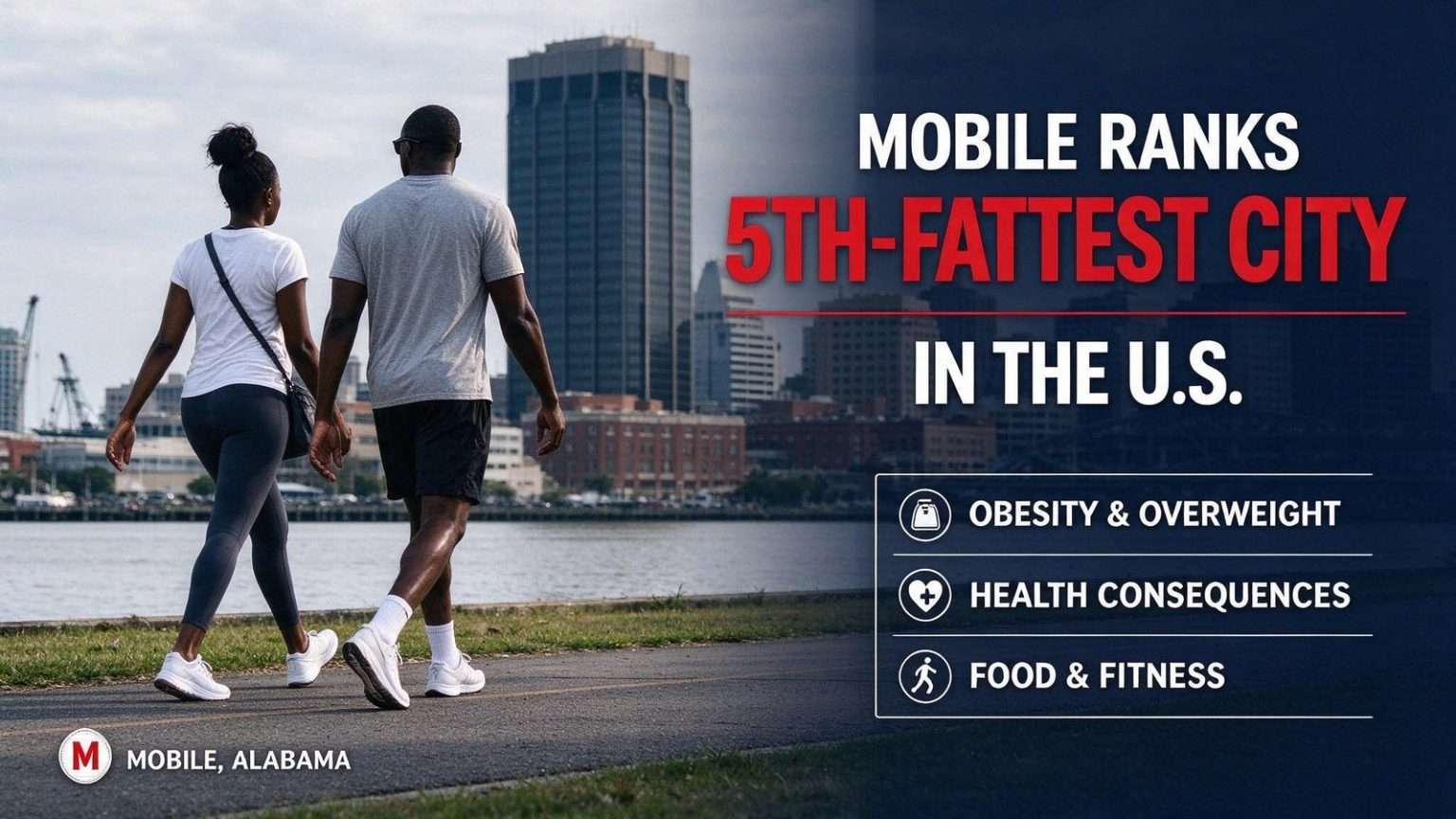
MOBILE, Ala. — Mobile has landed a national distinction nobody in the city will celebrate: WalletHub, the personal-finance website known for its data-driven rankings, has ranked Mobile as the fifth-fattest city in the United States.
To determine the fattest cities in America, WalletHub compared 100 of the most populated U.S. metro areas across three key dimensions: obesity and overweight, health consequences, and food and fitness. Each dimension was evaluated using a set of weighted metrics, and the combined scores produced a national ranking that placed Mobile among the very top of the list.
The ranking puts the Port City in unwelcome company near the top of a list no metro area wants to lead. Being fifth among the hundred largest metro areas in the country means Mobile scored worse on these measures than all but four comparable regions nationwide — a result that reflects patterns in diet, health outcomes, and access to fitness and nutrition resources that extend well beyond any single city’s borders.
For local officials, health care providers, and community organizations, rankings of this kind serve a purpose beyond the headline: they quantify a problem that has been building across the South for decades and give leaders a benchmark against which future progress can be measured.
How WalletHub Built the Ranking
WalletHub’s methodology rests on the three dimensions that produced Mobile’s score. The first, obesity and overweight, measures the share of residents who are classified as obese or overweight, drawing on public health survey data that tracks self-reported height and weight across metropolitan populations. This dimension captures the most direct evidence of the problem: how many people carry enough excess weight to affect their health.
The second dimension, health consequences, looks at what excess weight actually does to a population. Metrics in this category typically include rates of conditions strongly linked to obesity — type 2 diabetes, hypertension, high cholesterol, heart disease — along with related measures such as physical inactivity and premature death rates. A metro area can score poorly here even if its obesity rate is only average, if the health consequences of weight problems are more severe among its residents.
The third dimension, food and fitness, examines the environment in which residents make daily decisions about eating and exercise. It considers factors such as access to healthy food options, the availability and cost of gyms and recreational facilities, consumption of fruits and vegetables, sugary beverage habits, and the share of residents who meet recommended physical activity levels. This dimension is where the underlying infrastructure of a metro area — its grocery stores, parks, sidewalks, and fitness culture — shows up in the numbers.
By combining all three dimensions across a weighted set of metrics, WalletHub produces a single score for each of the 100 largest metro areas. Mobile’s placement at fifth means the city scored poorly across the board — not merely one weak category, but a composite profile in which obesity levels, health outcomes, and food and fitness conditions all worked together to push the metro near the top of the list.
Why the South Consistently Ranks Poorly
Mobile’s position near the top of the ranking fits a regional pattern that national health data has documented for years. States across the Deep South — Alabama, Mississippi, Louisiana, Arkansas, Tennessee, and West Virginia — consistently post the highest adult obesity rates in the country, and their metropolitan areas fill the upper reaches of rankings like WalletHub’s year after year.
Several forces drive the regional pattern. Southern food traditions, while culturally treasured, often center on fried foods, rich gravies, sweet tea, and generous portions. The region’s climate brings long, hot, humid summers that discourage outdoor exercise for much of the year. Rural sprawl and car-dependent development patterns mean fewer residents walk anywhere as a matter of routine. And the economic profile of the region — lower median incomes, higher poverty rates — correlates strongly with obesity, because calorie-dense processed food is often the cheapest option available.
Alabama’s statewide health statistics tell the same story the metro ranking does. The state routinely ranks among the highest in the nation for adult obesity and diabetes prevalence, and physical activity levels fall below national averages. Mobile, as one of the state’s two major metros, reflects conditions that prevail across much of Alabama rather than an anomaly confined to the city.
What the Ranking Means for Mobile
For a metro area of Mobile’s size — spanning Mobile County and reaching into the surrounding region — the fifth-place ranking is a signal about public health that carries real consequences. Obesity is not merely a cosmetic concern; it is a driver of chronic disease that shapes the demand for medical care, the cost of insurance, the productivity of the workforce, and the length and quality of residents’ lives.
The health consequences dimension of WalletHub’s methodology captures this directly. Elevated rates of diabetes and hypertension mean more residents managing lifelong conditions, more medication, more hospitalizations, and more strain on a health care system that serves a metropolitan area with significant pockets of poverty and limited access to preventive care. Mobile’s hospitals and clinics see the downstream effects of these statistics in their patient populations every day.
The economic dimension is equally significant. Employers in the region face the costs of obesity-related absenteeism and reduced productivity. Health care spending attributable to obesity runs into the billions nationally, and the share borne locally grows with every point of excess prevalence. A ranking like this one, unwelcome as it is, puts those costs into a form that civic and business leaders can act upon.
Food Access and the Built Environment
The food and fitness dimension of the ranking deserves particular attention because it measures conditions that local policy can actually influence. Large portions of Mobile, like many Southern metros, contain neighborhoods where full-service grocery stores are scarce and residents rely on convenience stores and fast food for much of their shopping. Public health researchers call these areas food deserts, and their residents face systematic obstacles to eating well even when they want to.
Mobile does have assets to build on. The city’s waterfront, its park system, and the growing network of walking and cycling initiatives give the metro a foundation that some higher-ranked peers lack. Community organizations, churches, and health care institutions across the city already run programs targeting nutrition education, youth fitness, and chronic disease management. The ranking is less a verdict on those efforts than a measure of how far the gap remains.
A Benchmark for Improvement
WalletHub publishes its fattest-cities ranking periodically, which gives Mobile something rare in public health: a recurring, comparable scorecard. If the metro’s obesity rates decline, its diabetes and hypertension numbers improve, or its food and fitness environment changes measurably, the next edition of the ranking will show it. Public health officials often note that rankings of this kind generate attention that raw statistics never do — and attention is the raw material of policy change.
The path from fifth-fattest toward the middle of the pack runs through familiar territory: expanding access to fresh food in underserved neighborhoods, strengthening physical education and youth sports, connecting residents to preventive care that catches diabetes and hypertension early, and building a built environment where walking is safe and exercise is convenient. None of it is quick, and none of it is free, but every piece of it is possible.
Until then, the ranking stands as an uncomfortable but honest snapshot: of the 100 most populated metro areas in the United States, only four scored worse than Mobile across obesity and overweight, health consequences, and food and fitness. The fifth-fattest city in America has work to do, and now it has a clear, public number to measure the work against.
The WalletHub ranking also functions as a mirror held up to the metro’s demographics. Obesity in the United States is not distributed evenly across populations: it correlates with income, education, age, and geography, and the neighborhoods with the highest rates are typically those with the least access to preventive health care. Mobile’s metro includes affluent suburbs along the Eastern Shore and its own growing suburban corridors alongside urban neighborhoods where poverty rates run well above national averages. The composite score reflects all of those realities averaged together.
Health researchers emphasize that metro-level obesity rankings measure conditions, not character. People gain weight in environments engineered around cars, in food markets where processed calories are cheaper than fresh ones, and in communities where safe places to exercise are scarce. Reading the ranking as an indictment of individuals misses the point that the underlying conditions — the ones the food and fitness dimension measures — are the things a community can change.
The Broader Alabama Picture
Placing Mobile’s ranking in statewide context sharpens the picture. Alabama’s adult obesity rate has climbed steadily for decades, moving the state up the national tables until it now sits near the very top among the fifty states. Diabetes prevalence in Alabama similarly runs well above the national rate, as does physical inactivity. These are chronic conditions built over years, and their trajectory suggests that without intervention, future rankings like WalletHub’s will look much like this one.
What Residents Can Take From the Numbers
For individual residents, the most practical reading of the ranking is the one that WalletHub’s three dimensions already suggest: weight outcomes track closely with food choices, activity levels, and access to care. Medical providers across the metro consistently recommend the same basics that the data supports — regular physical activity, even modest; more fruits and vegetables; routine screenings that catch diabetes and hypertension before they become debilitating; and using the preventive services available through community health centers.
The metro’s institutional assets play a role here as well. Mobile’s health care sector, anchored by its hospital systems and a network of clinics, provides screening and management programs for chronic disease. The city’s recreation infrastructure — from its parks to its community centers — offers venues for activity across the metro. Organizations ranging from churches to universities run fitness and nutrition initiatives targeted at the neighborhoods where the need is greatest.
The gap between those resources and the ranking’s fifth-place result is the measure of how much remains undone. Rankings of this kind tend to prompt exactly the civic conversation that follows: what would it take for the next edition to show movement? The honest answer involves sustained investment in the food and fitness environment, better connective tissue between residents and preventive care, and the patience to measure progress over years rather than months.
The National Context
Mobile’s ranking also belongs to a national story. American obesity rates have risen for decades across every state, every age group, and every income level, and the country’s most populated metro areas collectively mirror the problem. WalletHub’s 100-metro comparison sits within a wider body of research — from the Centers for Disease Control and Prevention’s surveillance data to academic studies of food environments — that has documented the obesity epidemic’s growth and its concentration in the South.
Within that national picture, Mobile’s fifth-place finish distinguishes it from the majority of American metros while situating it alongside a familiar cluster of Southern peers. The metros that score best on the same methodology tend to share recognizable traits: higher median incomes, denser urban cores where walking is practical, stronger grocery access, and climates or cultures that support outdoor activity.
None of those traits is beyond Mobile’s reach over time. The metro’s economy is diversifying, its downtown and waterfront have seen sustained reinvestment, and its population growth in outlying suburbs brings with it the recreational infrastructure that newer development tends to include. Whether those trends bend the metro’s health statistics is the question the next rankings will answer.
For now, the data speaks plainly. WalletHub compared 100 of the most populated metro areas in the country across obesity and overweight, health consequences, and food and fitness, and Mobile came out fifth-fattest. The number is unwelcome, but it is also specific, measurable, and public — three qualities that make a difficult problem easier to confront than the vague awareness that preceded it.