The Sun Belt Conference has set a goal of catching Conference USA and the Mountain West Conference as the strongest of the conferences outside the automatic-qualifying group, according to an Associated Press report by college football writer Ralph Russo published this week on Yahoo! Sports.
The league took a step in that direction last season, going 7-6 against its peer conferences, including 5-2 against Conference USA.
Benson Sets the Target
“The goal of the Sun Belt right now is to be the best of the quote, ‘below the line conferences,'” Sun Belt Commissioner Karl Benson said in the report. “There’s going to be five (conferences) above the line and five below the line. The Sun Belt’s goal is going to be to compete with those other conferences.”
Troy University Chancellor Jack Hawkins Jr. addressed the league’s standing in an email to the AP. “In my estimation the competitive position of the Sun Belt exceeds its ‘brand,'” Hawkins said. “This will change very soon. When its brand matches reality, the Sun Belt will equal or exceed several non-AQ (automatic qualifier) conferences it sought to emulate just a few years ago.”
Benson took over as Sun Belt commissioner this year following the retirement of Wright Waters. He previously led the Western Athletic Conference for 17 years, a period of nearly constant membership change. The WAC has announced that this season will be its last as a football conference.
Realignment Reshapes the Region
Conference realignment touched each of the peer leagues during the offseason. The Mountain West rebuilt with schools from the WAC after losing members, and Conference USA, which competes with the Sun Belt in the region for players, attention and member schools, filled openings by adding Florida International and North Texas from the Sun Belt. Both will leave for Conference USA next season. Conference USA is also adding Texas-San Antonio.
The Sun Belt responded by adding two football programs from lower divisions: Georgia State, which began playing football in 2010, and Texas State, which is competing in the WAC as a transitional member in 2012. Benson also added Texas-Arlington as a second member that does not sponsor football, replacing Denver and joining Arkansas-Little Rock.
“What my goal would be is for the Sun Belt to enhance our assets, our characteristics, so if and when the time comes that Conference USA comes looking to the Sun Belt for a replacement team because Conference USA lost school A, B or C, that the Sun Belt member will look at what the Sun Belt provides and come to the conclusion that there’s no reason for us to leave the Sun Belt,” Benson told the AP.
Limiting Guarantee Games
Like its peer conferences, the Sun Belt’s members typically schedule one-time “guarantee” games against major-conference opponents with no return trip, games that can pay upward of $1 million.
“We’ve talked about scheduling philosophy, scheduling strategy. Ideally we’d like to establish across the board some scheduling parameters that would limit those guarantee games to one a year,” Benson said.
Western Kentucky is already following that approach. According to the school’s president, the Hilltoppers will limit themselves to one single-game contract per year. This season, Western Kentucky has a single-game contract with Alabama, plays Football Championship Subdivision opponent Austin Peay, faces Kentucky and hosts Southern Miss.
South Alabama’s Scheduling Approach
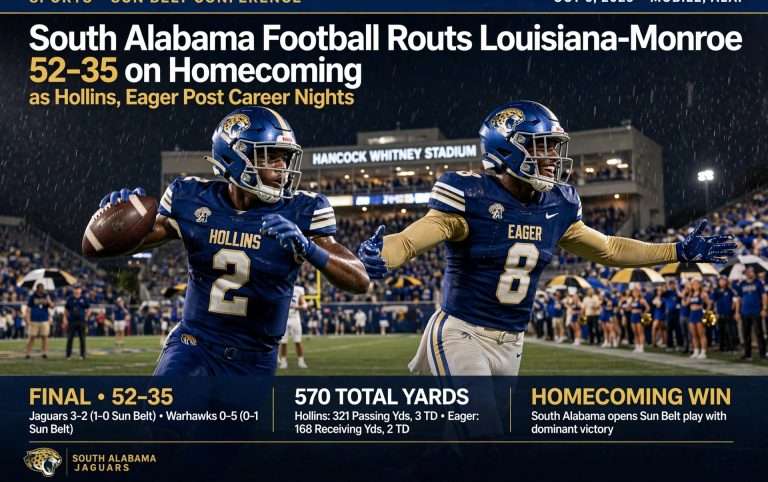
South Alabama, entering its first season of Sun Belt Conference football under head coach Joey Jones, has combined both kinds of games in its future schedules.
The Jaguars have scheduled two-for-one series with several programs from larger conferences. South Alabama visited N.C. State in Raleigh in 2011 and returns there in 2012, with the Wolfpack scheduled to play in Mobile in 2015. The Jaguars’ series with Kent State includes games in 2011 and 2012 and a 2013 meeting in Mobile. South Alabama has similar agreements with Tulane, Oklahoma State and Mississippi State for future seasons.
South Alabama also has single-game contracts with Tennessee, Georgia, Nebraska (two games), LSU and Ole Miss, with no more than one such game scheduled per season.