Sunday Socials at the Frog Pond on Blue Moon Farm Draw Baldwin County Music Lovers
Tucked into the woods of Silverhill between highways 59 and 98, Blue Moon Farm has become a quiet haven for Baldwin County music lovers.
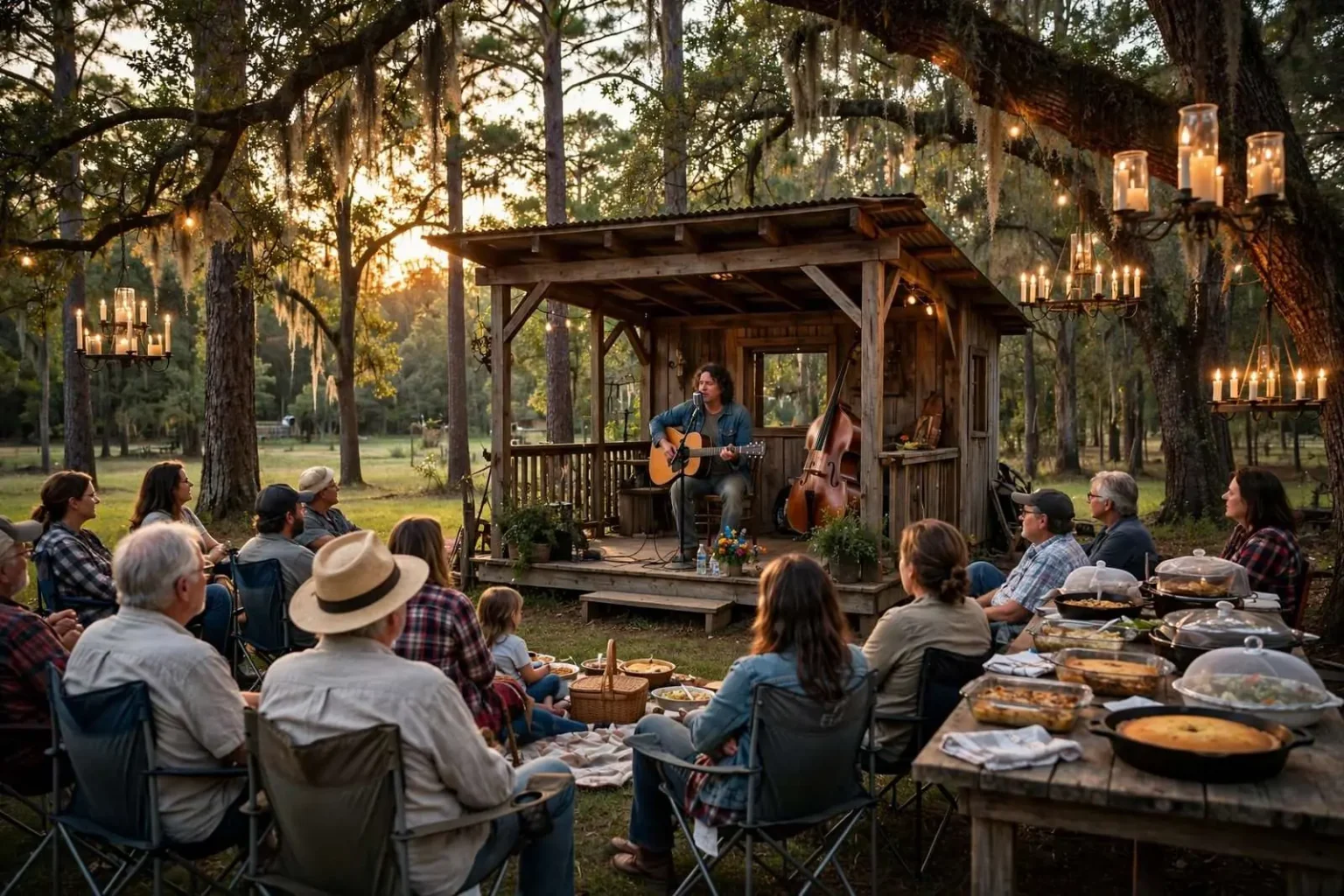
Tucked into the woods of Silverhill between highways 59 and 98, Blue Moon Farm has become a quiet haven for Baldwin County music lovers. Its centerpiece is the Frog Pond, a stage built to feel like a welcoming country veranda, where owner Cathe Steele hosts Sunday afternoon concerts that have grown into one of the Eastern Shore’s most distinctive musical traditions. Far from the noise of the beach corridor, the farm offers something increasingly rare on the Gulf Coast: an afternoon of live music measured in unhurried hours rather than ticketed slots.
The setting does much of the work. Visitors wind down a wooded drive onto the farm’s grounds, where the stage sits among mature trees and simple wooden details that make the space feel like a friend’s back porch scaled up just enough to hold a crowd. There are no big lit signs, no beer gardens, no merch tables pushing for attention — just a stage, the trees, and the low hum of neighbors catching up before the first set begins.
An intimate, phone-free concert tradition
For a $10 to $20 door charge, guests pull up lawn chairs and settle in for an afternoon where silence during the sets is expected and talking is gently redirected off to the side. The house etiquette is the heart of the Frog Pond experience: audiences are asked to give the performers the same attentive listening they would want in their own living rooms. Conversations are not banned so much as relocated, with Steele and regulars nudging chatty groups toward the edges of the grounds so the music carries clean across the yard.
Attendees bring dishes to a communal kitchen, and the mood is one of family fellowship and restrained enthusiasm. Potluck contributions pile up on the counter as guests arrive, and the shared meal has become as much a part of the tradition as the music itself. Newcomers are folded in quickly — someone hands them a plate, points them to a spot on the grass, and by the second set they are regulars.
The phone-free, listen-first atmosphere has proven to be the venue’s signature. In an era when most concerts compete with glowing screens, the Frog Pond asks for something old-fashioned, and the artists who play there consistently respond to it. Without cameras raised and side conversations running, the room — even outdoors — goes quiet in the way that tells a performer the audience is actually with them. Musicians who have played listening rooms across the country often describe the pond as one of the best rooms on their circuit precisely because of that discipline.
A season of songwriters and road veterans
The first two Sundays of the season featured Grayson Capps, Corky Hughes, Jon Cook and the Moonshine Babies, giving opening weekends a distinctly local-Songwriter flavor. The pairing of Capps and Hughes is a long-running collaboration, and the Moonshine Babies bring a rootsy harmony-rich sound that fits the farm’s unhurried character. Opening days at the pond tend to draw the faithful — season regulars who know to arrive early with a chair and a covered dish — and the early-season lineup rewarded them.
The following Sunday brought acclaimed bluesman Alvin Youngblood Hart and Brian Stoltz of the Funky Meters, a booking that shows the range the venue can pull. Hart, a Grammy-nominated roots and blues artist with a national reputation, and Stoltz, a New Orleans funk veteran, represent the caliber of player the pond’s reputation attracts despite its modest door charge. For Baldwin County audiences, hearing players of that stature from a lawn chair twenty feet from the stage is exactly the point of the place.
Capps, a Baldwin County resident and modern torchbearer for the Gothic South, is a fixture at the farm. His songs — steeped in Southern imagery, dark humor and acoustic grit — have made him a cornerstone of the lower Alabama music scene, and his willingness to keep returning to the small stage underscores the mutual loyalty between the venue and the artists who love playing it.
Golden-hour magic
The sound on the Frog Pond stage draws consistent praise. The venue was designed with acoustics in mind, and the wooded bowl around the stage keeps the music warm and present without amplification pushed to painful levels. Engineers and players alike credit the setting: soft ground, tree canopy and a close, respectful crowd combine to produce a natural mix that bigger venues spend fortunes trying to approximate.
As afternoon fades around six, Steele lights candle chandeliers hung from the trees, and the farm shifts from concert to something closer to ceremony. The glow is the moment regulars wait for — the transition that marks the last stretch of the afternoon, when the light drops, the candles take over and the final set plays out under a canopy of small flames. Some guests dance; most simply sit and bask in the glow.
That ritual has become part of the pond’s mythology among Gulf Coast music fans. Photos rarely do it justice, partly because phones stay away, and that may be the point: the candle-lighting hour is the reward for an audience that agrees to be fully present. Word of mouth about those Sunday evenings has spread far beyond Silverhill, pulling visitors from Mobile, Pensacola and beyond into the woods of south Baldwin County.
What the door charge buys
“The money goes directly to the artists on stage,” one visitor noted, and the model is as simple as it sounds. The modest door charge is not funding overhead, promotion or a corporate owner — it is handed to the performers, which is why national-tier roots musicians are willing to detour to a farm stage between highways 59 and 98. In an industry where streaming has hollowed out recorded income, rooms that guarantee the gate goes to the player have become lifelines for working songwriters.
The communal kitchen reinforces the same ethic. With guests supplying the food, the venue’s costs stay minimal, and the event retains the feel of a family gathering rather than a commercial production. Nobody is upsold; the extravagance of the afternoon is time — three or four hours of music experienced without a schedule pressing in.
The experience offers an unhurried alternative to noisier venues, and that contrast has defined the Frog Pond’s niche in a county better known for beaches and outlets. Baldwin County’s rapid growth has brought larger concert halls, brewery stages and festival grounds, but the pond occupies the opposite end of the spectrum: no crowds pressing toward a barrier, no opening act running long, no race to the parking lot. The afternoon ends when it ends.
A Baldwin County institution in the woods
Places like Blue Moon Farm do not happen by accident, and they do not last by luck. They survive because an owner — in this case Steele — treats the room as a trust: protect the listening, pay the artists, keep the door low, and let the community carry the rest. The Sunday Socials have quietly become part of the cultural map of south Alabama, the kind of venue traveling musicians trade tips about and locals hesitate to advertise too loudly, wary of loving it to death.
For residents of Baldwin and Mobile counties, the farm is a reminder that some of the region’s best cultural experiences are found a few miles off the highway, down a wooded drive, behind a $10 door. The combination of golden-hour light, candlelit oaks, potluck supper and world-class roots music has few equals on the Gulf Coast, and as long as the silence holds during the sets, the money keeps flowing where it belongs — to the artists on stage.
Why listening rooms matter
The Frog Pond belongs to a small national family of purpose-built listening rooms — venues where the unwritten contract puts the song first. Such rooms have proliferated in response to a decades-long slide in how musicians are paid: as recording revenue collapsed and touring economics tightened, the places that actually compensate performers became essential infrastructure for the craft. Singer-songwriters route their tours around them, and fans follow, because the difference between hearing a song in a bar and hearing it in a listening room is the difference between background and experience.
Baldwin County’s growth makes that infrastructure more valuable, not less. The county has been among the fastest-growing in Alabama for years, adding rooftops along the Highway 181 and Highway 104 corridors and reshaping communities like Silverhill, Foley and Fairhaven-adjacent neighborhoods. Growth brings good things — restaurants, venues, tax base — but it also pressures the quiet, low-cost traditions that made the area distinctive. A phone-free Sunday afternoon in the woods is precisely the kind of experience that cannot be rebuilt once lost, which is why its regulars guard the etiquette so carefully.
The farm’s location between highways 59 and 98 places it within easy reach of both the beach communities and the bay, a geographic sweet spot that lets a Sunday crowd mix tourists, transplants and lifelong county residents. That blend is visible in the potluck line: retired couples beside young families beside road-tripping music fans who planned a Gulf Coast stop around a single afternoon of music.
Carrying a Southern songbook forward
The bookings themselves tell a story about the Gulf Coast’s musical lineage. Grayson Capps’ Gothic South songwriting descends from the same literary-musical tradition that runs through Flannery O’Connor by way of Townes Van Zandt — narrative songs steeped in place, sin and redemption. Alvin Youngblood Hart carries the country blues tradition that took root across the South, while Brian Stoltz’s Funky Meters credentials tie the pond to New Orleans’ unbroken funk lineage just two hours west. On a given Sunday, the stage can connect Baldwin County to nearly every major current of American roots music.
For local players, sharing a bill — or simply a crowd — with artists of that standing is its own apprenticeship. The Mobile and Baldwin County scenes have long punched above their weight in songwriters, and venues like the pond are where the next generation hears how it is done from twenty feet away. The door money that goes straight to the artists also makes the pond a practical stop on regional tours, threading south Alabama into the circuit of listening rooms that stretches from New Orleans across the Gulf Coast to Florida.
As the season continues, the formula remains unchanged: arrive with a chair and a dish, find a spot in the shade, listen hard during the sets, and stay until the candles burn low. It is a modest prescription, and it has produced one of the most beloved music venues on the Gulf Coast — proof that the future of live music may depend less on bigger stages than on better listeners.