Swimmer found safe on Escambia County beach after five hours in the water
A swimmer was recovered on an Escambia County beach after roughly five hours in rough Gulf of Mexico surf, with help from the Coast Guard and local rescue.
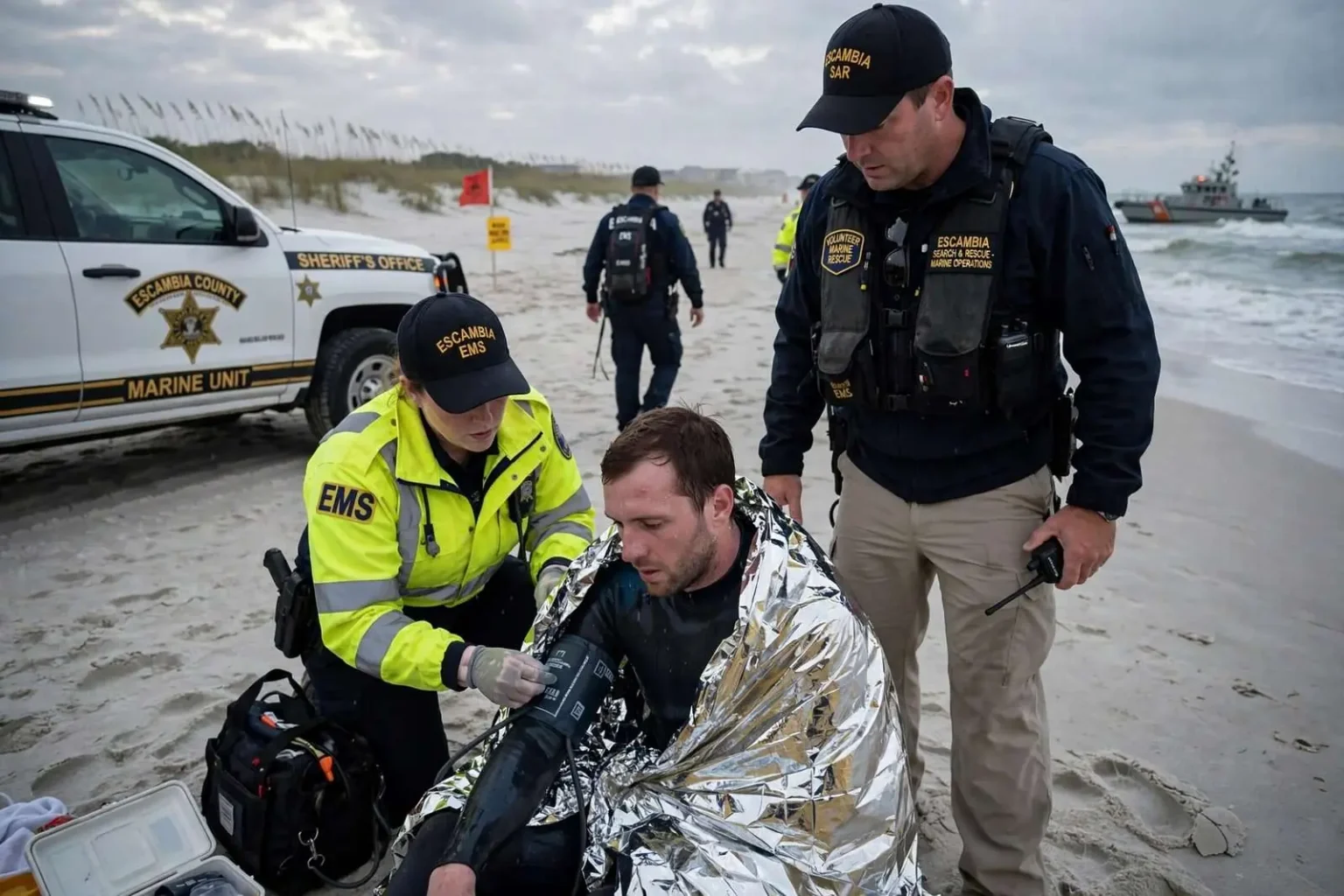
ESCAMBIA COUNTY, Fla. — A swimmer was found washed up on the beach after Escambia Search and Rescue Marine Operations responded to a call at 5 a.m. from the U.S. Coast Guard. The swimmer had gone missing after entering the water in rough surf in the Gulf of Mexico. After 10 a.m., the swimmer was found on the beach, disoriented, following a search that lasted about five hours.
The five-hour search ended in relief for everyone involved, but it also underscored how quickly a routine dip in the Gulf can become a life-threatening emergency. Escambia County’s barrier beaches, including Pensacola Beach and Perdido Key, draw hundreds of thousands of swimmers each year, and the same waters that look calm from the sand can hide strong longshore currents and rip currents that carry swimmers far from where they entered the water. In rough surf conditions, even strong swimmers can be overwhelmed in a matter of minutes.
Escambia Search and Rescue Marine Operations is the county’s volunteer-supported marine rescue organization, working alongside the Escambia County Sheriff’s Office, county lifeguards, and federal partners to answer distress calls along the Gulf Coast and the waters of Pensacola Bay and Santa Rosa Sound. A callout in the pre-dawn hours, as happened here, sets in motion a coordinated effort involving boats, four-wheel-drive vehicles on the beach, and coordination with Coast Guard aircraft and cutters that can sweep a much wider search area than any surface craft.
How a coastal search and rescue operation unfolds
When the U.S. Coast Guard receives a report of a missing swimmer, it typically assigns search-and-rescue mission coordinator duties and notifies local agencies that know the beach and its hazards best. In Escambia County, that means Escambia Search and Rescue Marine Operations and sheriff’s marine units get underway quickly, while the Coast Guard launches crews from its local stations to search offshore. The search area is calculated from where the person was last seen, adjusted for wind and current, and expanded as hours pass without contact.
Searching at night and in the early morning adds difficulty on top of darkness. Rough surf limits how close boats can safely operate to shore, and breaking waves can hide a person in the water from even a few yards away. That is why beach searches are as important as water searches: people carried out by currents are frequently pushed back to shore miles from their entry point, exhausted, injured, or unable to call for help. In this case, that dynamic is likely what brought the swimmer to the beach before rescuers could make contact in the water.
Finding the swimmer alive on the sand after roughly five hours was a best-case outcome that rescuers know is far from guaranteed. Survivors of long ordeals in Gulf waters frequently arrive on shore disoriented, dehydrated, and suffering from exhaustion or mild hypothermia, even in warm months. Immediate medical evaluation is standard, and first responders treat every recovered swimmer as a patient in potential distress rather than simply a person who can walk away.
Rough surf and the dangers swimmers underestimate
The Gulf of Mexico along the Florida Panhandle is famous for its gentle appearance, but local safety officials spend much of every year warning visitors about its less visible hazards. Rip currents, narrow channels of fast-moving water that pull away from the beach, can move faster than an Olympic swimmer can swim and are the leading weather-related killer at northern Gulf beaches. Longshore currents push swimmers steadily down the beach, and in rough seas, waves breaking in chest-deep water can hold even experienced swimmers under.
Escambia County uses a colored beach warning flag system, posted at public access points, to communicate daily conditions. A green flag means calmer conditions, yellow signals moderate surf or currents, red indicates high hazard with strong surf or currents, and a double red flag means the water is closed to the public. Purple flags warn of dangerous marine life. Rough surf days, like the one described in this incident, are exactly the conditions the system is designed to flag for beachgoers before they ever step into the water.
The role of the U.S. Coast Guard on the Panhandle coast
The Coast Guard’s presence along the Emerald Coast is a critical layer of the region’s safety net. Coast Guard stations in the Panhandle respond to hundreds of search-and-rescue cases each year, ranging from disabled vessels to swimmers swept off sandbars, and the service coordinates closely with county and municipal agencies. Because the Gulf is a vast search environment, the Coast Guard can bring resources local agencies cannot, including helicopters with search radar and night-vision capability, fixed-wing aircraft, and cutters capable of searching far offshore in poor weather.
That partnership matters most in cases like this one, where every hour in the water reduces the odds of survival. Water temperature, exhaustion, and injury all work against a swimmer over time, and search planners weigh those factors when deciding how long and how wide to search. A positive outcome after five hours is a testament to the persistence of the crews involved and, often, to the durability of the human body when it can stay at the surface and eventually reach land.
What beachgoers should know before entering the Gulf
Lifeguards and rescue organizations along the Gulf Coast repeat a short list of advice every season, and the details are worth remembering. Swim near a lifeguard whenever one is on duty, and check the posted beach flags before entering the water. Never swim alone, and keep children within arm’s reach. If caught in a rip current, do not fight it by swimming straight back to shore; swim parallel to the beach until free of the current, then angle back in. If a swimmer goes missing, call 911 immediately rather than spending critical minutes searching personally.
Alcohol, exhaustion, and overconfidence are recurring factors in Gulf drownings, and tourists unfamiliar with surf conditions are overrepresented in the statistics. Locals know that the sea state can change dramatically within hours as wind and tide shift, so a beach that was calm at midday can be hazardous by evening. Checking conditions more than once during a long beach day is a habit worth adopting.
After the rescue: recovery and accountability
Once a swimmer is recovered alive, the work is not finished. The person receives medical attention, and authorities typically attempt to identify companions or witnesses who can explain what happened. If the swimmer entered the water despite posted warnings, or if the incident involves a minor, agencies may review whether any rules were violated. Most often, though, the conclusion is simply that the Gulf’s conditions overpowered someone who misjudged them, a scenario that plays out along the northern Gulf coast dozens of times every year.
For the volunteer and professional rescuers involved, a successful outcome after a five-hour search is the kind of result they train for but cannot count on. Marine rescue work demands readiness at all hours, comfort operating in heavy seas, and the stamina to keep searching long after hope would seem reasonable to abandon. The pre-dawn call that started this case, and the disoriented swimmer found on the sand after 10 a.m., illustrate both the risk that comes with rough surf in the Gulf of Mexico and the value of the rescue network that stands ready along Florida’s Escambia County beaches.
Local officials regularly remind residents and visitors that the best rescue is the one that never has to happen. Reading the flags, swimming near others, and respecting rough surf are simple habits, but they are the difference between a day at the beach and a call at 5 a.m. that sends boats, aircraft, and volunteers into the dark to look for one person in a very large sea.
A network built by volunteers and neighbors
Organizations like Escambia Search and Rescue Marine Operations depend heavily on community support to keep boats fueled, equipment maintained, and crews trained. Marine rescue is an expensive undertaking, and along the Gulf Coast much of the burden of responding to swimmers, kayakers, and boaters in trouble falls to agencies that operate with limited budgets and, in many cases, volunteer manpower. Residents who use the beaches and bays of Escambia County are, in a very real sense, the beneficiaries of neighbors who are willing to leave their beds at 5 a.m. when the call comes in.
The same is true of the Coast Guard’s local stations, where active-duty crews stand around-the-clock watches precisely so that a distress call at any hour produces a response rather than a voicemail. For families who vacation on Pensacola Beach or Perdido Key, that readiness is easy to take for granted until the day it is needed. Stories like this one, which ended with a swimmer found alive and disoriented on the sand after five hours in the water, are a useful reminder of what stands behind a 911 call made from the beach.
Conditions along the northern Gulf will grow rough again as storms pass and wind patterns shift, and rescue crews will be called out again, day or night. The swimmer in this case survived an ordeal that many do not, and the lesson for everyone else who visits Escambia County’s beaches is straightforward: watch the flags, respect the surf, and never assume that calm-looking water will stay that way.