
Tacky Jacks Wine Tastings Return Sept. 22 With a Seven-Month Run of Regional Pairings
Wine tastings led by Winston McQuitery return to Tacky Jacks in Orange Beach on Sept. 22 and Gulf Shores on Sept. 24, opening a seven-month series with four South of France wines and four small plates.
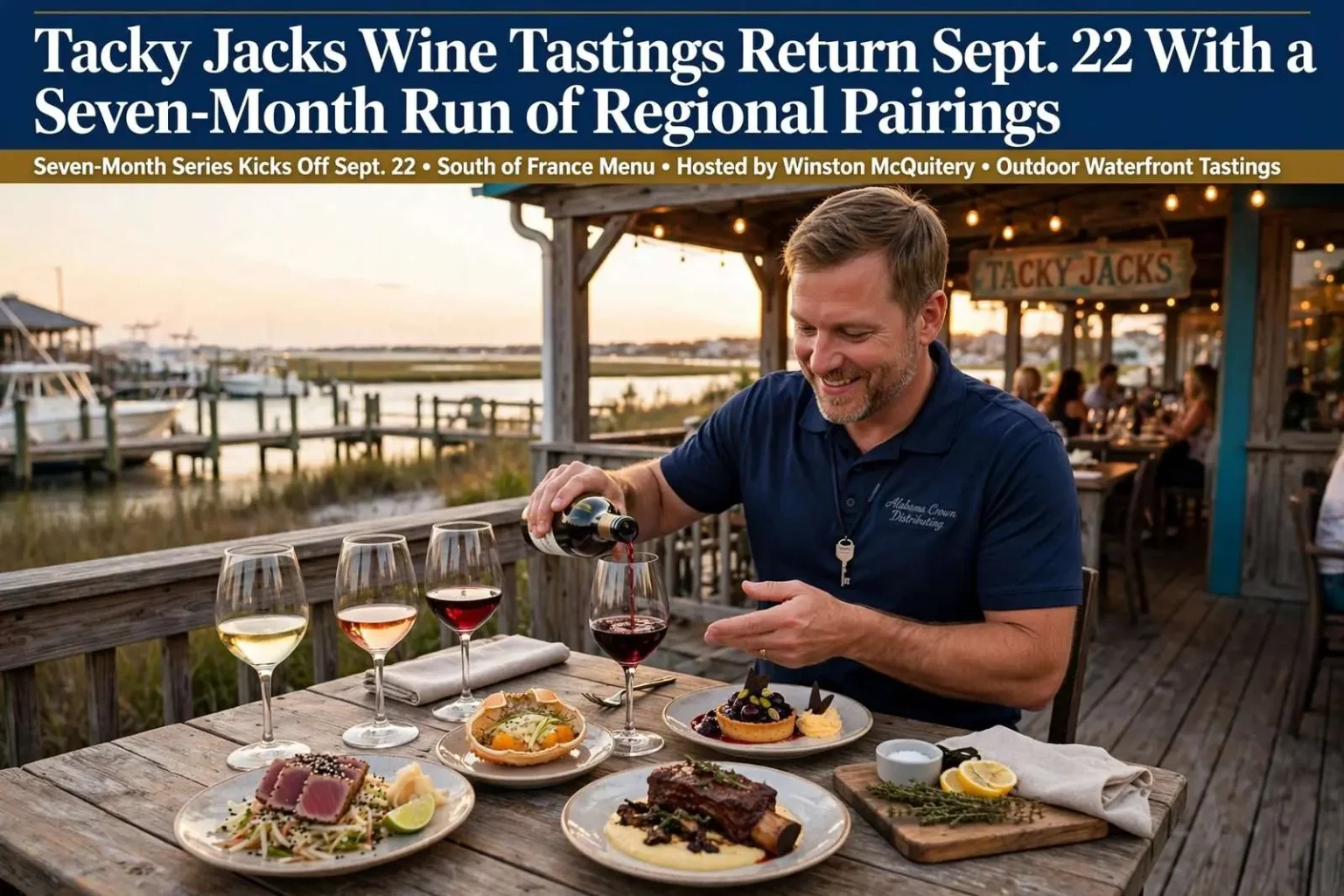
The Tacky Jacks wine tastings led by Winston McQuitery are back for a seven-month run along the Baldwin County coast, opening later this month with a four-course menu built entirely around the South of France.
The series begins Tuesday, Sept. 22, at Tacky Jacks in Orange Beach and repeats Thursday, Sept. 24, at Tacky Jacks in Gulf Shores. Both tastings run from 6 to 8 p.m. in outdoor waterfront seating areas. Each event pairs four wines with four small plates, with McQuitery walking guests through the flavor profiles, origins and stories behind every selection.
Tastings cost $45 per person. A $5 reservation fee holds a seat and is applied toward the $45 cost. Seating is limited and RSVPs are required. The events are for guests 21 and older.
Who Is Pouring
Winston McQuitery of Alabama Crown Distributing leads the tastings, which are hosted by Alabama Crown. The premise of the series is educational as much as social: rather than simply serving four glasses, each evening introduces guests to where the wines come from, how they are built and why each one has been matched to the plate in front of it.
That a distributor representative is running the event is worth a word of explanation, because it is common in the restaurant world and unfamiliar outside it. Wine in the United States generally moves through a three-tier system — producer to wholesaler to retailer or restaurant — and the wholesalers who sit in the middle employ specialists who know their portfolios in considerable depth. When a restaurant hosts a guided tasting, it is frequently a distributor’s wine expert doing the guiding, because that is the person who has tasted through the book, knows the producers and can explain how a given bottle got to be the way it is.
September: A Four-Course Menu From the South of France
The opening month draws on three of southern France’s most recognizable wine areas — Languedoc, Provence and the Rhône Valley — and pairs them with a menu that moves from seafood through beef to dessert.
First course: sesame-seared Ahi tuna. Thin slices of tuna are served over a crisp Asian slaw with a soy-lime glaze, pickled ginger and black sesame seeds. The pour is Le Jade Picpoul de Pinet from Languedoc, a wine described as showing citrus blossom, lemon zest and green apple, with crisp acidity and Mediterranean minerality.
Second course: a mini stuffed crab shell. The crab stuffing is baked until golden and served with lemon-herb beurre blanc and a shaved fennel-and-orange salad. It is paired with Domaine de la Sanglière “Juliette” Rosé from Provence, a dry rosé showing wild strawberry, white peach, citrus and Provençal herbs, chosen to complement the sweetness of Gulf crab.
Third course: red-wine-braised short rib. The slow-braised beef arrives over creamy Parmesan polenta with sautéed wild mushrooms and a thyme demi-glace. The wine is C’est La Vie! Pinot Noir-Syrah from Vin de Pays d’Oc, with bright cherry and raspberry fruit layered over subtle pepper, herbs and silky tannins.
Fourth course: dark-chocolate cherry tart. Bittersweet chocolate ganache in a crisp pastry shell, served with cherry compote, orange mascarpone and candied pistachios. Dessert is poured with Domaine La Terre de Lune Côtes du Rhône from the Rhône Valley, showing blackberry, plum, black pepper and warm spice, with a velvety finish set against the dark chocolate and cherries.
Why These Three Regions
The South of France is a sensible place to start a coastal wine series, and not only because the Mediterranean and the Gulf share a certain affinity for seafood, olive oil and long dinners outdoors.
Languedoc stretches along France’s Mediterranean coast and is one of the largest wine-producing areas in the world by volume. For much of the 20th century it was known chiefly for enormous quantities of everyday wine, but the last several decades have transformed its reputation, with a patchwork of appellations now producing distinctive wines at prices that remain notably reasonable.
Picpoul de Pinet is one of the region’s most recognizable white appellations. It is made from the Piquepoul Blanc grape grown near the coastal lagoons, and it has a long-standing local partnership with shellfish — the wine and the oyster beds are essentially neighbors. Its defining characteristic is acidity. The name itself is often translated as something close to “lip stinger,” which tells you most of what you need to know about the style.
Provence, farther east along the same coast, is the world’s reference point for dry rosé. Rosé is made there not as an afterthought or a byproduct but as the primary business of the region, and the house style is pale, dry and built around freshness rather than sweetness. Grenache, Cinsault, Syrah and Mourvèdre are the common grapes. The region’s aromatic signature — the herbal note the source describes as Provençal herbs — reflects a landscape of wild rosemary, thyme and lavender growing in and around the vineyards.
The Rhône Valley runs south from Lyon toward the Mediterranean and is effectively two regions. The steep northern stretch is Syrah country, producing structured, peppery reds. The broader south is dominated by Grenache-led blends grown on warm, stony ground, and Côtes du Rhône is the wide regional appellation that covers most of it. Southern Rhône reds tend toward ripe dark fruit, garrigue herbs and black pepper spice — precisely the profile described in the dessert pairing.
The short rib pairing comes from a fourth designation worth knowing about. Vin de Pays d’Oc, now more formally known as IGP Pays d’Oc, is a broad country-wine category covering the Languedoc area. Its practical advantage is flexibility: unlike the stricter appellations, it permits producers to plant and label international varieties, which is why a Pinot Noir-Syrah blend from southern France is possible at all. That combination — the bright red fruit of Pinot Noir with the pepper and structure of Syrah — is not a blend the classic appellation rules would allow.
How the Pairings Are Built
Guests who want to follow the logic of the evening rather than simply enjoy it will find the September menu is a fairly clear demonstration of standard pairing principles.
- Acidity cuts richness and resets the palate. A high-acid white against seared tuna with a soy-lime glaze does the same job a squeeze of lemon does — it lifts the dish and keeps the fat and salt from accumulating.
- Match weight to weight. A delicate first course wants a light wine; a slow-braised short rib over polenta wants something with more substance. Overwhelming a dish with the wine, or the reverse, is the most common pairing failure.
- Follow the sauce, not just the protein. Crab with beurre blanc and a fennel-orange salad is a different pairing problem than crab on its own, and a dry rosé with citrus and herbal notes speaks to the whole plate.
- Sweetness in the dish reads as bitterness in the wine. This is why dessert pairings are difficult. A dark-chocolate tart with cherry compote is bittersweet rather than sugary, which gives a dry red with ripe dark fruit and spice room to work alongside it.
- Regional logic usually holds. Wines and foods that grew up in the same place tend to get along, which is the organizing idea behind a menu built region by region.
Seven Months, Seven Regions
September’s South of France theme is the first stop in a rotation that runs through March, with a different wine region featured each month at both the Orange Beach and Gulf Shores locations.
After the South of France, the series moves to the Pacific Northwest, then Tuscany, South Africa, Coastal California and the Iberian Coast, finishing in Northern Italy in March.
Taken together, that lineup covers a wide spread of styles and a fair amount of ground. It runs from cool-climate Pacific Northwest wines to the Sangiovese-based reds of Tuscany, from South Africa’s distinctive Cape wines to California’s coastal appellations, through the wines of the Spanish and Portuguese Atlantic and Mediterranean coasts, and finally to the northern Italian regions at the foot of the Alps. Menus for those months have not been released.
Practical Details
The particulars are straightforward, but a few of them matter for planning.
- Cost: $45 per person.
- Reservations: A $5 reservation fee is required to hold a seat and is applied to the $45 tasting cost. Seating is limited and RSVPs are required.
- Refunds: Reservation refunds are available with at least 24 hours’ notice.
- Age: The tastings are for guests 21 and older.
- Setting: Both events are scheduled for outdoor waterfront seating areas. Guests attending in Gulf Shores are advised to prepare for outdoor weather and dress appropriately.
The outdoor-seating note deserves emphasis for a late-September evening on the Alabama coast. A 6 p.m. start in the third week of September can begin warm and humid and finish considerably cooler after sunset, and a waterfront table catches whatever breeze is moving. A light layer is rarely a mistake.
Where to Go
Tacky Jacks Orange Beach is at 27206 Safe Harbor Drive. The Orange Beach tasting is set for Tuesday, Sept. 22, from 6 to 8 p.m.
Tacky Jacks Gulf Shores is at 240 E. 24th Ave. The Gulf Shores tasting is set for Thursday, Sept. 24, from 6 to 8 p.m.
Because both locations run the same menu two days apart, guests who cannot make one date can generally catch the other. With seating limited and a reservation required at both, however, the practical advice is the same either way: reserve early rather than planning to walk up.
A Note on the Format
Guided tastings of this kind occupy a useful middle ground between a wine dinner and a class. Four two-ounce pours across two hours, spread over four courses, is a moderate amount of wine by design — enough to compare and contrast, not so much that the comparison stops being possible. The small-plate format keeps the focus on how each wine changes when it meets food, which is the entire point and is something no amount of tasting wine on its own will teach.
For coastal residents and visitors, it is also a fairly economical way to try wines that would otherwise require buying four bottles to sample. Whether guests come for the education or simply for two hours on the water with good food, the series runs monthly from now through March.