
Teen Arrested After Social Media Threat Against Theodore High School
A teenager who is not a Theodore High student was charged with making a terrorist threat after a threatening social media post targeted the school.
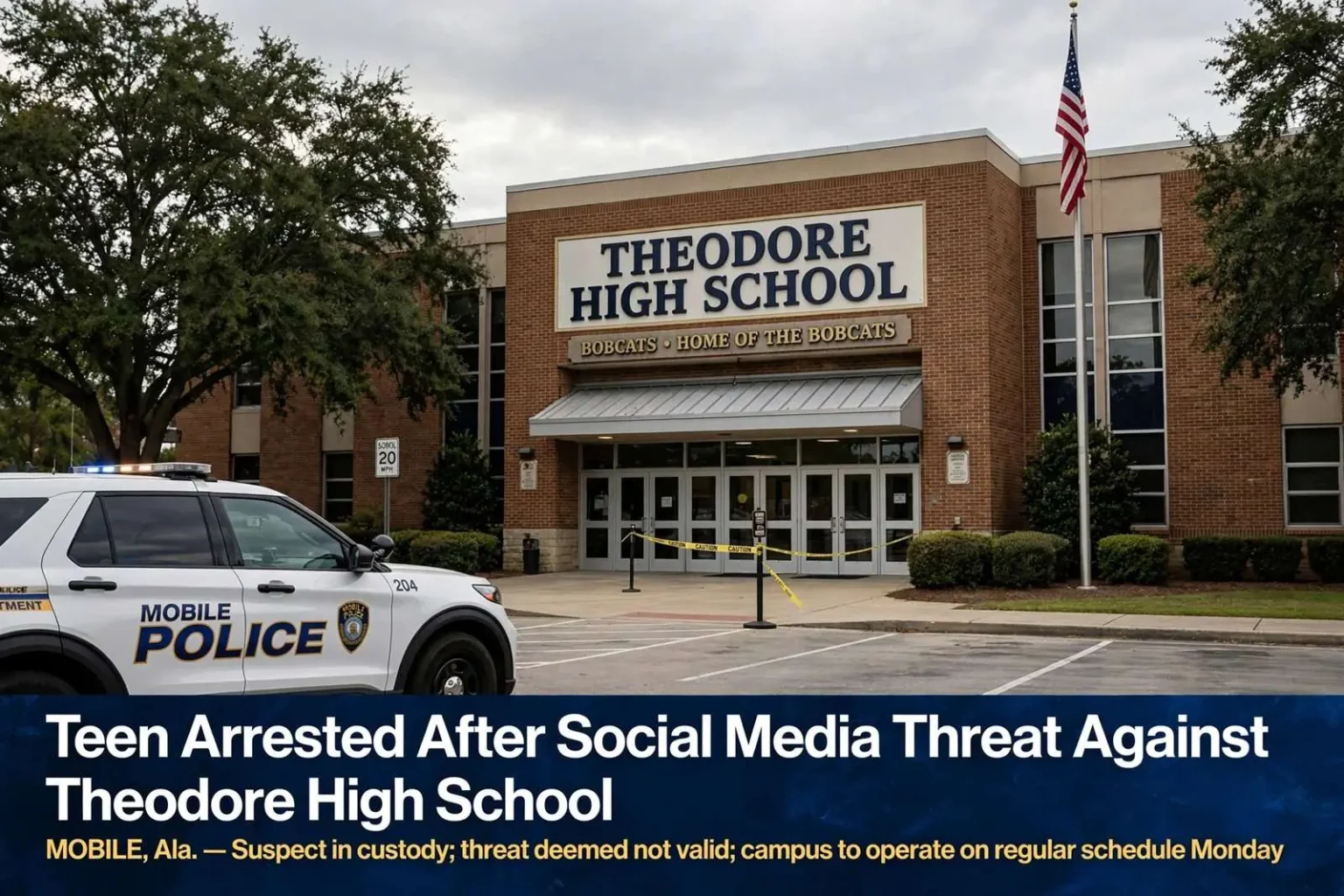
MOBILE, Ala. — Mobile County school officials said a suspect has been arrested in connection with a threatening social media post aimed at Theodore High School, though they confirmed the threat did not appear to be valid. The arrest closes the most urgent phase of a weekend scare that put students, parents, and staff on alert and brought police and school administrators into a rapid, coordinated response.
According to Rena Philips with the Mobile County Public School System, the suspect is a teenager but is not a student at Theodore High. The identity was not released, and the suspect was charged with making a terrorist threat, authorities said. The charge reflects the seriousness with which Alabama law treats threats against schools, whatever the intent behind them, and it sends a signal that posts made from outside a school community carry consequences just as surely as those made inside it.
How the Weekend Unfolded
The investigation began after a threatening post circulated Saturday, warning of a weapon on campus Monday. The timing maximized the disruption: a Saturday post lands when schools are closed, administrators are off campus, and families are following social media rather than official channels, which allows anxiety to build for a full day before any authoritative response appears.
School officials and police moved on the post as soon as it came to their attention. Detectives worked to trace the account behind the threat, and by Sunday evening the district had a suspect in custody and a public message ready. The speed of the resolution — an arrest before the threatened Monday — stands out among school threat cases, many of which drag on for days while investigators work to determine whether a threat is credible and who is behind it.
Principal Chip Menton addressed the post on the school’s Facebook page Sunday evening, writing that the school system had worked with the Mobile Police Department during the investigation and that the threat did not appear to be valid. Menton said police and school staff were nonetheless taking precautionary steps to ensure campus safety, and that school would continue on its regular schedule Monday.
Keeping School Open
The decision to hold a regular school day, with precautions in place, is the standard playbook in cases where a threat has been deemed not credible but the community’s confidence needs shoring up. Canceling school in response to a threat rewards the threat’s author, school safety experts note, and teaches would-be disruptors that a post on Saturday night can empty a campus by Monday morning. Continuing on schedule, with a visible police presence, tells the community that officials did the work and stand behind the finding.
For Theodore High’s families, the weekend’s messages served that purpose. Menton’s Sunday evening post laid out what had happened, what the police had found, and what Monday would look like — the sequence school communications specialists recommend for any threat response, because the vacuum left by silence is what turns a contained incident into a community-wide panic.
The precautionary steps mentioned by the principal typically include additional officers on campus, restricted or monitored access points, and heightened attention from staff, all visible enough to reassure without disrupting the school day. The Mobile Police Department’s role in the investigation and the follow-up presence reflects the partnership between the city and the school system in protecting campuses that sit within city limits.
The Charge: Making a Terrorist Threat
The charge filed against the teenaged suspect — making a terrorist threat — is Alabama’s tool for prosecuting threats that disrupt institutions and communities, and it applies to threats of violence against schools regardless of whether the person making them had any means or intent to carry them out. The statute was strengthened in recent years, and prosecutions of school threats, including those made entirely through social media, have become routine across the state as authorities have adopted a zero-tolerance posture toward posts that frighten families and consume police resources.
The law’s reach beyond a school’s own students is the detail this case illustrates. A teen who is not enrolled at Theodore High faced the same exposure as a student would have, and investigators traced the post to its author outside the school community. Juvenile suspects in cases like this move through the juvenile court system, where proceedings are confidential and outcomes range from detention to probation and counseling, with the severity shaped by the facts investigators uncover.
Officials did not release the suspect’s name or age, consistent with juvenile confidentiality, and they did not describe a motive. What they did confirm is the legal bottom line: the post was treated as a crime from the start, investigated as one, and charged as one within roughly 48 hours of appearing online.
Social Media and School Threats
The case fits a pattern that has reshaped school safety across Alabama and the country. Threats against schools increasingly arrive through social media posts — screenshots that circulate faster than any single school can respond — and school systems have built their response frameworks around that reality. The Mobile County Public School System, the largest district in Alabama, maintains protocols with municipal police departments and the county sheriff’s office for exactly this scenario, and district communications staff like Philips serve as the public voice that connects the investigation to worried parents.
Safety experts offer families a consistent set of guidelines when a threat circulates: report it to the school or police immediately rather than sharing it, because sharing multiplies the disruption; rely on official district channels for accurate information; and take the opportunity to talk with students about the consequences of forwarding or fabricating threats. The past several years have seen students across the country arrested for reposting threats they did not write, a legal exposure many teenagers do not appreciate.
Districts have also invested in reporting tools — anonymous tip lines and apps that let students flag concerning posts or rumors before they escalate — on the theory that the community closest to a threat usually sees it first and needs a safe way to say so.
Monday at Theodore High
By the time classes began Monday, the case had moved from rumor to resolution: suspect arrested, threat assessed as not valid, precautions in place, and a principal’s message behind them. Students who saw the post over the weekend walked into a school day that looked, in the ways that matter, like any other.
Theodore High School serves a large student body in the Theodore community of western Mobile County, one of the district’s established high schools along the U.S. 90 corridor between Mobile and Tillman’s Corner. Its size and its place in the community mean a weekend threat reaches hundreds of households within hours, particularly through parent groups and student accounts on social media — the same channels that spread the original post carried the principal’s response.
School leaders in the district have emphasized in similar cases that the aftermath is as important as the response: students returning after a threat need the reassurance of a normal day, and parents need to know who to contact with lingering concerns. Menton’s willingness to communicate directly through the school’s Facebook page — rather than leaving the explanation to a distant district office — reflects the role principals now play as the most trusted voice in a school threat’s public record.
The Investigation’s Lessons
The resolution offers several takeaways that school safety officials highlight in every case of this kind. First, speed matters: the gap between a threat appearing and an authoritative response determines how much fear it generates, and this weekend’s turnaround — post on Saturday, arrest and public message by Sunday evening — limited the window. Second, credibility assessment is a professional task: officials concluded the threat was not valid, but they still charged its author and still posted extra precautions, separating the judgment about danger from the judgment about consequences. Third, jurisdiction is not a shield: the suspect’s status as a non-student changed nothing about the legal exposure.
For the suspect, the juvenile justice process will now weigh the case, and the outcome will remain confidential by law. For the school community, the episode ends where officials wanted it to: with a threat answered, a campus open, and a clear demonstration that the system connecting students, parents, principals, and police works as designed when it is tested.
Mobile County school officials have not announced any additional steps at Theodore High beyond the precautions described, and the district treats the matter as closed from a safety standpoint now that the suspect is in custody. Officials continue to urge students and parents to report concerning posts directly rather than circulating them, a practice investigators credit with resolving cases like this one quickly.
The case stands as the latest example of the volume of school threats that flow through social media in any given school year, and of the response framework — trace the post, assess the threat, charge the author, inform the community, keep the school open — that Mobile County’s schools and police have refined each time the system is tested.


