Ten Sixty Five 2015: Mobile’s Free Downtown Music Festival Delivers a Fresh Take on Bayfest’s Absence
A review of Ten Sixty Five 2015, Mobile's free downtown music festival that filled the gap left by Bayfest's cancellation with regional and national acts.
Downtown Mobile got a new kind of music festival in 2015. Ten Sixty Five emerged in the wake of Bayfest’s cancellation, and with a scaled-back lineup, free admission, fewer stages and a stronger focus on regional musicians, the event promised a different experience from the big-ticket festival that had anchored downtown for years. For the most part, it delivered, filling the Dauphin Street entertainment district for a weekend and giving the Azalea City a fresh answer to the question of what a downtown music festival could look like.
The timing mattered. Bayfest, the long-running downtown festival that had drawn crowds along the Mobile riverfront for years, had been cancelled, leaving the city without a signature fall music event. Ten Sixty Five, named for the downtown address that anchored its organization, stepped into that vacuum with a deliberately leaner model: no admission charge, a compact footprint and a lineup built around the regional acts that call the Gulf Coast home, supplemented by a handful of nationally known headliners.
An Open Layout Built Around Local Business
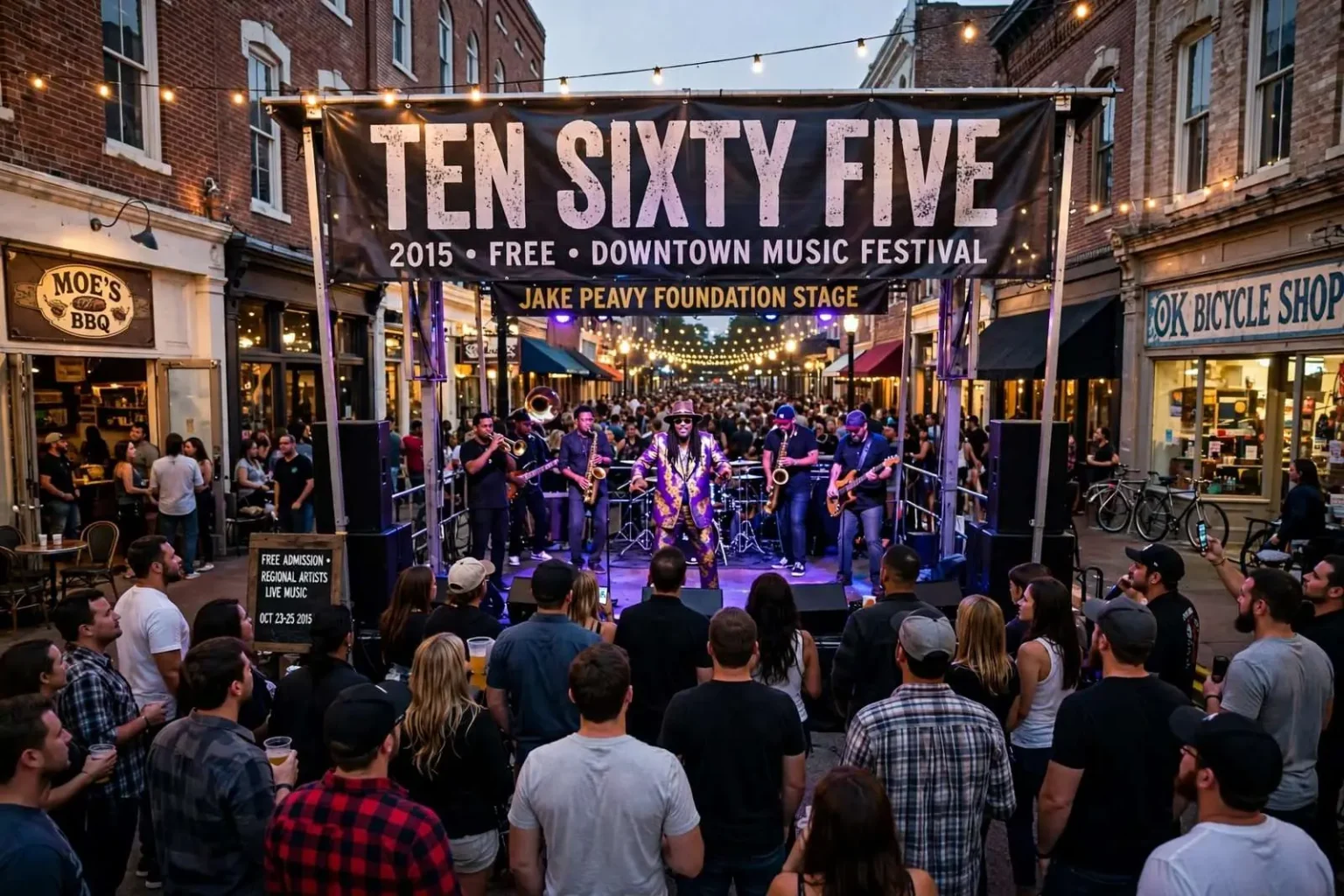
Rather than a gated-off area, the festival adopted an inspired open layout among Dauphin Street businesses that let guests wander freely and support local establishments throughout the weekend. The design was a statement of intent. Instead of fencing ticket holders inside a containment zone, organizers wove the stages into the existing fabric of the entertainment district, so that a fan could step out of a bar for a set and back inside for a drink without ever passing through a gate.
A major headliner anchored each day, including George Clinton and Parliament Funkadelic, Three Days Grace and Sublime with Rome, giving the free event the drawing power it needed to fill the street. The booking strategy balanced the nostalgia appeal of veteran national acts against the economics of a festival that charged nothing at the door and depended on sponsors and the spending of festivalgoers inside neighborhood businesses.
The Jake Peavy Foundation stage sat beside Moe’s BBQ, facing OK Bicycle Shop, and many fans watched from the rooftop of the former business for a unique vantage point over the crowd. The stage carried the name of the Mobile-born Major League Baseball pitcher whose foundation has been active in his hometown, tying the event to a locally rooted institution. The second stage, focused mostly on local musicians, was set in Cathedral Square and offered plenty of grassy space to spread out, a quieter counterweight to the street-level bustle a block away.
Highlights From the Stages
P-funk opened the first night with its trademark bass-heavy grooves, fronted by the grandmaster of funk himself, George Clinton. The music carried a block away, and the crowd never stopped moving. For audiences who had come of age on Clinton’s catalog with Parliament and Funkadelic, the set was a rare chance to see the architect of the genre in person, and his band delivered the sprawling, horn-driven, groove-obsessed performance style that had made him a legend across four decades of American music.
Meanwhile, on the Wind Creek Casino stage, Mobile musicians Kristy Lee and Eric Erdman performed, and Lee drew a sizable audience of her own. Their slots underscored the festival’s stated commitment to regional artists, placing hometown songwriters on equal footing with the national names on the marquee. For local performers, the exposure in front of a dense downtown crowd was its own reward, and for fans, the sets doubled as a survey of the talent the Gulf Coast music scene produces year after year.
Sublime with Rome drew arguably the largest crowd of the weekend, with fans packed shoulder to shoulder singing along to “What I Got” and “Santeria.” The band occupies a singular place in the Long Beach ska-punk lineage: original bassist Eric Wilson is the sole remaining founding member, with Rome handling vocals and guitar after the death of frontman Bradley Nowell. The singalong that greeted the band’s biggest hits confirmed the enduring reach of the Sublime songbook, and the crush of bodies on Dauphin Street ranked among the most vivid images of the weekend.
Three Days Grace brought the hard-rock counterweight to the lineup, giving the festival a second commercial radio constituency alongside the funk and ska-punk acts. The spread of genres across the three nights was itself part of the design, ensuring that no single audience owned the weekend and that the street’s bars and restaurants drew a rotating cast of festivalgoers from one night to the next.
After the main stages closed, venues such as Azalea Manor hosted free after-parties, extending the festival deep into the night for those with energy left to spare. The after-party circuit followed the same open, neighborhood-friendly logic as the festival itself: anyone could walk in, no wristband was required, and the late-night sets gave touring and regional acts a second chance to play for the crowds filling the district.
Sunday night featured Mobile band Fat Man Squeeze performing an acoustic set of guitar, mandolin and upright bass, a fittingly homespun close to the weekend. The stripped-down arrangement was a deliberate contrast to the amplified sprawl of the headline nights, and it highlighted the range of the local scene, where the same players can fill a street with electric energy one night and hold a room with acoustic instrumentation the next.
A Boost for Downtown Business
Many local businesses reported a welcome boost during the festival, and the open layout was engineered with exactly that result in mind. Bars and restaurants along Dauphin Street and the surrounding blocks absorbed the weekend crowds directly, and the free-admission model meant that money visitors might have spent on tickets went instead into cash registers across the entertainment district. For a downtown working to sustain momentum after the loss of its longtime festival, the spending pattern was as important as the music.
The Cathedral Square stage added its own geographic spread, drawing festivalgoers several blocks south of the main strip and spreading foot traffic across more of downtown. Merchants in the vicinity of the square, a park framed by historic churches and some of the oldest architecture in the city, saw audiences they might not otherwise have reached on a festival weekend.
A New Vision Takes Root
Organizers hoped the event would become a yearly tradition enriching the culture of the Azalea City, and the first edition offered reasons for optimism. The festival proved that a free, open, walkable format could coexist with serious national bookings, and that Mobile’s own musicians could hold a stage beside multiplatinum headliners without the event losing its identity.
Ten Sixty Five also demonstrated something about the city itself: that downtown Mobile’s compact grid of historic streets, bars, restaurants and parks could absorb and animate a multi-day festival without extensive gating or infrastructure. The 2015 edition closed with the sense that the city had found a workable successor to its festival tradition, one built on open streets, regional talent and the businesses that line Dauphin Street, and that whatever form the event took in future years, the template had been drawn.
The contrast with the festival that preceded it was instructive. Bayfest had operated on the model of a large-ticketed event, with fenced grounds, headline slots and the infrastructure that came with them, and its cancellation left downtown organizers weighing what kind of festival the district could realistically sustain. Ten Sixty Five’s answer was to shrink the footprint and remove the walls entirely, betting that the appeal of a free weekend in the streets would draw a crowd that a scaled-back lineup alone might not.
The bet showed in the crowd behavior all weekend. Families moved between Cathedral Square and the main drag, bar patrons drifted out to the sidewalk when a set started, and the rooftop vantage points above the street became informal viewing decks for anyone who could claim a spot. The festival felt less like an event imported into downtown and more like downtown performing itself, with the music as the occasion.
For the regional musicians on the bill, the value ran in both directions. Acts such as Kristy Lee and Eric Erdman play constant dates across the Gulf Coast, but a free festival with national headliners concentrates an audience that no club gig can match, and every new listener gathered on Dauphin Street was a potential fan at the next show. The festival’s structure treated that pipeline as a feature, not an afterthought, scheduling local acts in high-visibility slots rather than relegating them to early afternoon filler.
The headliners, for their part, gave the local scene a measuring stick. George Clinton’s ensemble, Three Days Grace and Sublime with Rome represent decades of touring experience and multiplatinum catalogs, and the crowds that sang every word of “What I Got” and “Santeria” showed the draw that established acts still command. Folding those names around a spine of regional talent made the case that the distance between a Cathedral Square stage and a national tour is shorter than it sometimes appears.
By the time Fat Man Squeeze played its final acoustic notes on Sunday night, the first Ten Sixty Five had established its identity: free to attend, open to the street, proud of its hometown acts and ambitious enough to book the names that guarantee a crowd. Whether the experiment would repeat annually remained to be seen, but as a first statement, it made the case clearly that downtown Mobile could carry a festival of its own kind.