Termite Damage Shuts Down Parts of Murphy High School Library, Computer Labs
Termites caused structural damage to part of Murphy High School's library and two computer labs, prompting an emergency repair declaration. MCPSS says classes continue uninterrupted as the district moves to hire an architect and contractors.
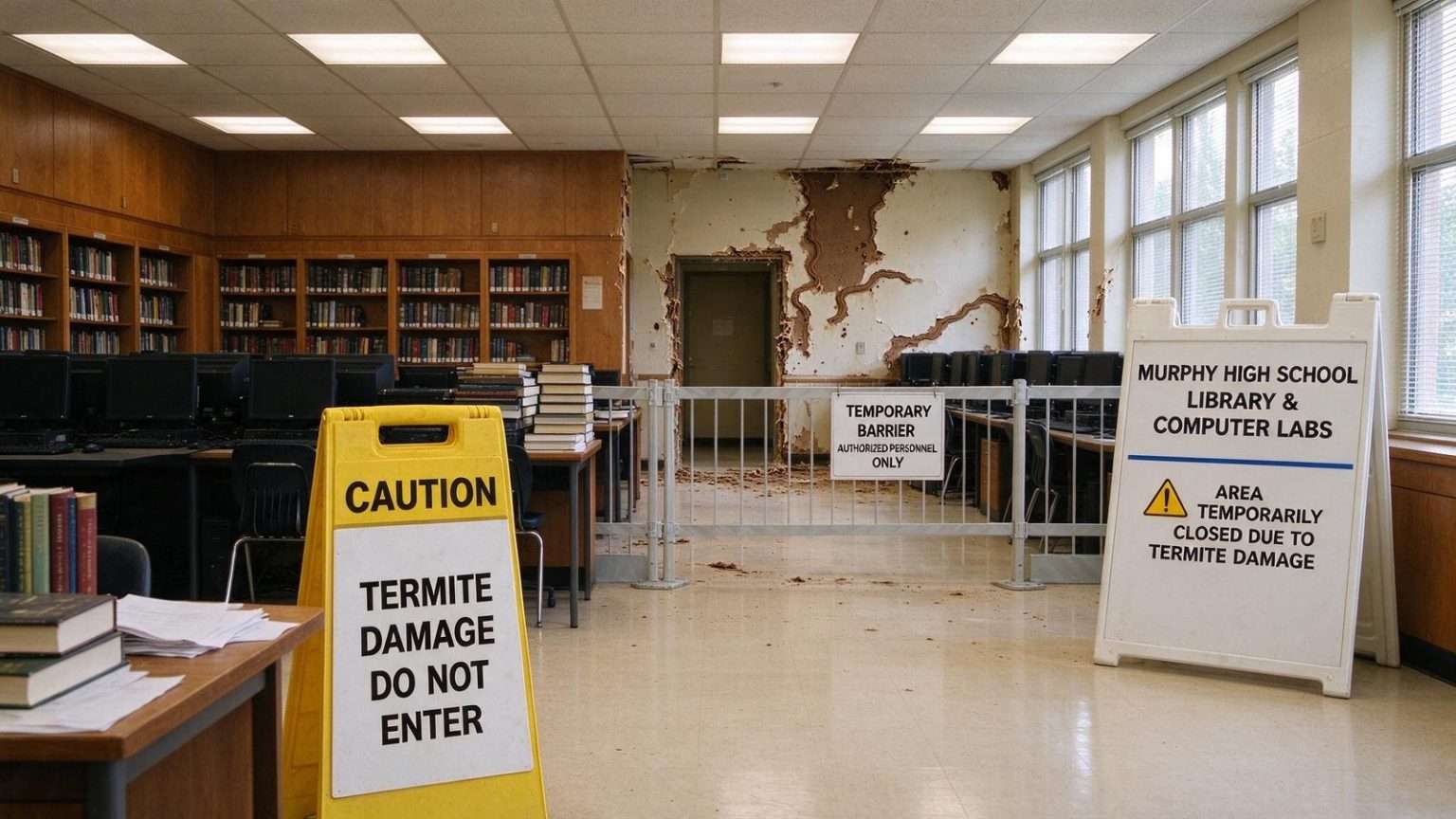
Termites have eaten through structural wood in part of Murphy High School’s library and two computer labs, prompting the Mobile County Public School System to declare an emergency so repairs can move forward without the delays of a standard bidding process. The damage was discovered earlier this month and is serious enough that MCPSS closed and vacated the affected areas for safety reasons. The two computer labs have since been relocated to another building on campus, while the portion of the library that was not damaged remains open to students.
The discovery adds Murphy High School to a list of older Gulf Coast public buildings that have had to confront the region’s persistent termite problem. South Alabama sits in one of the most termite-active zones in the United States, where both native subterranean species and the more aggressive Formosan subterranean termite thrive in the warm, humid climate. For school districts along the coast, that reality means wood-framed and wood-trimmed buildings that are decades old require constant monitoring, and infestations that would be a nuisance elsewhere can become structural emergencies when they reach load-bearing members.
District Says Learning Hasn’t Stopped
Despite the closures, district officials say the disruption to students has been minimal. MCPSS spokesperson Rena Philips said instruction has continued uninterrupted across the Murphy campus. “Teaching and learning are taking place throughout the campus, and we haven’t missed a beat,” Philips said. “We are following the state emergency procurement process to assess and repair the damaged areas.”
Moving two full computer labs into another building on campus is no small logistical task. Each lab typically holds dozens of desktop workstations, along with the networking, power and furniture that go with them, and the relocation had to be carried out without interrupting the class schedules of students who depend on those rooms for coursework. That the district managed the shuffle in-house reflects the scale of the Murphy campus itself, which is large enough to absorb displaced classrooms in a way a smaller school could not.
Keeping the undamaged portion of the library open was a similar balancing act. School libraries in the Mobile County system serve not only as book repositories but as study space, research centers and sites for scheduled class visits, so losing even part of one during the fall semester creates pressure on remaining seating and resources. By cordoning off only the damaged section, MCPSS preserved most of that function for students while ensuring no one enters the affected areas.
How the Emergency Declaration Works
Michael Griswold, MCPSS’s contract administrator, formally declared the emergency in a sworn letter dated Aug. 10. Griswold invoked Section 39-2-2(f)(1) of the Code of Alabama, a provision that allows public agencies to bypass competitive bidding requirements when a structural or safety emergency demands immediate action. “MCPSS is requesting Emergency Procurement for the Murphy High School Library and Computer Labs Areas for safety reasons,” Griswold wrote. “These areas are damaged structurally due to termites.”
Alabama’s competitive bid law is among the strictest in the country for public purchases, generally requiring formal advertising and sealed bids for work above modest dollar thresholds. The process protects taxpayer money but typically takes weeks or months to run its course — time a district does not have when the structural integrity of an occupied building is in question. The emergency exemption in Section 39-2-2 exists precisely for that situation, and school systems along the Gulf Coast have turned to it before after hurricane damage, burst pipes and other sudden failures.
Invoking the exemption is not a unilateral act. The declaration must be documented, sworn and presented to the district’s governing board, which must formally acknowledge it before emergency spending can proceed. That is why the request is on the agenda for the Mobile County Board of School Commissioners’ meeting on Monday, Aug. 24, when the board is expected to formally act on the declaration. The board’s regular meetings are where all of the system’s contract actions are ratified, and an emergency item typically appears alongside a summary of the circumstances that justified bypassing the normal bid process.
Once the board acts, the district can retain design professionals and hire contractors immediately, with the paperwork reconciled afterward. The sworn letter from Griswold, dated Aug. 10, will become part of the permanent procurement record, which state examiners review to confirm the emergency was genuine and the spending was limited to what the emergency required.
What Repairs Will Involve
Before permanent repairs can begin, crews must install temporary shoring to stabilize the damaged sections of the building. Shoring in a masonry and wood structure of Murphy’s age means bracing compromised framing from below and alongside so that ceilings, floors and walls above cannot sag or collapse while workers are inside. Only after the structure is stabilized can selective demolition safely proceed.
Selective demolition will then be needed to determine just how far the termite damage extends, since the full scope has not yet been established. Termites frequently travel inside wall cavities, under flooring and through attic spaces far beyond the point where visible evidence first appears, so contractors must open walls and remove finishes section by section until they reach sound wood. That exploratory work determines the final repair scope, and it is one reason the district has not yet put a price on the project.
Once that assessment is complete, the district plans to develop a permanent repair project and competitively bid it out in accordance with Alabama Division of Construction Management requirements. The division oversees construction procured by public entities across the state, setting the standards for advertising, bid security, contractor licensing and contract administration that apply once the emergency phase ends. Returning to the competitive process for the permanent work is standard practice: the exemption covers the immediate stabilization and assessment, not the full reconstruction.
MCPSS intends to hire Allred Architects to handle architectural and engineering design work for the project, and the district plans to solicit proposals from at least three contractors for the construction itself. Retaining an architect under emergency procurement and then competing the construction is a common hybrid approach that saves time on design while preserving price competition on the build.
According to the emergency declaration, repair work is expected to include replacing or repairing termite-damaged wood throughout the affected areas — including structural support members, trim boards, casework and sections of the roofing. The breadth of that list shows how far the infestation reached. Structural support members carry the loads of the building, and their repair is the most urgent and expensive item. Trim boards and casework are finish carpentry, but in an older school they are often custom-milled to match the original character of the building, making replacement more involved than an off-the-shelf swap.
Roofing sections damaged by termites present their own challenge, because roof repairs must be sequenced with weather and integrated with the structural work below them. Crews typically repair the framing first, then close the roof envelope so subsequent interior work is protected from rain. In a coastal market like Mobile, where afternoon storms are frequent much of the year, that sequencing matters to the schedule.
Cost and Cause Still Unclear
MCPSS has not yet disclosed the total projected cost of the repairs, nor has it detailed exactly when or how the termite damage was first discovered. The district also has not said whether termite damage has turned up anywhere else on the Murphy campus, when the school was last inspected or treated for termites, or whether MCPSS contracts with an outside company for termite treatment and prevention. It also remains unclear who will ultimately bear the cost of the repairs. MCPSS has not responded to those follow-up questions.
Those unanswered questions matter to taxpayers and to the school community alike. If the damage is confined to the library and lab wing, the cost will be measured in hundreds of thousands of dollars at most; if selective demolition reveals a broader infestation elsewhere on campus, the figure could grow substantially. Insurance typically does not cover termite damage, which insurers classify as a maintenance issue rather than a sudden accident, so the expense would likely fall on the district’s operating or capital budgets. Preventive treatment contracts, baiting systems and annual inspections are standard tools for coastal school systems, and how well those measures were applied at Murphy is a natural line of inquiry once the immediate repair work is underway.
Terminology also matters in assessing the cause. Subterranean termites, including the Formosan variety that is well established in Mobile, live in soil colonies and enter buildings through ground contact or mud tubes, so infestations in upper floors usually trace back to hidden pathways established over years. Determining where the colony entered — and whether prior treatments failed or lapsed — would typically be part of the contractor’s assessment and any future treatment plan for the rest of the campus.
Murphy High School, located in Mobile, is one of the largest and oldest high schools in the Mobile County Public School System, and its age is directly relevant to the episode. Buildings constructed in the early twentieth century rely heavily on wood framing, floors and trim, and the same architectural character that makes them landmarks makes them attractive to termites. The school system, the largest in Alabama by enrollment, maintains dozens of aging campuses along the coast, and facility maintenance across that portfolio is a recurring budget pressure.
The board’s Aug. 24 vote on the emergency procurement request will determine how quickly the repair process can move forward. With shoring, demolition and design work queued behind that approval, the district’s goal is to return the library and computer labs to full service as soon as the structural repairs are complete. For now, students continue their classes in relocated rooms, and the undamaged part of the library stays open — while the silent damage behind the walls of one of Mobile’s landmark schools is measured and repaired.