

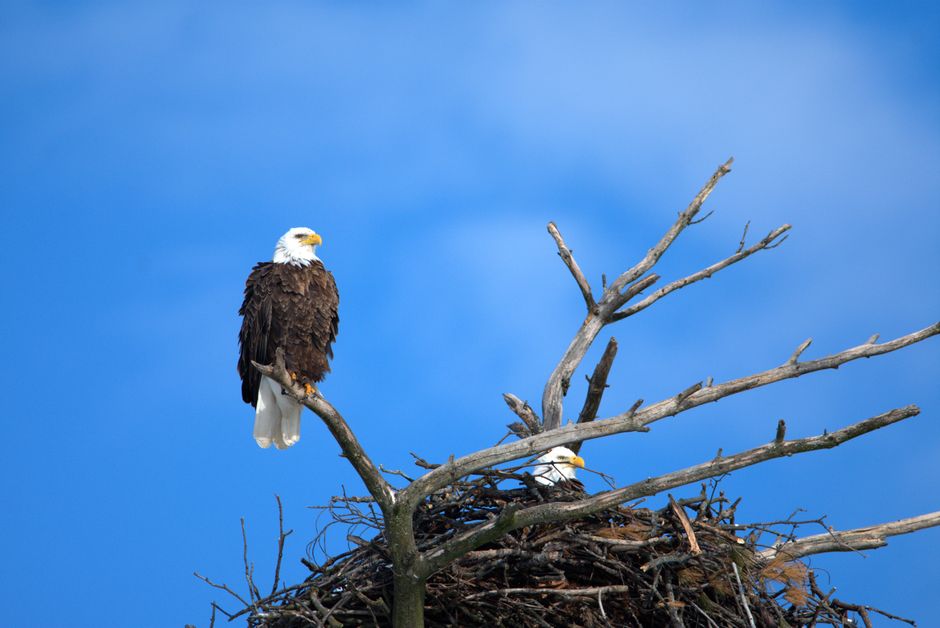
The Bird That Almost Wasn’t: Jack E. Davis Brings the Bald Eagle’s Story to Fairhope
Few animals carry as much symbolic weight as the bald eagle — and few have come as close to disappearing. When historian Jack E. Davis, the Pulitzer Prize-winning author of “The Gulf: The Making of an American Sea,” brought his book “The Bald Eagle: The Improbable Journey of America’s Bird” to Page & Palette in Fairhope, the standing-room crowd got a history lesson that doubled as an environmental resurrection story — one with a direct connection to the Gulf Coast birds that now nest along Alabama’s waterways.
Davis, a distinguished professor and the Rothman Family Chair in the Humanities at the University of Florida, divides his time between Gainesville and New Hampshire, but the South is his intellectual home. He did his doctoral work in Mississippi and fell in love with the region in the process. “There is something about the South,” he says. “A sense of place that you don’t find in the North. It’s a powerful sense of place and literary strength.” The Gulf’s natural environment — one of the most biologically diverse regions in the United States — has inspired his work throughout his career.
A Symbol, but Not a National Bird
Davis began his talk with the kind of detail that reorders what people think they know. In 1776, within hours of the colonies declaring independence, a committee was formed to create a Great Seal for the new nation — a necessity for signing treaties. The seal took six years to finalize, and in 1782 Congress adopted a design featuring the bald eagle. Yet for all its heralded prominence, the bald eagle is not officially America’s national bird. To this day, the United States recognizes no national bird at all.
And the eagle’s early American reputation was nothing to celebrate. Through the first half of the nation’s existence, bald eagles were widely considered a nuisance — competitors for fish, accused of stealing livestock — and they were hunted extensively. The species was pushed to the brink of extinction twice in the twentieth century.
Two Recoveries, Two Narrow Escapes
The first redemption came in 1940, with the Bald Eagle Protection Act, the first federal law shielding the bird. But a second, more insidious threat was already spreading. DDT, introduced around 1945 to eradicate disease-carrying insects, worked its way through waterways into the fish that eagles, ospreys, and brown pelicans ate, thinning eggshells and collapsing reproduction across the country.
In the South, eagles faced an additional blow: avian malaria reduced populations everywhere except Florida. That refuge proved decisive. Young eaglets from Florida nests were relocated to other states with nearly complete success, and the comeback that followed exceeded every expectation — by 2010, the national population had quadrupled from its lows. Today, raptor rehabilitation centers operate in every state in the union.
That recovery is the reason Davis wrote the book the way he did. So much environmental writing reads as tragedy, he says, and he wanted the opposite: “I wanted positive reinforcement. Not everything is tragic in our relationship with the natural world.”
An Author Built for the Subject
Davis came to the eagle project after “The Gulf,” his environmental history of the Gulf of Mexico that won the 2018 Pulitzer Prize for History and the Kirkus Prize. “The Bald Eagle: The Improbable Journey of America’s Bird,” published by W.W. Norton in 2022, applies the same method to a single species — using the bird’s fortunes as a lens on America’s relationship with its own environment.
The Natural History Worth Knowing
The talk’s wildlife facts gave the audience as much as the history. Bald eagles are found only in North America. They mate for life and return each year to their natal territory, adding to the same nest year after year — some nests survive 30 to 40 years if storms and loggers spare the trees that hold them. Most pairs lay two eggs a year, and eaglets leave the nest after eight to 14 weeks. The famous white head takes about five years to fully mature.
Along the Alabama coast, the story has a visible ending: bald eagles now reside and raise their young in the coastal region in growing numbers, a sight locals of a certain age never expected to see. Each winter, part of the population departs for northern grounds, and each spring the nesting territories fill again.
A Bookstore That Hosts the Conversation
The Page & Palette appearance was part of the Fairhope bookstore’s long-running author event series, which has made the corner of Section Street and De La Mare Avenue one of the Gulf Coast’s reliable stops for writers of national consequence. Davis’s visit fit a pattern: the store regularly hosts environmental and literary voices whose subjects — the Gulf, its waters, its wildlife — are local reality, not abstraction.
The bald eagle’s journey, from national symbol to doomed species to recovering icon, is the rare environmental story with a genuinely hopeful third act. Davis tells it with a historian’s rigor and a Southerner’s affection for place — and its closing chapter is being written, nest by nest, in the trees over Mobile Bay.