The Blind Mule Pairs Local Art and Holiday Cheer in Downtown Mobile
Downtown Mobile's Blind Mule runs a Last Minute Shopper's Artist Alley with local art under $75 plus free wine tasting.
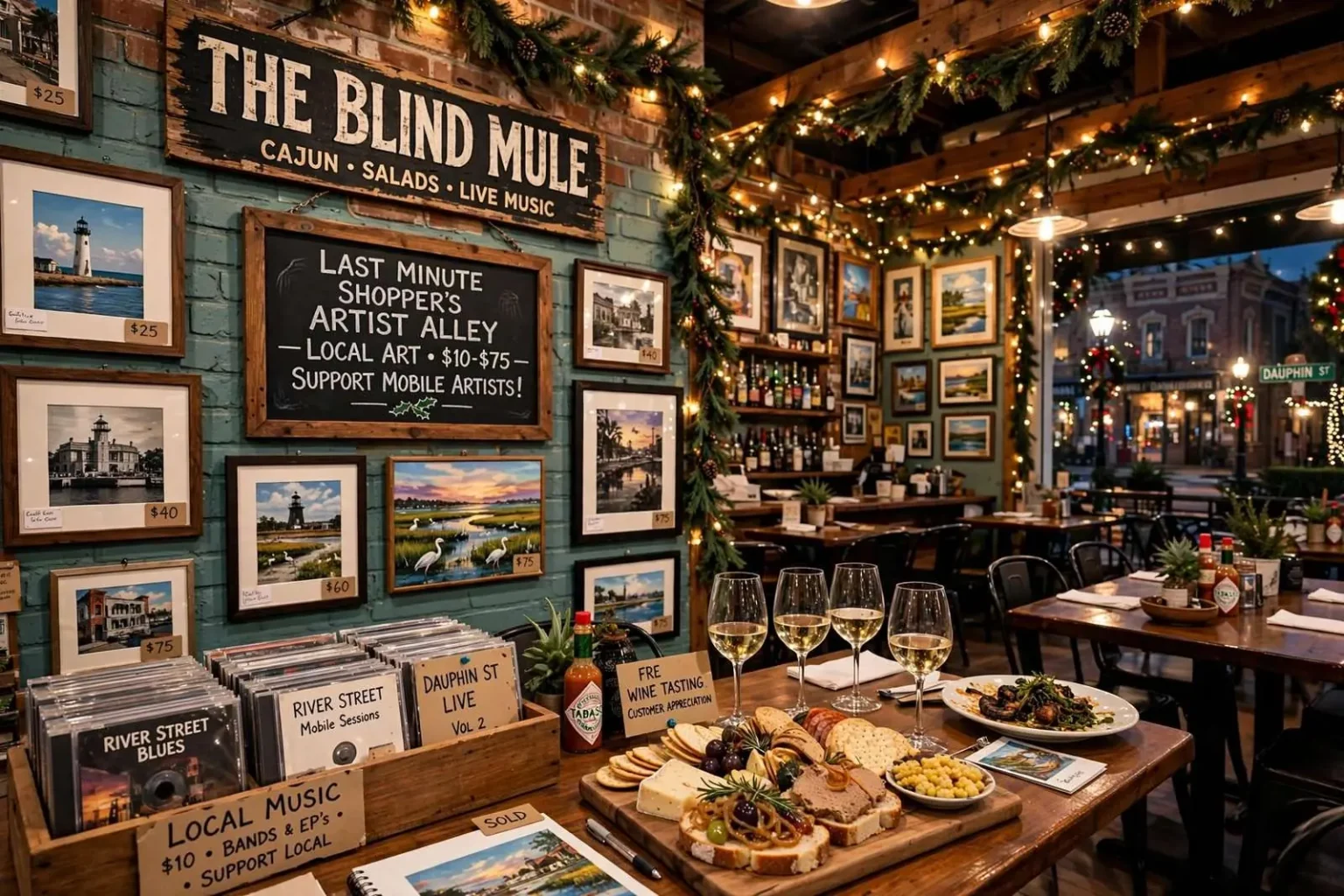
The Blind Mule has spent the holiday season doing double duty in downtown Mobile — plating Cajun dishes and signature salads while turning its space into a gallery of local work for last-minute shoppers. The restaurant, a fixture of the LoDa entertainment district, has long made local creativity part of its identity, and the holiday season gave that habit its most practical expression yet: a marketplace where diners could leave with a painting or photograph instead of just a to-go box.
The concept answers a problem every holiday shopper knows. By mid-December, the obvious gifts have been bought, the shipping deadlines have passed, and the remaining names on the list need something personal, affordable and immediately available. Original art fits that niche almost perfectly — one of a kind, made nearby, and priced here within reach — yet most shoppers never think of it because galleries can feel intimidating. Putting the work on the walls of a restaurant removes that barrier entirely: browse between courses, ask the staff about a piece, and walk out with it the same night.
Last Minute Shopper’s Artist Alley
The restaurant’s “Last Minute Shopper’s Artist Alley” showcases photography, paintings and other visual art at gift-friendly prices, with every piece $75 or less and some works as low as $10. Those price points put original work in the same range as the mass-produced prints and novelty items that crowd holiday shopping, while offering something no big-box store can: art made by a neighbor. Photography of familiar Mobile scenes, Gulf Coast landscapes and local landmarks tends to do especially well at events like this, because it lets the buyer give a piece of the place they share.
Shoppers can also browse recorded music from local acts — a welcome alternative to another loop of seasonal standards. The Blind Mule’s connection to Mobile’s music scene runs through its regular live shows, and selling recordings alongside the visual art turns the restaurant into a one-stop shop for locally made gifts. For the musicians, each sale is direct income and a new listener; for the buyer, it is a gift with a story attached.
The event doubles as a chance to support working Mobile artists directly, with proceeds flowing to the creators rather than a retail middleman. That structure is the quiet engine of the whole arrangement. Artists who sell through galleries or stores typically split the price with the venue; here, the restaurant provides the walls and the foot traffic, and the money goes where the work came from. In a city with a growing but still tight-knit arts community, that kind of venue support matters to whether working artists can keep working.
Christmas party on the side
The market overlaps with the restaurant’s Christmas and customer-appreciation party, where guests get a free wine tasting along with hors d’oeuvres — cheeses and pâté on rye with caramelized onions among the spread. The pairing is deliberate. A customer-appreciation night gives regulars a reason to come out, the free tasting gives them something to do while they browse, and the art gives them something to buy on the way out. Every element feeds the others in a way that a standalone market or a standalone party would not.
The Blind Mule’s kitchen carries its Cajun-leaning menu through the season — the hearty, regional cooking that made the restaurant a downtown favorite — alongside the signature salads that balance the menu for lighter appetites. Holiday crowds get the same food they come back for, with the added energy of the market and the party layered on top.
Since opening downtown, the Blind Mule has made local artists and musicians part of its regular formula, hosting shows alongside its menu and giving the LoDa district another reason to draw evening crowds during the holidays.
LoDa and downtown Mobile’s holiday pull
The Blind Mule operates in the heart of LoDa — Lower Dauphin — the stretch of Dauphin Street that serves as downtown Mobile’s entertainment corridor. Bars, restaurants and galleries line the blocks around it, and on weekend nights the street fills with pedestrians moving between venues in a scene unmatched elsewhere in the city. The district’s identity grew out of Mobile’s effort to repopulate and reactivate its historic downtown, where restored nineteenth-century buildings now house exactly the kind of independent businesses that chains rarely provide: music venues, galleries, cafes and restaurants like the Blind Mule.
The holiday season sharpens LoDa’s pull. Mobile’s downtown calendar runs heavy in December — the city’s Christmas lights, the traditional season of decorated historic districts, and a run of parties and events that bring office crowds and families downtown in the evenings. Restaurants that program something extra during those weeks capture an audience that is already out and looking for a reason to stop. The Blind Mule’s artist market and appreciation party slot directly into that flow, converting seasonal foot traffic into sales for artists and customers for the kitchen.
Downtown Mobile’s revival has leaned on this symbiosis for years. Venues that host local artists draw the creative crowd; the creative crowd draws the nightlife; and the nightlife supports the restaurants that keep the historic blocks economically alive. A $10 print bought at a holiday market is a small transaction, but multiplied across a season it is part of what keeps doors open on Dauphin Street.
The economics of local art
The price ceiling the restaurant set — every piece $75 or less, some at $10 — is more strategic than it may look. Working artists face a perennial dilemma: their work has to be priced to survive, but most casual buyers hesitate to spend hundreds on impulse. A market built around sub-$75 original pieces lets artists move volume in the season when discretionary spending peaks, introduces their work to buyers who may return for bigger pieces later, and clears inventory before the new year. The buyers, meanwhile, get original art at a price that competes with mall décor — and the artists get paid, not a gallery’s margin.
Recorded music works the same way. A local band’s album or EP is an easy gift at exactly the price point holiday shoppers expect to pay, and every disc sold downtown is worth more to the musicians than dozens of streams. Mobile’s music scene — from the acts that play Dauphin Street venues to church choirs and festival performers — has historically depended on exactly this kind of direct, face-to-face support.
The Blind Mule’s formula makes the restaurant something more than a place to eat: a low-overhead gallery that pays rent with food sales and passes the art sales through. Venue-hosted markets like this one have become a quiet institution in cities the size of Mobile, where gallery space is limited but restaurant walls are plentiful.
What the season says about the city
There is a bigger point inside a holiday market. Cities that keep their downtowns healthy are the ones where small venues, artists and restaurants reinforce each other instead of competing, and Mobile’s LoDa district is a working example. The Blind Mule’s December — Cajun plates, signature salads, free wine tastings, local art on the walls, local music on the speakers — is the district’s economy in miniature, and the customer-appreciation party that ties it together is a thank-you to the regulars who sustain it all year.
For shoppers who walked out with an original painting, a local band’s album and a full plate of Cajun cooking, the evening delivered everything the season is supposed to be about: something made by hand, bought from its maker, and enjoyed a few steps from the Mobile nights that inspired it. For the artists and musicians on the other side of the counter, it was a paycheck with the city’s name on it.
A restaurant built on local talent
The Blind Mule’s artist-friendly identity did not begin with the holiday market. Since opening downtown, the restaurant has hosted local artists and musicians as part of its regular formula, hanging work on its walls and putting bands on its stage alongside a menu of Cajun dishes and signature salads. That dual identity — kitchen and cultural venue — is how many of downtown Mobile’s best-loved spots sustain themselves, but the Blind Mule has been unusually consistent about it, treating the art and the music as part of the product rather than an occasional special event.
The payoff is loyalty. Regulars come for the food and stay for whatever is on the walls or the stage; artists bring their own followings, who become diners; and the restaurant becomes known as a place where the city’s creative life is visible year-round. A holiday market built on that foundation is less a new venture than a seasonal extension of what the business already does.
It also fits the rhythms of the LoDa district, where venue owners learned long ago that programming — art walks, live music, themed nights — is what turns a street of bars and restaurants into a destination. December, with its built-in crowds and gift-buying mood, is simply the month when that programming pays best.
The party that holds it together
The Christmas and customer-appreciation party gave the market its social center. Free wine tastings have a way of loosening the pace of a shopping evening — guests linger, talk, ask the artist’s story behind a piece they are considering — and the hors d’oeuvre spread of cheeses and pâté on rye with caramelized onions turned the restaurant’s floor into a room people wanted to stay in rather than hurry through. Customer-appreciation events also serve a quieter business purpose: they reward the regulars whose weeknight visits keep the lights on, and they remind occasional diners why the restaurant deserves a spot on their January calendar too.
The timing matters in a district where December weekends are crowded with competing invitations. Companies hold parties downtown, friends schedule their annual gatherings, and every venue on Dauphin Street is fishing for the same evenings. Combining the market, the party and the free tasting into one event concentrated the drawing power instead of splitting it.
Why it matters to Mobile’s artists
For the artists themselves, an event like the Last Minute Shopper’s Artist Alley is one of the few reliable December sales opportunities in a city of Mobile’s size. Formal galleries are few, juried art shows are seasonal, and the costs of a solo exhibition — space, promotion, time — fall on the artist. Restaurant-hosted markets invert that math: the venue already has walls, foot traffic and advertising, and the artist simply brings work and takes home the proceeds. Every sale at $10 or $75 is direct, and every buyer is a potential collector for life.
The same logic carries the recorded music on offer. Local acts that play the district’s stages sell their recordings to audiences that have just heard them, a transaction no streaming platform can replicate. Events that let musicians sell alongside painters and photographers treat the city’s creative community as one economy — which, downtown, it genuinely is.
The Blind Mule’s holiday season ended where it began: a restaurant doing double duty, giving downtown Mobile one more reason to come out on a winter evening, and sending shoppers home with gifts that carry a piece of the city — and the artist’s name attached.