
The Endangered Mouse That Builds Alabama’s Dunes Gets Its Own Night at Gulf State Park
The South Alabama Land Trust hosts a free Oct. 1 talk at the Gulf State Park Interpretive Center on the endangered Alabama beach mouse, whose seed-carrying habits help build the dunes that shield coastal communities from storm surge.
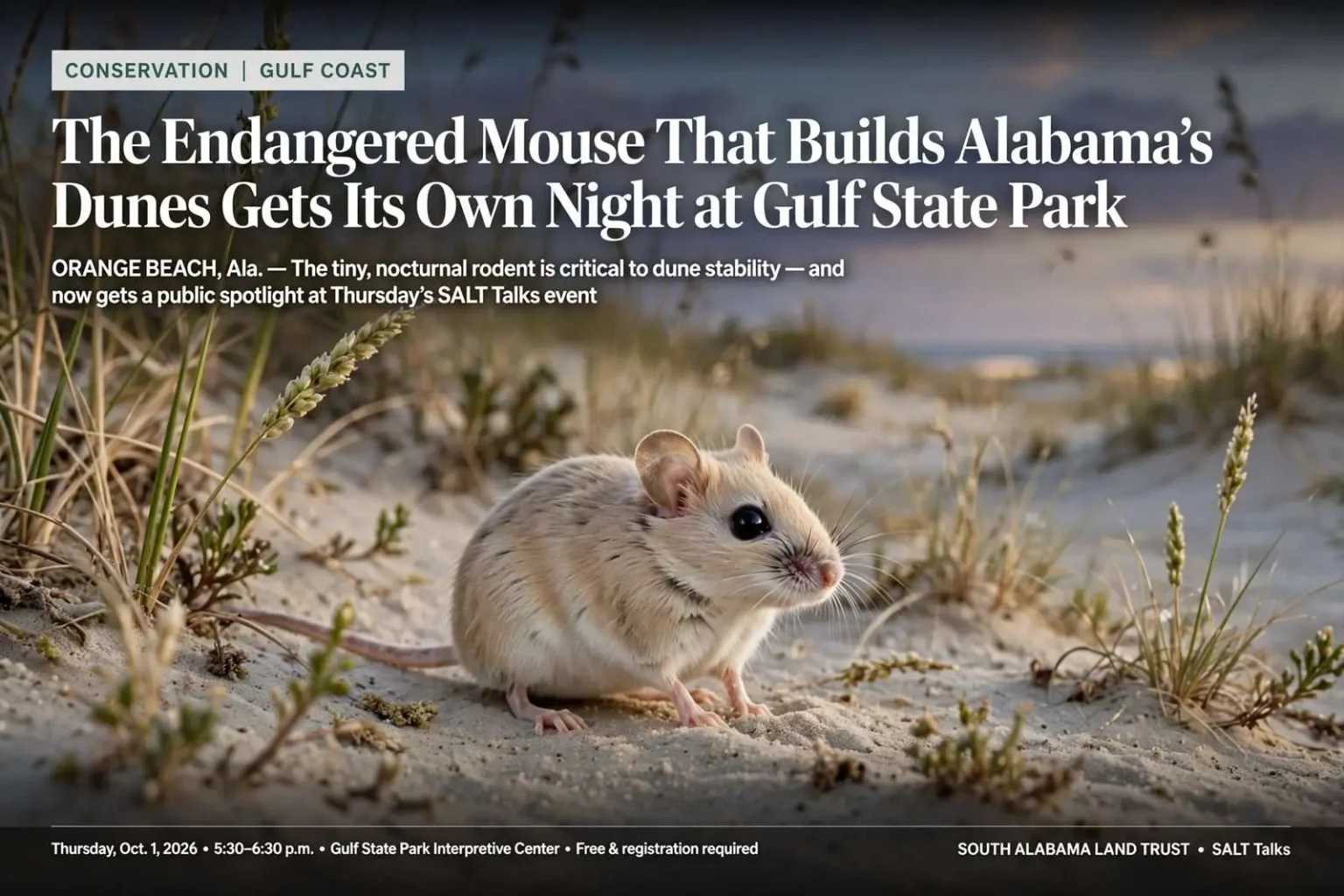
ORANGE BEACH, Ala. — The white-sand beaches of Gulf Shores and Orange Beach are famous for their beauty. One of their most consequential caretakers is an endangered animal that almost no one who visits will ever see.
Both the Alabama beach mouse and the Perdido Key beach mouse are federally protected, endangered subspecies native to this stretch of coast. These nocturnal rodents measure less than six inches in length and are highly adapted to the coastal strand community, making their homes among the sand dunes.
Their impact on the health, stability and preservation of the Alabama Gulf Coast is out of all proportion to their size — and it is the reason a mouse is a recurring factor in beachfront development decisions.
The South Alabama Land Trust will host a free public event on the Alabama beach mouse on Thursday, Oct. 1, from 5:30 to 6:30 p.m. at the Gulf State Park Interpretive Center. Admission is free, but registration is required because seating is limited.
What the Beach Mouse Actually Does
The beach mouse functions as an ecological engineer for the coastal dune system, with effects across several areas:
Dune stabilization and growth. As the mice forage, they carry seeds from native plants such as sea oats and bluestem back to their underground burrow networks. Many of those seeds are dropped along the tunnels, where they germinate. The resulting vegetation strengthens the dunes, preventing erosion and buffering coastal communities against storm surge.
Seed dispersal and plant diversity. By moving seeds across the dune system, beach mice maintain plant diversity and distribute vegetation throughout the coastal community.
Natural pest control. Preying on insects, they help regulate insect populations.
Food chain support. They are a primary food source for native dune predators including snakes and owls.
Why Dunes Are Infrastructure
The dune stabilization function is the one with direct financial consequences for coastal property owners, and it deserves to be understood in those terms.
A vegetated dune is not decorative. It is a physical barrier that absorbs wave energy during a storm surge event and reduces the amount of water and force reaching structures behind it. The vegetation is what holds it together — sea oats in particular develop root systems that bind sand and allow a dune to accrete rather than blow away.
Coastal engineers and emergency managers treat dune systems as a component of storm protection alongside seawalls and elevation requirements, and dune restoration is a standard element of post-storm recovery on the Gulf Coast.
The beach mouse contributes to that system by moving the seed that produces the vegetation that holds the sand. It is a small contribution repeated continuously over generations, and it is not easily replicated by human effort at the same scale.
A Fragmented Range
The present-day distribution of the beach mouse is greatly reduced and highly fragmented. Populations are restricted to areas including the Fort Morgan Peninsula, the Perdue Unit of the Bon Secour National Wildlife Refuge, and Gulf State Park.
Fragmentation is a particular problem for a species like this one. Beach mice live in dune habitat that runs in a narrow band along the shoreline. When development, roads or hardened structures interrupt that band, populations become isolated from one another.
Isolated populations face two compounding risks. Genetic diversity declines within a small breeding population, reducing resilience. And a local extinction event — a hurricane that overwashes a section of dune, for instance — cannot be repopulated from a neighboring group if there is no connected habitat between them.
That is why conservation strategy for the species emphasizes acquiring continuous parcels rather than simply protecting acreage.
The Conservation Fund and Who Pays Into It
In June 2026, the South Alabama Land Trust took over a long-standing agreement with the U.S. Fish and Wildlife Service to manage the beach mouse conservation fund.
The fund collects fees assessed to developers whose projects impact beach mouse habitat, and uses those resources to acquire and protect continuous parcels of land on the Fort Morgan Peninsula.
This is a mitigation mechanism, and it reflects a pragmatic approach to a genuine conflict. Development on the Alabama coast is not going to stop. The fund converts development that affects habitat into funding that protects habitat elsewhere, with the emphasis on connectivity that fragmentation demands.
Orange Beach’s Habitat Conservation Plan
The City of Orange Beach has implemented a habitat conservation plan to protect the Perdido Key beach mouse and other sensitive wildlife, and has received an Incidental Take Permit from the federal government allowing it to manage development impacts within a defined framework.
In January 2026, the Orange Beach City Council authorized a $53,100 contract with Wetland Sciences to develop the city’s portion of the beach mouse habitat conservation plan.
The mechanism here is worth explaining, because it is frequently misunderstood as a loophole.
The Endangered Species Act prohibits “take” of a listed species, a term that includes harming or harassing an animal and extends to significant habitat modification. Without a permit, that prohibition applies project by project, which produces a slow, adversarial process in which every individual development is evaluated separately.
A habitat conservation plan changes that structure. A jurisdiction develops a comprehensive plan identifying which areas will be conserved, what conservation measures will apply, and how impacts will be mitigated. In exchange, the U.S. Fish and Wildlife Service issues an Incidental Take Permit allowing development consistent with the plan.
The trade is predictability for both sides. Developers gain a clear framework rather than case-by-case uncertainty. The species gains a landscape-scale conservation commitment rather than a series of individual negotiations. Whether any particular plan strikes that balance well is a legitimate subject of debate, but the structure is designed to resolve a conflict rather than to avoid the law.
Two Subspecies, One Coast
The Alabama beach mouse and the Perdido Key beach mouse are distinct subspecies occupying different portions of the coastline — the Alabama beach mouse along the Fort Morgan Peninsula and Gulf Shores area, the Perdido Key beach mouse in the Perdido Key and Orange Beach vicinity extending into Florida.
Both are federally listed as endangered. The subspecies distinction matters legally, because protections and conservation planning are applied to each separately, which is why Orange Beach’s planning addresses the Perdido Key subspecies specifically.
The SALT Talks Event
The Oct. 1 event is part of SALT Talks, the land trust’s ongoing educational series aimed at sparking conversation about the future of Alabama’s natural landscapes.
What: Free public talk on the endangered Alabama beach mouse
When: Thursday, Oct. 1, 2026, 5:30 to 6:30 p.m.
Where: Gulf State Park Interpretive Center
Cost: Free, registration required
Organizers encourage the public to reserve seats early, as venue capacity is limited.
What Residents and Visitors Can Do
Beyond attending, a few ordinary behaviors matter for dune habitat:
Use designated dune walkovers. Foot traffic across dunes crushes vegetation and collapses burrows. Walkovers exist for precisely this reason.
Keep cats indoors. Free-roaming domestic cats are a documented predation pressure on beach mouse populations.
Secure trash and avoid feeding wildlife. Food waste attracts predators and competitors that would not otherwise concentrate in dune habitat.
Respect posted habitat areas. Signage marking protected dune areas reflects specific conservation commitments, not general landscaping preference.
The animal most people will never see is doing work that protects the properties they can.