

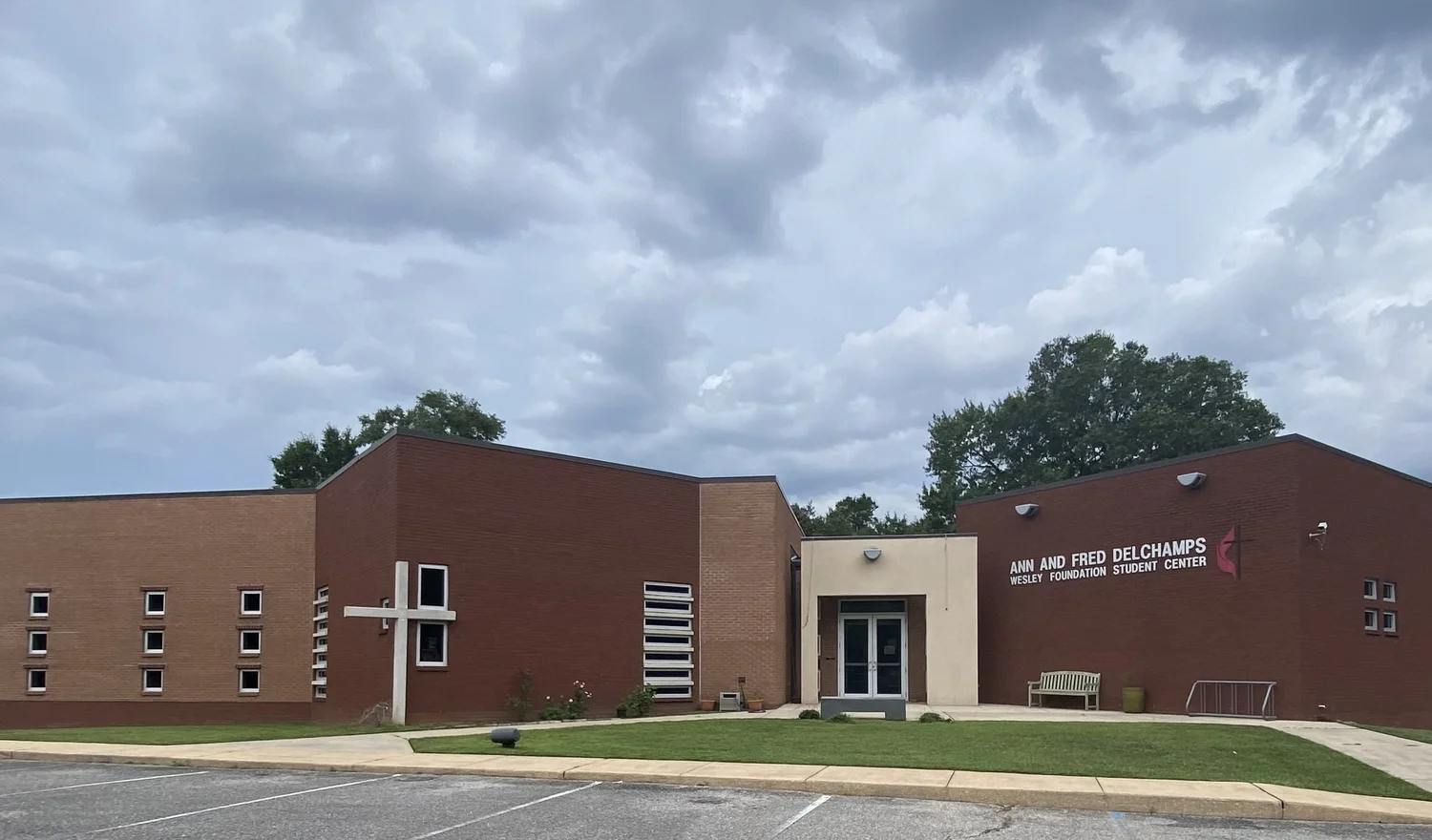
On paper, the USA Wesley Foundation looked like everything a struggling college student could hope for. A place of worship. A free meal. A community of believers. A “safe space for students to connect to the community and to thrive,” as the organization described itself in a recent announcement.
For years, the United Methodist campus ministry across from the Mitchell Center on Old Shell Road welcomed students from the University of South Alabama, Spring Hill College, the University of Mobile, and beyond with open doors and promises of spiritual refuge. Its mission, as stated in official materials, was to help students “grow their faith, build Christian community, and love their neighbors.”
But for many who walked through those doors seeking solace during some of the most disorienting years of their lives, what they found was something else entirely.
Behind the veneer of Christian fellowship, a different culture thrived—one of exclusion, public humiliation, and a leadership style that, according to multiple former students, weaponized shame and intimidation under the guise of pastoral care. At the center of it all were Johnny Peters and his wife Danielle Peters, who for years operated the Wesley Foundation not as a sanctuary for the lost and confused, but as a kingdom built on cliques, favoritism, and the systematic vilification of those who didn’t fit in.
The Promise and the Reality
Johnny Peters arrived in Mobile with an impressive pedigree. He had been a youth leader at a prominent Dallas church and was recruited to the board of a philanthropic foundation created in memory of a young man who died of cancer. Early profiles painted Peters as a committed Christian leader who helped connect foundation work with missional efforts in Mobile’s toughest neighborhoods.

But somewhere between the mission trips and the ministry, something went wrong.
Students who came to the Wesley Foundation during Peters’ tenure describe an environment that was anything but welcoming. What was advertised as a judgment-free zone for exploring faith and finding community turned out to be a pressure cooker of social hierarchy, where belonging was conditional and mistakes—real or perceived—were met with disproportionate punishment.
“They talked constantly about loving everyone and sharing Christ’s vision for helping people in need,” said one former student, who asked to remain anonymous for fear of retaliation. “But if you actually watched how they treated people, it was the exact opposite. It was like they had a script they recited, and then a completely different playbook they followed.”
The Case of the Missing Remote
Perhaps no single incident better encapsulates the toxic culture that allegedly flourished under the Peters’ watch than the saga of the missing television remote.
According to multiple sources, a television remote control went missing at the Wesley Foundation facility. What should have been a minor inconvenience—a lost household item in a busy student center—instead became the subject of an intensive, days-long campaign of harassment directed at one student.
Johnny Peters reportedly called and messaged the student repeatedly over several days, demanding he come to the office immediately. The messages came at least four separate times, each more urgent than the last. The student, confused but compliant, made an appointment and arrived at the Wesley Foundation expecting something significant—perhaps a new ministry opportunity, or an important announcement about the organization’s future.
Instead, he walked into an interrogation.
Peters sat the student down and proceeded to grill him about the missing remote. The conversation was not a gentle inquiry or a pastoral conversation about community responsibility. It was an accusation. The student was being blamed for stealing the remote, questioned as if he were a criminal rather than a young person who had come to the Wesley Foundation seeking spiritual guidance and community.
“He was treated like a thief,” another student who witnessed the aftermath said. “Over a TV remote. They made him feel like he had committed a felony. For what? A piece of plastic worth maybe twenty dollars?”
The student left humiliated, his reputation within the organization tarnished over an item that could have been misplaced by anyone. The incident became a cautionary tale whispered among students: cross the Peters, and even the smallest transgression could become grounds for public shaming.
A Devoted Donor, a Cruel Rebuke

Then there was the night of the midnight meal.
The Wesley Foundation, like many campus ministries, hosted late-night meals for students burning the midnight oil during finals week. These events were marketed as acts of care—a warm meal for tired students, a moment of respite in the chaos of exams. For students far from home, these meals were supposed to be a taste of comfort, a reminder that someone cared.
The student who walked in that night was no stranger to the Wesley Foundation. Far from it. Over the preceding months, this young person had quietly become one of the organization’s most faithful supporters. He had purchased items at multiple silent auctions, eagerly bidding to help raise funds for ministry activities. He had made regular cash donations out of his own limited student budget. And when the Foundation’s main projector in the worship room broke—a critical piece of equipment for services and events—he didn’t hesitate. Without fanfare or expectation of praise, he paid for and bought a brand-new projector with his own money, donating it outright to the organization he believed in.
In every measurable way, this student had invested his heart and his wallet into the Wesley Foundation. He had given not out of abundance, but out of sacrifice, because he truly believed in the mission of love and community that the ministry proclaimed.
That night, he arrived hungry and hopeful, looking forward to a simple meal with fellow students. He approached Johnny Peters and innocently asked a single, harmless question: “Pancakes?”
According to witnesses, Peters’ response was immediate and brutal. “Yeah, is that OK with you?” he snapped back, his voice loud and harsh, his tone dripping with contempt.
The student was stunned. There was no context for the hostility, no reason for the venom. It was a simple question about food at a food event. But Peters had chosen to make it a moment of public humiliation, turning a hungry student’s innocent inquiry into an opportunity to assert dominance—and doing so to one of the ministry’s most generous benefactors.
The student left without eating. Without the meal. Without the community. Without the refuge he had been promised. He walked out of a building he had helped keep running, with a projector he had paid for still beaming in the main hall, and he wondered if any of it had ever meant anything at all.
“The whole point of the midnight meal was to help students,” another former attendee said. “But that night, one of the people running it made sure someone who needed help felt like garbage instead. And this wasn’t some random kid off the street—this was a guy who had given and given to that place. He bought them a projector! And they treated him like dirt over pancakes. It was beyond cruel. It was obscene.”
A Pattern of Control

These incidents were not isolated. Former students describe a consistent pattern of behavior from the Peters that undermined the very mission the Wesley Foundation claimed to serve.
Students who were struggling—the very people the ministry claimed to exist for—often found themselves on the outside looking in. The organization developed into what multiple sources describe as “cliques and groups that vilified other people.” Rather than a welcoming community for all, the Wesley Foundation allegedly became a place where belonging was determined by proximity to power, and where those who didn’t play the game were systematically excluded.
“Young people came to this organization under the auspice that it was a welcoming place where they could find refuge and help while navigating being lost and confused at a young age,” one source said. “Instead, they found problems. They found judgment. They found that the people running it were more interested in controlling them than caring for them.”
The contrast between the organization’s public messaging and its internal reality is stark. Even as students were being publicly shamed and excluded, the Wesley Foundation was presenting itself as a beacon of Christian love. Community events, fundraisers, and art markets were promoted as family-friendly celebrations of diversity and creativity. The ministry’s public face was warm, inclusive, and welcoming.
But for those who experienced the darker side of the ministry, these public-facing events felt like a mask hiding a much uglier truth.
The Question of Accountability

Johnny Peters has since been replaced as campus minister. A new campus minister now leads the organization. The transition was described as a natural change, but the question of accountability remains.
How did a United Methodist campus ministry—an organization ostensibly dedicated to shaping “the next leaders of our church”—allow a culture of fear and exclusion to flourish under its roof? Where was the oversight from the board of directors? Where was the accountability from the regional conference?
The Wesley Foundation’s own materials boast of a “great board of directors” that meets regularly. Yet if the accounts of former students are accurate, serious problems persisted for years without intervention.
The foundation’s stated mission—that students would “Grow their faith in Christ, Connect with other students in Christian fellowship, and Serve their neighbors in response to the love of Christ”—stands in grim contrast to the experiences of those who felt targeted, shamed, and excluded.
A Betrayal of Trust
Campus ministries occupy a unique and sacred space in the lives of college students. For many young people, these organizations are the first communities they find away from home. They are places where faith is explored, friendships are forged, and identities are shaped. The people who lead these ministries carry an enormous responsibility.
When that trust is betrayed—when a place of refuge becomes a place of fear—the damage can be lasting. Students who came to the Wesley Foundation seeking support left with wounds. Some may have left the faith altogether. Others may carry the scars of public humiliation into their adult lives.
The story of the USA Wesley Foundation under Johnny and Danielle Peters is a cautionary tale about the gap between mission and practice, between the words we say and the way we treat people. It is a reminder that Christian love cannot be performed—it must be lived. And when it is not, the consequences are real.
“For a lot of us, it was our first real experience with church as adults,” one former student said. “And what we learned was that church can be just as cliquey and cruel as anywhere else. Maybe worse, because at least other places don’t pretend to love you while they’re tearing you down.”
The Wesley Foundation continues to operate in Mobile. New students will walk through its doors, seeking community and meaning. They will be greeted with smiles and promises of welcome. Whether the organization has truly changed—whether the culture that allegedly flourished under the Peters has been rooted out—remains an open question.
What is not in question is the pain that was caused. The students who were blamed for missing remotes. The student who bought a projector with his own money and was publicly humiliated for asking about pancakes. The students who came looking for a home and found something far less.
They deserved better. And the institution that failed them owes them more than a quiet transition and a new face at the front of the room.