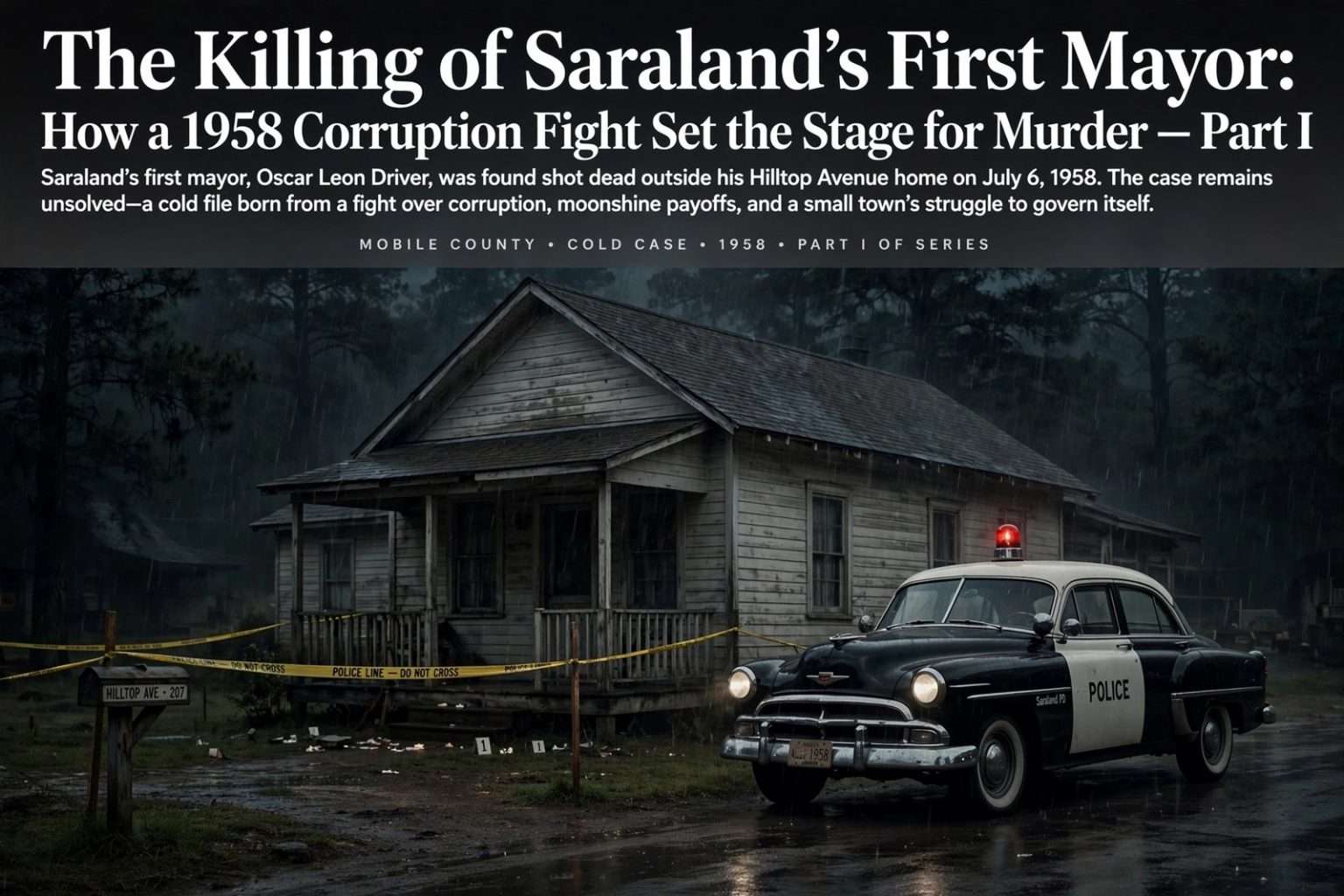
Saraland’s first mayor, Oscar Leon Driver, was found dead outside his home on July 6, 1958, in a killing that would come to be tied to a bitter power struggle between the young mayor and the town’s own police chief. Records later compiled by state and federal investigators, along with accounts from surviving relatives and townspeople, describe a town founded almost by accident, a police force accused of corruption, and a mayor who appears to have been digging into that corruption in the weeks before he died. The case became one of the most persistent cold files in Mobile County law enforcement history, surfacing in fits and starts for decades as investigators chased leads that often ran into walls of silence.
A Town Built to Escape a Beer Ban
Saraland grew out of a narrow strip of buildings along U.S. Highway 43, north of Mobile and across a bridge from Chickasaw. By the mid-1950s the area had a hunting and fishing club, a handful of gas stations and beer joints, and little formal government of its own — it fell under the jurisdiction of the Chickasaw Police Department, which opposed beer sales. According to accounts later given to investigators, residents grew tired of arrests connected to their beer joints and, in March 1955, petitioned Mobile County Probate Court to incorporate a narrow strip of land along both sides of the highway. Voters approved incorporation that April, and Oscar Driver, a longtime powerhouse foreman at the Aluminum Company of America (ALCOA) plant in Mobile, was elected the new town’s first mayor in July 1957, defeating challenger C.C. Rogers.
A New Chief, and New Suspicions
Norman “Pat” Patrick, a Prichard-area native, was hired as Saraland’s first police chief. He also held a financial stake in a local bail-bond company alongside Joe Neal, the businessman who rented the town its city hall and jail. According to accounts investigators later collected, Patrick was unhappy with his share of the bond income and his police salary, and rumors circulated that he had begun accepting payoffs tied to moonshine trafficking through the small town. Former Saraland officers told investigators that shipments of illegal whiskey were moving through the area, and that some of those involved in the trade had ties to the police chief. The arrangement, if true, would have made Patrick both the town’s chief law enforcement officer and a beneficiary of the criminal activity he was supposed to suppress.
The Mayor Begins to Ask Questions
Driver, by several accounts, began quietly pressing the chief for answers in the weeks before his death. The mayor had been hearing the same rumors about moonshine payoffs that had circulated for years, and he reportedly began keeping notes about specific incidents, including the names of people who were bringing illegal whiskey into the area and the locations where the pickups were happening. Those notes, if they still exist, have never been made public. Investigators who later reviewed the case believed that Driver’s questions had begun to alarm at least some of the people involved in the trade, including, possibly, members of his own police department.
The Night of the Killing
On the night of July 6, 1958, Driver was found dead outside his home on Hilltop Avenue. The official cause of death was a gunshot wound, and the investigation that followed produced more questions than answers. Investigators quickly developed suspicions about Chief Patrick, but no immediate arrest was made. The state Bureau of Investigation, the predecessor of the Alabama Law Enforcement Agency, took the lead on the case, working with the Mobile County Sheriff’s Office and later with federal investigators who were brought in to look at the moonshine angle.
The Investigation Drags On
What followed was a years-long investigation that touched dozens of witnesses, several of whom were reluctant to talk. Some of those witnesses later recanted statements they had given to investigators, while others simply stopped cooperating altogether. The pattern was familiar to law enforcement officers who worked moonshine and corruption cases in mid-century Alabama: the people who knew the most were often the same people who had the most to lose if the truth came out. Without a cooperative witness who could place someone at the scene of the killing, prosecutors were left with circumstantial evidence that they concluded was not strong enough to bring to trial.
What the Records Show
Records later compiled by state and federal investigators, along with accounts from surviving relatives and townspeople, describe a town that had grown faster than its ability to police itself. Saraland was small — only a few hundred residents when it incorporated — but it sat on a major highway and was close enough to Mobile to attract transient criminal activity. The police department, which consisted of the chief and perhaps one or two part-time officers, had neither the manpower nor the training to deal with the kind of organized moonshine traffic that moved through the area. The corruption allegations that swirled around Chief Patrick were part of a broader pattern of small-town police forces in Alabama being compromised by the illegal liquor trade that persisted long after Prohibition ended.
Why the Case Endures
The killing of Saraland’s first mayor has lingered in local memory for the same reason that other unresolved cases do: there is enough evidence to suspect what happened, but not enough to prove it in court. The town itself has grown enormously since 1958, expanding from a narrow strip of beer joints into a sizable Mobile County suburb with thousands of residents. The Highway 43 corridor that once defined Saraland now runs through a community that looks little like the place Oscar Driver was elected to govern. But the questions raised by his death — about who really controlled the small-town police force, about what the mayor knew and when he knew it, about who fired the fatal shot — remain part of the oral history of the community, passed down through families who lived through the early years of the town.
The legal fallout from the killing was minimal. Chief Patrick remained in office for several years after Driver’s death, and although investigators continued to develop evidence against him, he was never charged in connection with the mayor’s killing. He was eventually forced out of the police chief’s job amid continuing allegations of corruption, but he remained in the Saraland area and continued to be a presence in local affairs. Other figures implicated in the moonshine trade also avoided prosecution. The reasons for the lack of convictions are familiar from other cold cases of the era: reluctant witnesses, lost evidence, and the difficulty of building a murder case on circumstantial evidence decades after the fact.
The Federal Angle
Federal investigators became involved in the case in the early 1960s, primarily because the moonshine trade that Patrick was suspected of benefiting from crossed state lines. Agents with the federal Alcohol and Tobacco Tax Division, the predecessor of today’s Bureau of Alcohol, Tobacco, Firearms and Explosives, interviewed many of the same witnesses who had spoken to state investigators. They came away with the same impression: that the moonshine trade was real, that local officials were benefiting from it, and that the mayor had been killed because he had started to ask questions about it. But again, the evidence did not quite clear the bar needed to bring federal charges.
The Case in Retrospect
Looking back, the Driver case illustrates many of the challenges that investigators faced in mid-century Alabama when they tried to take on small-town corruption. The communities involved were tight-knit, and witnesses were often reluctant to cooperate with outside investigators for fear of retaliation. The moonshine trade generated significant cash that could be used to buy silence, and the lines between legitimate local politics and the illegal trade were often blurry. Driver, by most accounts, was an honest mayor who had tried to clean up a corrupt police department, and he paid for that effort with his life. The full story of who killed him and why may never be known. But the case remains a reminder of how difficult it was, and sometimes still is, to police the small towns that line the highways of the Deep South.
The Driver case has also become a touchstone for historians who study the moonshine era in Alabama. The illegal liquor trade persisted in many parts of the state long after Prohibition ended in 1933, and it was particularly entrenched in rural communities where state and federal law enforcement had limited reach. Mobile County, despite its urban core, had extensive rural areas where moonshine operations could flourish. The same highways that connected Saraland to Chickasaw and Mobile were used to move illegal whiskey from rural stills to urban markets. The corruption that came with that trade touched many small police departments across the region, and Saraland was not unique in struggling with how to deal with it.
Driver’s Legacy
Despite the unresolved nature of his death, Oscar Driver is remembered in Saraland as the mayor who gave the new town its first real government. The decisions he made in his brief time in office — hiring the first police chief, setting up the first town budget, organizing the first town council meetings — laid the groundwork for the community that Saraland has become. The town has honored his memory in small ways over the years, including by naming a street and a public building after him. His killing, and the failure to solve it, remains a reminder of how vulnerable small-town officials can be when they take on entrenched local interests. It is a story that residents of Mobile County’s smaller communities still tell, more than six decades after the events it describes.