The Kloud Over Mobile: How a Pakistan-Run Telecom Has Cornered the Gulf Coast
Investigative report reveals how Mobile's Kloud 7 cornered the Gulf Coast telecom market using Pakistani outsourcing (MCG Technologies) and a secret.
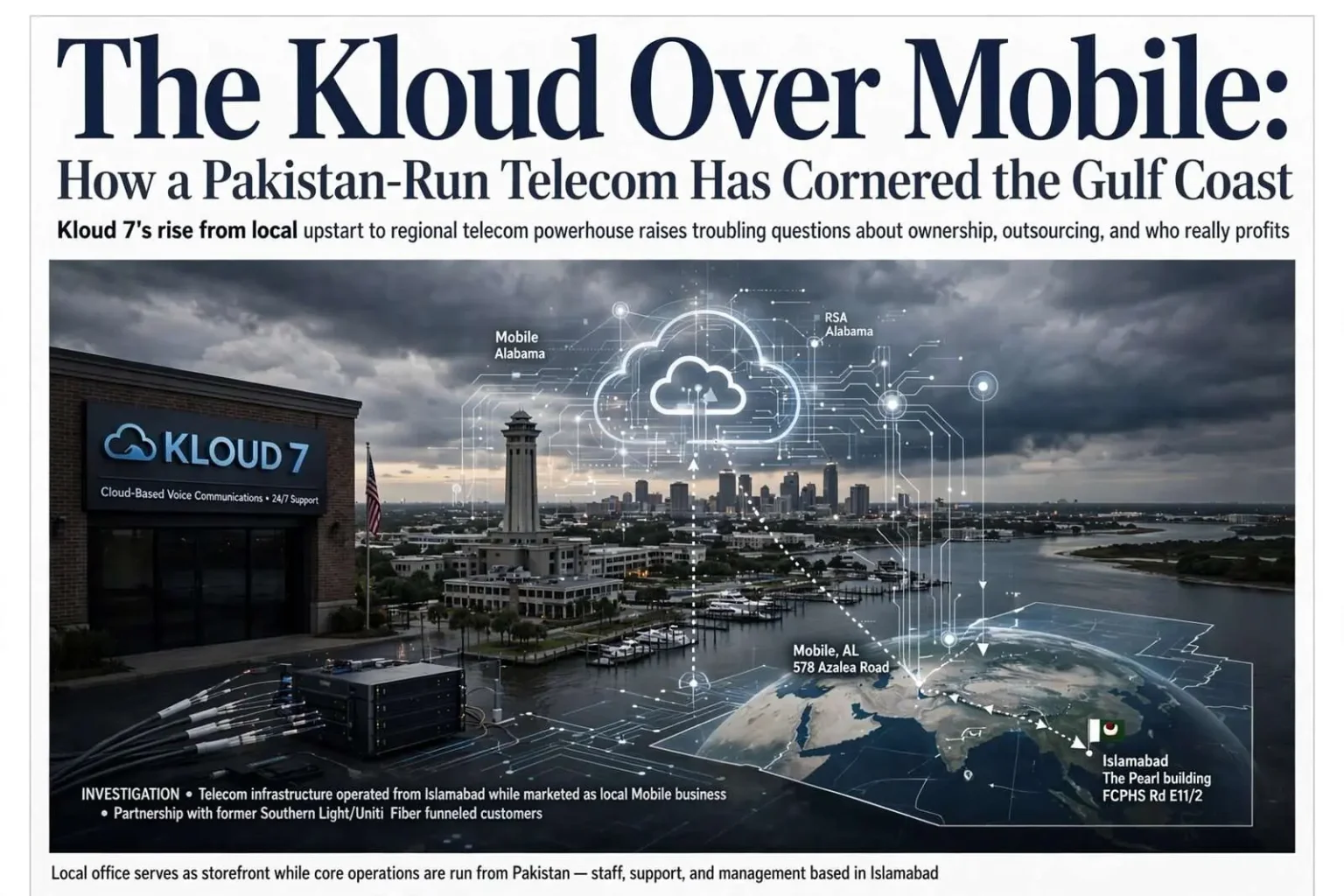
Kloud 7's rise from local upstart to regional telecom powerhouse raises troubling questions about ownership, outsourcing, and who really profits. In the parlance of modern business, Kloud 7 presents itself as a quintessential American success story. Headquartered at 578 Azalea Road in Mobile, Alabama, the company bills itself as a "global telecommunications provider" offering "full-service, cloud-based voice communications" to businesses across the United States. It has been celebrated as a Mobile Chamber Small Business of the Year Finalist, with executives actively participating in local networking events and ribbon-cuttings.
But beneath the glossy veneer of local community engagement lies a far more complicated—and deeply troubling—reality. Kloud 7 may not be the homegrown American enterprise it seems to be. It is, in large part, a Pakistan-run and Pakistan-operated company that has systematically offshored its core operations to Islamabad, while simultaneously cornering the VoIP and business phone services market in Mobile and the broader Gulf Coast region. And it has done so with a massive assist from Southern Light—now Uniti Fiber—which effectively served as Kloud 7's personal referral engine for years. The Islamabad Connection: Who Really Runs Kloud 7?
Public records and job postings paint a stark picture. While Kloud 7 maintains a modest physical presence in Mobile, its operational nerve center is thousands of miles away in Islamabad, Pakistan. The company's Islamabad office is located at "The Pearl building FCPHS Road E11/2". Job listings consistently place Kloud7's core functions in Pakistan's capital, with positions ranging from Network and System Specialists to Marketing Managers and Finance Officers.
One listing for a Marketing Manager explicitly states that the role involves managing "all marketing activities across the board brands we have, like Kloud7, MCG Technologies, and MCG Education"—all from an Islamabad office. The relationship between Kloud 7 and MCG Technologies is particularly revealing. Zulfiqar Tipu, an Associate Finance Officer, has worked at both MCG Technologies and Kloud 7, with Kloud 7 identified as "the parent organization of MCG Technologies". MCG Technologies itself openly advertises its role as the entity that "keep[s] Kloud 7 Running Smoothly – Behind the Scenes".
The company's own website declares: "At MCG Technologies, we're a tech-driven Telecom & IT solutions team powering the growth and innovation behind Kloud7". In other words, the company that presents itself to Mobile businesses as a local telecom provider is actually a Pakistani-owned and Pakistani-operated enterprise, with its parent organization and core operational staff based in Islamabad. Customer Service? That's in Pakistan, Too If you call Kloud 7 for support, there is a very good chance you are not speaking to someone in Mobile, Alabama. You are speaking to someone in Islamabad.
Background and Context
The company's job postings for Pakistan-based positions make this explicit. A "Network And System Specialist" role in Islamabad describes the position as working "as part of a worldwide professional support team" responsible for resolving "customer issues through email, phone, and remote support sessions". A "Telecommunications Network Engineer" position in Islamabad similarly involves being "a member of our worldwide professional support team" handling customer issues. Kloud 7 proudly touts its "24/7 support" as a key selling point.
What it fails to mention is that this around-the-clock coverage is achieved not through American jobs, but through a Pakistan-based workforce operating on night shifts to align with U.S. business hours. One job listing specifies timings of "7 pm to 4 am (Winters)" and "6 pm to 3 am (Summers)"—overnight shifts designed to cover the American workday. This is not merely outsourcing; this is the wholesale relocation of the company's customer-facing operations to a country on the other side of the world.
Mobile businesses calling for technical support are effectively outsourcing their IT troubleshooting to Pakistan, whether they know it or not. The Southern Light Connection: A Referral Engine That Built an Empire Perhaps the most damning chapter in Kloud 7's rise involves its relationship with Southern Light, the now-defunct fiber optic provider that was acquired by Uniti Fiber in a $700 million deal. According to multiple industry sources, Southern Light maintained a strong partnership with Kloud 7, referring virtually all of its fiber internet customers to Kloud 7 for their VoIP and phone service needs.
This referral arrangement was not a minor side deal—it was a systematic pipeline that channeled Southern Light's entire customer base directly into Kloud 7's sales funnel. Southern Light, at the time, was one of the Southeast's premier fiber optic network providers, operating more than 6,000 route miles of fiber across the region. Every business that signed up for Southern Light fiber internet was effectively handed over to Kloud 7 for voice services. This arrangement gave Kloud 7 a captive audience of high-value business customers without the need for meaningful sales or marketing efforts of its own.
When Uniti Fiber acquired Southern Light, it inherited this referral relationship. The partnership persisted, and Kloud 7 continued to benefit from the steady stream of customers delivered by one of the region's largest fiber providers. This raises obvious questions about competition and consumer choice. Were Southern Light customers informed that their voice services were being routed to a Pakistan-run company? Were they given alternatives, or was Kloud 7 the only option presented? And what exactly did Southern Light receive in return for handing over its entire customer base? A Pattern of Deception The picture that emerges seems like systematic misdirection.
Background and Context
Kloud 7 presents itself as a Mobile-based company, and it is—in the narrowest legal sense. It maintains a registered agent, William A. Donaldson, at a Mobile address. Its executives, including COO Ahmed Jalal and CTO Nick Segers, participate in local chamber events. But the company's actual operations—its support staff, its network engineers, its marketing team, its finance officers—are overwhelmingly located in Islamabad. The parent organization, MCG Technologies, is a Pakistani entity. The company's leadership structure and operational control flow from Pakistan, not Alabama. This is not necessarily illegal.
But it is deceptive, according to multiple former customers and other companies offering telecom survives in the Mobile area. When a Mobile business signs a contract with Kloud 7, it is hiring a company whose core operations are managed and staffed from Pakistan. The local office may be little more than a storefront—a facade of American presence masking a fundamentally foreign operation. The Cost of Convenience There is nothing inherently wrong with international business. Global telecommunications companies routinely operate across borders. But Kloud 7's model is different. It actively cultivates an American identity while systematically offshoring its operations.
It benefits from local goodwill and chamber of commerce credibility while directing jobs and profits to Pakistan. The Southern Light referral arrangement compounds this problem by effectively eliminating consumer choice. Businesses that chose Southern Light for fiber internet were funneled to Kloud 7 for voice services, often without meaningful alternatives. This is not competition; this is a carve-out. As Kloud 7 continues to expand its footprint in Mobile and beyond, the questions only grow more urgent: Who really owns this company? Where are its profits going?
And why is a Pakistan-run enterprise being celebrated as a pillar of the Mobile business community? The answers are not flattering. Kloud 7 has built its success on a foundation of offshore labor, opaque ownership, and a cozy referral relationship that handed it a customer base it never had to earn. Mobile businesses deserve to know who they are really doing business with. The cloud over Kloud 7 is not just in the sky—it's over the truth.
Wider Significance for Coastal Alabama
This story is part of a broader set of changes playing out across Mobile, Baldwin and the wider Gulf Coast region. Local residents, businesses and government agencies have been watching developments like this one closely, because decisions made in Mobile and Baldwin counties often ripple outward into neighboring communities across south Alabama, Mississippi and the Florida Panhandle. Public meetings, council work sessions and state legislative hearings have all carried echoes of the underlying concerns, with stakeholders ranging from neighborhood associations to industry groups weighing in on what the outcomes will mean for daily life along the Gulf Coast. Reporters and editors in the region have worked to document how these issues affect ordinary people, from commuters on Interstate 10 to families visiting the public libraries and parks that anchor so many of the Port City’s neighborhoods. The deeper context often emerges over months rather than days, as projects move from announcement to planning to construction, and as the people most directly affected find their voices in the public record. Continued coverage remains important, both for accountability and for the historical record, and the unfolding situation is one that warrants attention from anyone with a stake in the future of south Alabama.
Looking ahead, observers across the region expect the conversation to continue evolving. Local officials have signaled their intent to monitor outcomes closely, and community organizations have indicated they will remain engaged as new information becomes available. The intersection of state policy, local implementation and on-the-ground impact is precisely where stories like this one tend to develop their lasting significance. For Mobile and Baldwin residents, the practical effects will play out over time, in everything from tax bills and utility rates to traffic patterns and the availability of public services. Following the developments requires patience and attention to detail, but it is also a reminder of how civic life in coastal Alabama continues to be shaped by decisions that begin far from the neighborhoods they ultimately touch. Residents who want to stay informed can do so by following local government meetings, attending public hearings when significant issues arise, and reading the regional reporting that tracks how these stories progress from one phase to the next.
Local news organizations continue to follow this story closely, and updates are expected as more details emerge. The developments have generated discussion across the region, with attention from both longtime residents and newcomers who are following the issue for the first time. Community leaders have emphasized the importance of staying engaged with local government and participating in public meetings when significant decisions are being made. As the situation continues to unfold, residents are encouraged to remain informed through reliable local reporting and official city and county communications channels. The story remains active, and additional information is anticipated in the coming days and weeks as the relevant agencies and stakeholders complete their work.