The Legend of the Eslava Tomb: Mobile’s Coin-Leaving Curse at Church Street Cemetery
Local legend says leaving coins at Miguel Eslava's grave in Mobile's Church Street Cemetery brings luck in business, but taking them brings a curse.
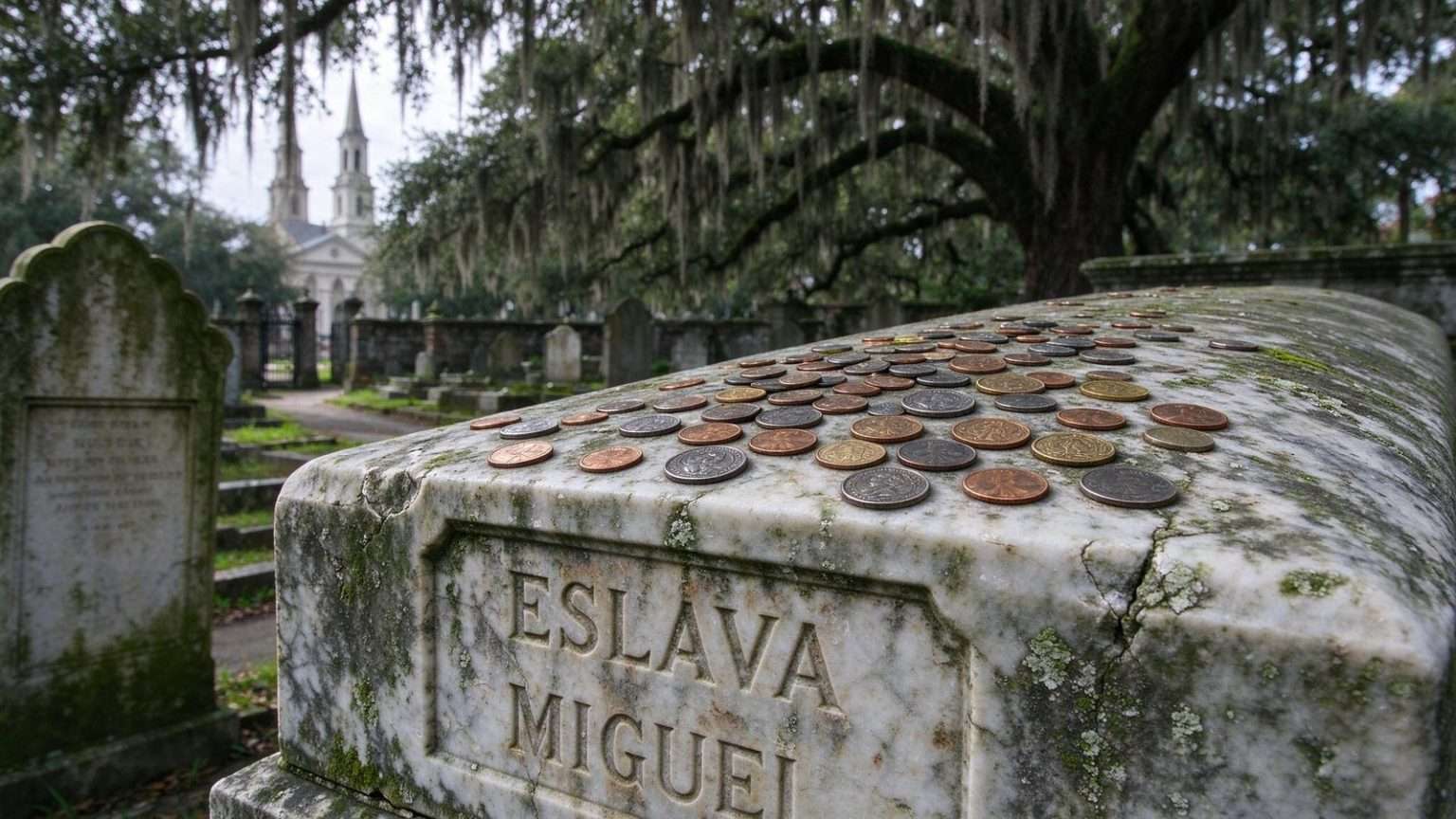
Beneath the moss-draped oaks of Church Street Cemetery in downtown Mobile lies the grave of Miguel Eslava, a Spanish colonial official who served as royal treasurer under the king of Spain during Mobile’s time as a Spanish possession. More than two centuries after his death, Eslava’s tomb has become one of the city’s most enduring pieces of local folklore.
According to long-standing local tradition, people hoping for good fortune in business can symbolically “pay Eslava’s taxes” by leaving coins at his grave. The ritual is Mobile’s own blend of history and superstition: a treasury official from the colonial era, still collecting tribute from visitors two hundred years on, in exchange for luck in the endeavors they carry with them to his resting place.
Coins for the Colonial Treasurer
Visitors to the historic cemetery have left pennies, other loose change, and even Mardi Gras doubloons on the tomb for generations, treating the ritual as a small offering for luck. The offerings accumulate quietly among the weathered stones, sometimes in handfuls after weekends and Carnival season, and the tradition has passed from one generation of Mobilians to the next without ever needing an official explanation or promoter.
There is a certain logic in the choice of Eslava for the honor. As royal treasurer, he was the man who handled the colony’s money, the official whose ledgers tracked the flow of silver and supplies through Spanish Mobile. Asking a treasurer for financial blessing — and paying him in the coin of the realm, however symbolic — follows a folk logic that outlived the empire he served.
A Curse for Taking the Coins
The legend carries a warning as well as a promise. Local storytellers say anyone who takes coins left on the tomb without returning them will be cursed with financial misfortune until the money is put back.
The tale has been passed down informally among Mobile residents and cemetery visitors, and it remains one of the better-known ghost stories associated with the city’s historic burial grounds. Like the best local legends, it enforces its own etiquette: the coins belong to the tomb and to the luck of whoever leaves them, and sticky fingers are said to answer to the treasurer himself.
Whether anyone has ever tested the curse with enthusiasm is, fittingly, a matter of the same hearsay that keeps the legend alive. The story survives because it wants to survive — a self-sustaining piece of folklore that gives every visitor a reason to participate, a reason to behave, and a story to retell on the way home.
The Cemetery That Holds Mobile’s Story
Church Street Cemetery, established in the early 1800s, is one of Mobile’s oldest cemeteries and the final resting place for numerous notable figures from the city’s Spanish, French, and early American periods. Its gates open onto a compressed history of the Gulf Coast: mayors and steamboat captains, yellow fever victims and veterans, merchants who built the city’s economy and the families who carried its culture forward.
The ground itself reflects Mobile’s layered colonial past. Few American cities have flown three national flags before joining the United States, and Mobile’s succession of French, British and Spanish rule left the community with names, customs and burial traditions that persist in places like Church Street Cemetery. Walking its rows is a tour of that succession, with surnames from every period of the city’s political life carved into tablets softened by two centuries of Gulf Coast weather.
Eslava’s role as royal treasurer places him among the officials who managed the colony’s finances during Spain’s control of the Gulf Coast, a period that shaped much of Mobile’s early civic and cultural life. Spanish administration organized the town’s commerce, land and governance during the years before the city became American, and the families who held those offices left marks on the community that outlasted the flag they served.
Mobile’s Tradition of Haunted History
The Eslava legend fits comfortably into Mobile’s broader folklore, a city whose humid streets, antebellum neighborhoods and Carnival traditions have generated ghost stories as readily as recipes. Historic cemeteries anchor much of that lore, and Church Street Cemetery in particular has long attracted visitors interested in both the history above the stones and the stories beneath them.
Ghost stories of Eslava’s kind do cultural work that formal history cannot. They attach a personal, participatory ritual — the leaving of a coin, the wish for luck — to the city’s colonial past, letting a resident who has never read a Spanish land grant touch that era in a few seconds of gesture. Children learn the story from parents, parents from grandparents, and the colonial treasurer keeps collecting his taxes in the small change of the living.
The connection to Mardi Gras deepens the legend’s local roots. Mobile proudly claims the oldest Carnival celebration in the country, and the doubloons that end up on the tomb — the aluminum tokens thrown from floats during the season — tie the grave’s fortunes to the city’s signature festival. A coin that rode a float down Government Street in February can end the season resting on the tomb of a Spanish official who died two centuries before Carnival came to town.
Visiting the Tomb
For visitors, the tomb offers one of Mobile’s most accessible pieces of living folklore: a physical object, a simple ritual and a warning tale, all within a few steps of downtown. The cemetery’s moss-hung oaks and weathered markers provide the atmosphere; the tradition provides the meaning; and the coin in the visitor’s pocket provides the participation fee.
Whether or not visitors believe in the curse, the tradition of leaving coins at the Eslava tomb has helped keep the story of Mobile’s Spanish colonial treasurer alive for new generations exploring the cemetery’s historic grounds.
That may be the legend’s real function. Eslava’s ledgers are long gone and the empire he served has vanished from the map, but on any given week new coins appear on his tomb — proof that in Mobile, history is not only remembered but paid its respects, one small piece of silver at a time. The treasurer, it seems, is still on duty, still collecting, and still, by the account of generations of Mobilians, keeping his books in order.
The story also illustrates how folklore and preservation reinforce each other. Legends like the coin tradition draw visitors to historic cemeteries, and visitors who come for the stories leave with a stake in the stones that hold them. For a burial ground that has weathered two centuries of Gulf Coast hurricanes, heat and development pressure, that stream of interested feet is more than romance — it is part of what keeps a place like Church Street Cemetery cared for, remembered and protected.
Local historians note that the distinction between the verifiable and the legendary is part of the site’s charm. The tomb is real, the official’s role in Spanish Mobile is documented, and the cemetery’s place in the city’s early American period is a matter of record. The luck and the curse belong to the other side of the ledger — the one every visitor gets to decide for themselves, with a coin in hand.
The ritual’s endurance says something about how Mobile relates to its own past. In many cities, colonial-era figures survive only as street names and museum plaques; in Mobile, the treasurer is still part of the community’s practical life, consulted by anyone starting a business, hoping for a promotion or simply trying their luck. The tradition requires no membership, no belief statement and no fee beyond the coin itself — exactly the kind of simple, open ritual that lets a story run for two hundred years.
Generations of Mobilians have their own version of the same tale, and the details shift with each telling: the origin of the custom, the severity of the curse, the fate of some named skeptic who took the coins. What never changes is the practice itself, which continues quietly at the tomb regardless of how the story is told. The consistency of the ritual, more than any single version of the legend, is what marks it as authentic folklore rather than a modern invention.
For the city’s tour guides and history teachers, the tomb provides an on-ramp to deeper subjects. A visitor who comes for the curse leaves having heard about Spanish administration, colonial succession and the city’s early burial customs — the legend is the doorway, and the history is the house behind it. Few pieces of local folklore carry that much educational freight in a single stop, which is why Church Street Cemetery remains a fixture of Mobile’s historical tourism.
The coins will keep coming, in other words, as long as the story keeps being told — and in Mobile, there is little sign of either stopping. The treasurer’s tomb remains what it has been for generations: part history, part hope, and entirely Mobile’s own.