The Western Lands to Score Soviet Silent Film ‘Aelita, Queen of Mars’ Live in Downtown Mobile
The Western Lands performed a live soundtrack to the Soviet silent film Aelita, Queen of Mars at Mobile's CLA art park on Dauphin Street in September 2013.
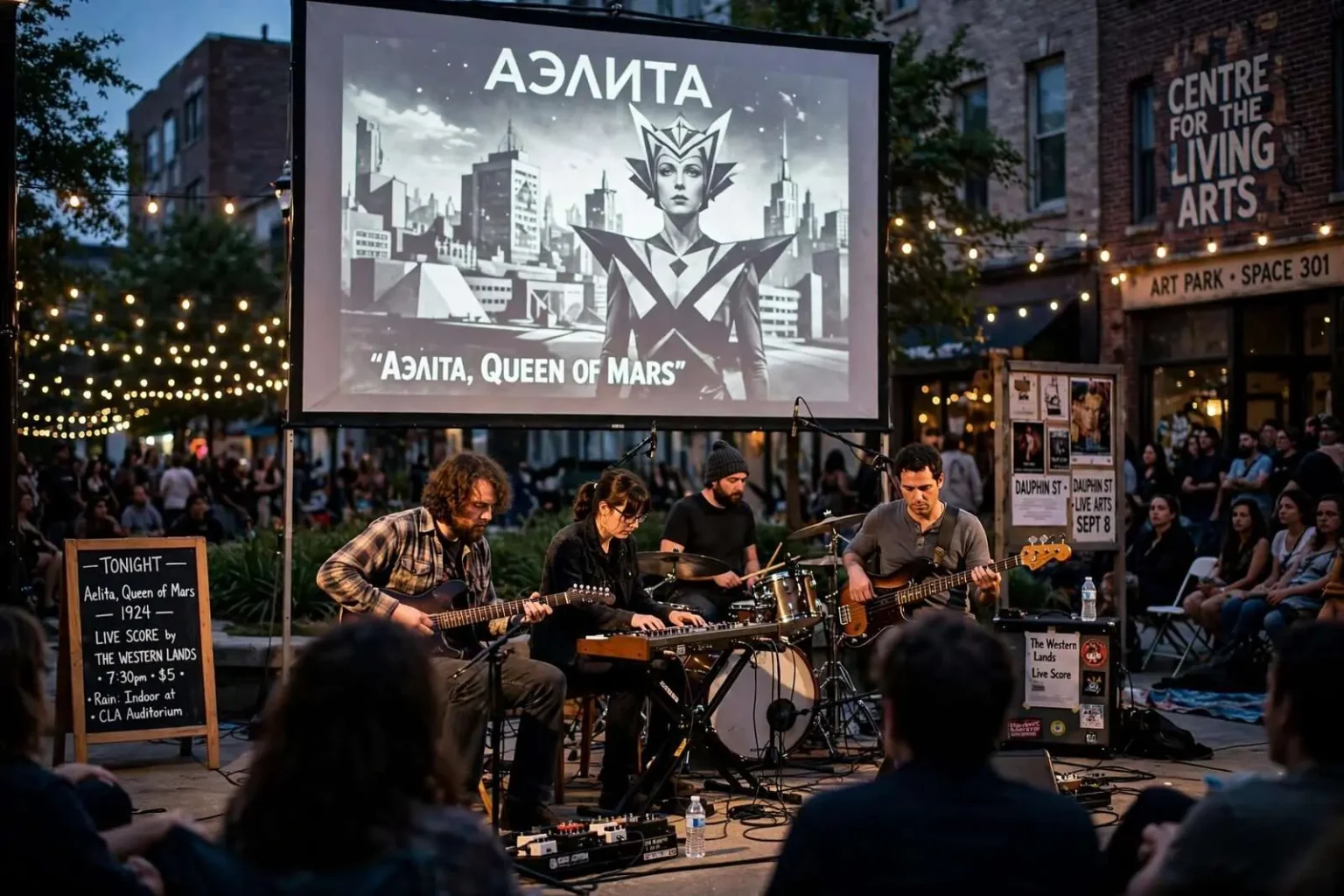
Downtown Mobile’s art scene got a one-night-only collision of cinema and live music in early September 2013, when local outfit The Western Lands performed an original live soundtrack to the 1924 Soviet silent film “Aelita, Queen of Mars” at the Centre for the Living Arts art park on Dauphin Street. The event paired one of cinema’s earliest science fiction landmarks with hometown musicians working in atmospheric territory, all in the open air in the heart of the city’s downtown entertainment district.
The screening-and-score event was set for Sunday, September 8, starting at 7:30 p.m., with the outdoor stage tucked between Webber’s and the Centre for the Living Arts. Admission was just $5, and organizers had a rain plan ready: any washout would move the show indoors to the CLA auditorium, keeping the evening intact even if Gulf Coast weather interfered.
Band member Frankie Little talked through the project ahead of the show, describing how the group built a live score to accompany the pioneering sci-fi silent film, in which a Moscow soldier’s fevered imagination carries him to a revolution on Mars. Building music for a film of that age and ambition meant treating the score as a translation exercise — taking the film’s visual language and answering it in sound, scene by scene, in real time.
The Film Behind the Event
“Aelita, Queen of Mars” occupies a significant place in film history as one of the world’s first feature-length science fiction movies, produced in the Soviet Union just a few years after the Russian Revolution. The film’s imagined Mars, with its angular, geometric sets and costumes, remains one of the most striking examples of early design-driven filmmaking, and its story of earthly disillusionment projected onto another planet anticipated themes that science fiction would explore for the next century.
Because silent films were made without synchronized soundtracks, they invite exactly the kind of reinterpretation a live performance provides. Every revival screening is, in a sense, a new production, and the musicians on stage become co-authors of the audience’s experience. That openness is what draws contemporary bands to the format — the film supplies the structure, and the score supplies the mood.
For Mobile audiences, the format also meant something rare: a chance to see a landmark of world cinema presented not as a museum piece but as living performance, with the drama on screen answered by musicians working a few feet away in the dark.
The Band and the Venue
The pairing made sense for both the band and the venue. The Western Lands have long worked in atmospheric, cinematic territory, building music that favors texture and mood over conventional song structure — the kind of material that naturally fits moving images. Scoring a silent film gave the group a framework for music that might otherwise be difficult to present on a typical club bill.
The Centre for the Living Arts, meanwhile, is the arts organization behind the Space 301 gallery on Conti Street, and it has used its Dauphin Street art park as an open-air stage for film, music and public art events aimed at pulling foot traffic back into downtown Mobile. The park sits in the middle of the Dauphin Street corridor, within easy walking distance of the restaurants and bars that anchor the city’s nightlife, making it a natural gathering point for audiences that might not otherwise step inside a gallery.
Silent Film, Live Sound
Live-scored silents were having a moment among Gulf Coast musicians in 2013, giving bands a chance to treat an album’s worth of mood-driven material as an actual film score while introducing classic cinema audiences to hometown players. The format solves a problem both art forms share: instrumental bands struggle to hold an audience’s attention for a full evening without a focal point, and classic films reach new viewers when presented with the energy of a live show.
The tradition behind the format is older than the movies themselves. In the silent era, theaters employed pianists, organists and even full orchestras to accompany films, and the practice of scoring silents live never entirely disappeared. Revival houses and festivals around the country keep the tradition alive, often inviting contemporary acts to replace the old theater ensembles with music that reflects the performers’ own generation.
Gulf Coast audiences had seen versions of the idea at venues and festivals around the region, but a full-length Soviet science fiction feature scored by a Mobile band in an outdoor art park was an unusual proposition even by the standards of an adventurous season. The choice of “Aelita” in particular — rather than a more familiar horror or comedy silent — signaled an audience trusted to follow something genuinely strange.
For five dollars, attendees got an early-fall evening of avant-garde film history in the open air, blocks from Bienville Square — the kind of experimental programming that helped mark the Centre for the Living Arts as one of downtown Mobile’s more adventurous cultural outposts.
Downtown’s Cultural Rebuild
Events like the “Aelita” screening fit into the larger story of downtown Mobile’s revival in the early 2010s. The Dauphin Street corridor had spent years rebuilding its reputation as the city’s entertainment center, with restaurants, bars and music venues drawing crowds on weekends and festivals filling the calendar. Cultural organizations worked to make sure the revival included visual art and film, not only nightlife.
Free or low-cost outdoor events were a deliberate strategy in that effort. A five-dollar admission kept the evening accessible to students and families, while the open-air setting allowed casual passersby to become an audience simply by stopping to listen — a low barrier that indoor galleries cannot match.
The collaboration between a local band and an arts organization also reflected a broader pattern on the Gulf Coast: musicians, visual artists and filmmakers pooling resources to create programming that no single group could stage alone. The result was a downtown scene that offered residents something beyond the standard concert lineup, one unusual evening at a time.
For The Western Lands, the show represented the kind of opportunity local bands rarely get — a full evening built around their own material, with a built-in narrative arc supplied by a film from 1924. For the Centre for the Living Arts, it was another demonstration that downtown Mobile would turn out for programming that took genuine creative risks.
Why Silent Film Scoring Tests a Band
Scoring a film live is one of the most demanding formats an instrumental group can take on. Unlike a typical set, the music must hit specific dramatic beats — chase, discovery, disaster, resolution — in sync with images the band does not control. There is no pausing the projector, no adjusting the setlist mid-song, and no covering a misstep with volume.
Groups that take the challenge on usually prepare by watching the film repeatedly, mapping scenes to musical passages and rehearsing transitions until the score flows like a single extended composition. The best live scores feel improvised but are heavily charted, with room left for the performers to respond to the audience’s energy.
Little’s description of the process suggested The Western Lands approached “Aelita” in that spirit — building a score that would carry the audience through the film’s strange journey from Moscow to Mars without simply decorating the images. The band’s strengths in sustained, evolving arrangements made the assignment a natural fit.
The Space 301 Connection
The Centre for the Living Arts’ work at Space 301 on Conti Street gave the organization a regular downtown presence, and the Dauphin Street art park extended that reach outdoors. Using both spaces allowed the organization to program a range of events — gallery exhibitions on one block, performances and screenings on another — and to cross-promote between audiences.
For a September Sunday evening, the art park setting offered its own appeal. Early-fall weather on the Gulf Coast begins to loosen its grip after Labor Day, making outdoor evenings pleasant again after the long humid summer, and downtown’s street grid keeps the park connected to the surrounding nightlife.
Attendees could make a full evening of the outing: dinner downtown, the 7:30 p.m. screening at the park, and the bars and cafes along Dauphin Street afterward. That walkability was part of the pitch organizers made all along — downtown Mobile as a place where arts events anchor a broader social scene.
The one-night-only format also created its own urgency. With no second performance and only a modest admission price, the event rewarded those who paid attention to the local arts calendar, and it gave the CLA another data point in its case that adventurous programming could draw a real audience downtown.
A Lasting Model for Local Programming
The economics of an evening like the “Aelita” screening made sense for every party involved. The band gained a high-profile showcase for its original material, the venue gained a distinctive event for a small fraction of the cost of booking a national act, and audiences gained an experience unavailable anywhere else on the Gulf Coast that weekend.
For local musicians, projects like this one also build skills that transfer back to ordinary shows. Arranging for drama, listening across an ensemble and holding an audience for a full evening are exactly the disciplines that make a band stronger, and bands that have scored a film tend to bring that ambition to their regular repertoire.
For the city, each such event added to the accumulating case that downtown Mobile’s revival would be cultural as much as commercial — that the restaurants and clubs would be matched by galleries, screenings and performances giving people more reasons to come downtown and stay late.