Thieves Smash Into Mobile Charitable Pharmacy, Make Off With $120
Thieves used a chunk of concrete to smash into Ozanam Charitable Pharmacy in Mobile, stealing $120 from the donation box.
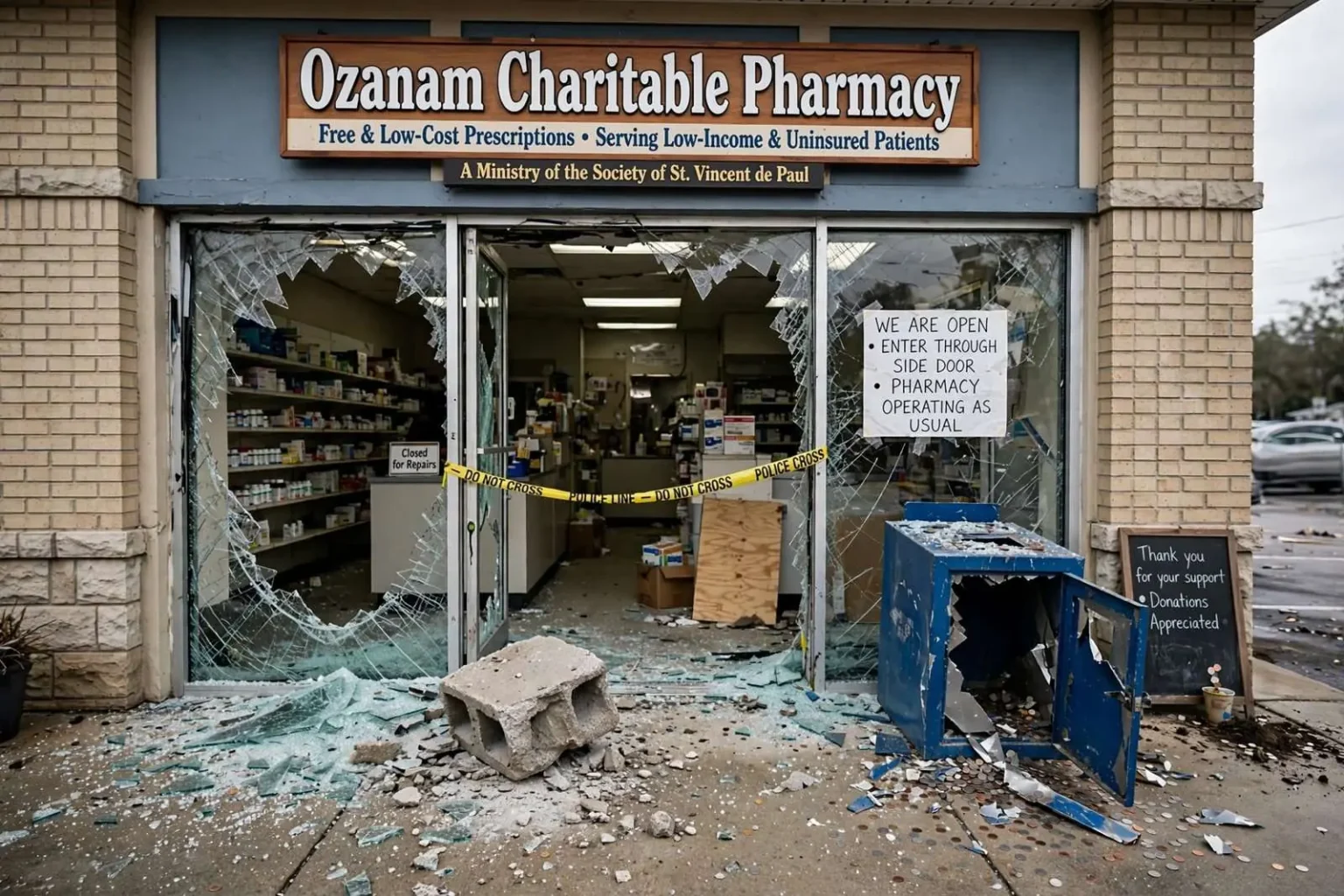
MOBILE, Ala. — A nonprofit pharmacy that provides medication to people who cannot afford it is now covering the cost of its own repairs after an overnight break-in in Mobile. Someone hurled a large piece of concrete through the glass door of Ozanam Charitable Pharmacy, shattering the entrance, and once inside, the intruder smashed the facility’s donation box and made off with roughly $120, according to the organization.
The damage far exceeded the take. For a charitable operation, even a small loss stings: beyond the stolen cash, the pharmacy is left paying to replace a heavy commercial glass door, an expense the nonprofit absorbs directly out of the budget that would otherwise go toward its mission. No medications were reported taken in the incident, which spared the pharmacy its most valuable inventory — and spared its patients any interruption in the prescriptions they depend on.
Ozanam Charitable Pharmacy serves low-income and uninsured patients across the Mobile area, filling prescriptions for people who would otherwise go without medications for chronic conditions, infections, and other illnesses. The donation box targeted by the thieves supports that mission directly, collecting contributions from visitors and supporters who stop by the facility. The organization said it planned to continue operating while repairs were made, and staff worked around the broken entrance to keep serving patients in the days that followed.
What Ozanam Charitable Pharmacy Does
Charitable pharmacies occupy a specific niche in the American health care landscape, and Ozanam’s is a Mobile example of the model. These organizations exist for the large population of people who fall between the supports of the health system — those who have no insurance, or insurance that does not cover their medications, and whose incomes are too low to absorb the full retail price of prescription drugs. A charitable pharmacy obtains medications at reduced cost through assistance programs, manufacturer donations, and bulk purchasing, then dispenses them to qualifying patients free or at nominal cost.
The patients such a pharmacy serves are often managing exactly the conditions for which a missed prescription is most dangerous: diabetes, high blood pressure, heart disease, asthma, and mental health conditions. Studies of medication access have repeatedly shown that cost is one of the leading reasons patients skip doses or fail to fill prescriptions, and the consequences land in emergency rooms across the country. By covering the gap, a charitable pharmacy prevents those downstream costs — which is also why an expense as ordinary as a broken door matters more to such an operation than it would to a commercial business.
A Costly Break-In
The arithmetic of the break-in illustrates the imbalance. The intruder took roughly $120 from the donation box — real money to a nonprofit, but a small fraction of the cost of replacing a heavy commercial glass door, which must be ordered, fitted, and installed by a glass contractor. Commercial door replacement of that kind typically runs to hundreds or thousands of dollars, and until the new door was in place the pharmacy had to secure its entrance some other way while remaining open to patients.
The loss also carries a less measurable cost: the donation box is a public gesture of support, and its destruction in a break-in lands on an organization whose resources are already stretched. Nonprofits that operate pharmacies rely on a mix of grants, donations, and volunteer labor, and unexpected expenses compete directly with medications. The organization’s statement that it would continue operating while repairs were made was, in effect, a message to its patients: the mission continues, whatever the entrance looks like.
Charity Pharmacy and Its Namesake
The Ozanam name ties the Mobile pharmacy to a wider Catholic charitable tradition. The organization takes its name from Blessed Frederic Ozanam, the 19th-century French scholar who founded the Society of St. Vincent de Paul, one of the oldest lay charitable organizations in the world. St. Vincent de Paul conferences and councils operate across the United States, running food pantries, thrift stores, rent and utility assistance programs, and specialized ministries like pharmacy services — and the Mobile pharmacy stands in that lineage, serving the city’s poorest patients regardless of the details of their circumstances.
The pharmacy’s work fits within Mobile’s broader safety net of clinics and charitable providers, a network that includes community health centers, free clinics, and church-based ministries. Within that network, medication access is a persistent weak point: clinics can see patients and diagnose illness, but if the patient cannot afford the prescription, the visit’s benefit stops at the door. Organizations like Ozanam exist to close that specific gap, and their dispensing records tell a story of chronic illness managed one filled prescription at a time.
How Break-Ins Affect Nonprofits Differently
A break-in at a commercial business is absorbed by a company’s margins; a break-in at a small nonprofit is absorbed by its mission. The differences run through every layer of the aftermath. Insurance deductibles that a business shrugs off can exceed a small charity’s monthly discretionary budget. The donation box that was smashed is not a minor convenience but a stream of contributions — and its loss, even temporarily, cuts off the simplest way visitors have of supporting the work. And the staff time spent dealing with police reports, insurance claims, and contractors is staff time not spent helping patients.
That is why the community response to such incidents matters disproportionately for organizations like Ozanam. A break-in that becomes known in the neighborhood often draws replacement donations from people moved by the story, and the pharmacy’s supporters in Mobile’s Catholic and civic communities have historically been the base that carries it through shortfalls. The stolen $120 and the broken glass were the incident’s costs; the response of donors and volunteers is what determines its lasting effect.
Prescription Theft: Why It Didn’t Happen Here
One detail of the break-in stands out to anyone familiar with pharmacy security: no medications were reported taken. Pharmaceutical theft is a serious category of crime — controlled substances carry black-market value, and pharmacy burglars frequently target drugs rather than cash. Pharmacies respond with time-delay safes, alarm systems, cameras, and vault storage for controlled medications, and pharmacists are trained to limit quantities on hand that would make a burglary profitable.
At a charitable pharmacy, the medication inventory is largely the same stock of maintenance medications — blood pressure pills, diabetes drugs, inhalers, antibiotics — that has limited street value, and controlled substances are typically secured in ways that make them an unattractive target. The intruder who came through the shattered glass door went for the donation box instead, which may say something about the opportunistic nature of the break-in: a smashed box and a jar of cash, not a planned heist of the pharmacy’s stock.
The Security Aftermath
After an incident like this one, the practical response follows a routine familiar to any small organization that has been broken into. Police take a report and document the scene, including the concrete that was thrown through the door — the tool of the break-in itself. The organization assesses whether anything beyond the door and donation box was damaged, reviews its security, and arranges the replacement of the entrance. Glass contractors can board up or temporarily secure a doorway within hours, but the permanent replacement of a commercial door assembly — frame, glass, hardware, and lock — takes days to order and install.
In the interim, the pharmacy continued operating, seeing patients and dispensing medications through a secured entrance. The organization’s decision to keep its doors open — in whatever condition — reflected the nature of its work: its patients include people managing chronic illness for whom a missed refill is not an inconvenience but a health risk, and a day of closures would have meant triage at clinics and emergency rooms across Mobile that serve the same population.
The Population Ozanam Serves
The pharmacy’s patients reflect the economics of health coverage in Alabama, a state that for years had one of the nation’s higher rates of uninsured residents. In Mobile, the people who qualify for charitable pharmacy services include the working poor whose jobs do not offer insurance, residents between jobs, and people whose conditions make insurance unaffordable on the individual market. For many of them, a charitable pharmacy is the difference between taking a medication consistently and rationing it — splitting pills, skipping days, or simply going without.
The donation box the intruder smashed supported precisely that work. Contributions of that kind — small, voluntary, and collected at the site — are the visible edge of a funding structure that also includes grants, church support, and larger gifts. The box’s destruction interrupted one small channel of that support, and the theft of roughly $120 removed a modest sum from a budget where every dollar maps to medication for a patient who cannot pay.
Continuing the Mission
The pharmacy’s response to the break-in — repair the door, keep serving patients, and carry on — matched the temperament that charitable operations must have to survive. Break-ins, thefts, and vandalism are among the ordinary hazards of running a facility that serves the public in an urban neighborhood, and organizations like Ozanam absorb them the way they absorb every other setback: by continuing the work the donations were given to support.
For Mobile’s low-income and uninsured patients, the practical effect of the incident was negligible only because the organization refused to let it be otherwise. No medications were taken, the prescriptions kept flowing, and the glass door was replaced in time. The thieves who hurled the concrete got roughly $120 from a smashed donation box; the cost of the door came out of a mission budget; and the pharmacy that serves people who cannot afford their medication went on doing what it does — a small, stubborn continuity that the break-in disrupted for a few days and could not stop.