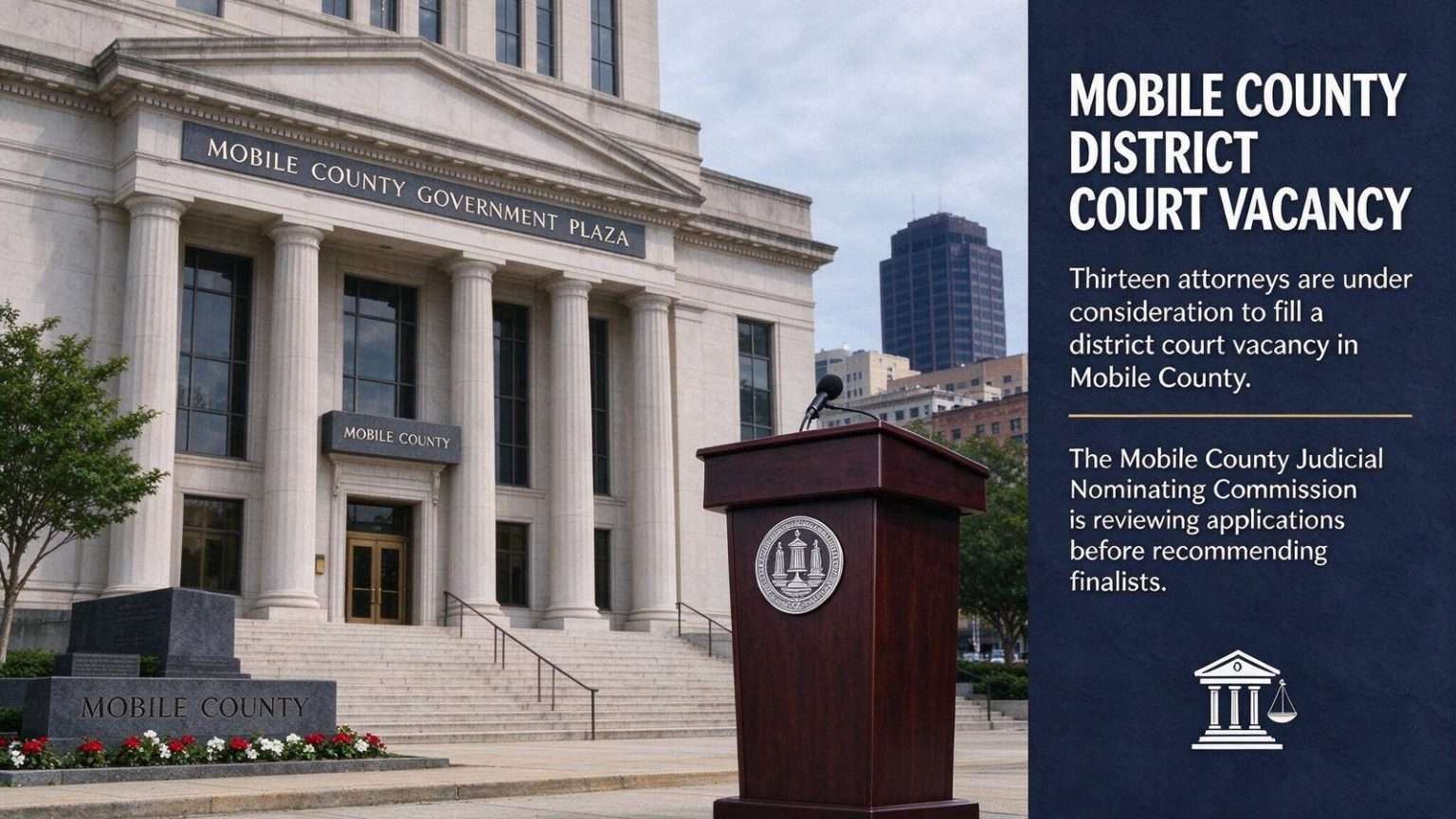
Thirteen attorneys are now under consideration to fill a vacancy on the Mobile County District Court bench, a seat left open after Judge Jill Phillips was recently appointed to the Circuit Court. The Mobile County Judicial Nominating Commission will review the full slate of candidates before recommending finalists to fill the position. The outcome will decide who occupies one of the busiest trial court seats in a county that, as the home of Mobile and a string of suburban communities stretching to the Mississippi line, generates one of the heaviest court dockets in the state of Alabama.
The vacancy traces back to Phillips’ elevation from the District Court to the Circuit Court, a move that left her former district seat open and set the formal selection machinery in motion. When a district judgeship opens mid-term in Alabama, it does not go before voters immediately; instead, a judicial nominating commission vets applicants and forwards a short list of finalists to the appointing authority. That structure is meant to ensure that whoever takes the bench is qualified on paper and vetted in practice before ever hearing a case.
The Mobile County Judicial Nominating Commission will now take up that work. Its members are tasked with reviewing applications, weighing each candidate’s legal experience and temperament, and narrowing a field of thirteen down to a small group of finalists. The commission’s review is confidential in its internal deliberations, but the breadth of the applicant pool has been made public, and it offers a window into how sought-after the seat is among Mobile’s bar.
A Pool of Thirteen
The full list of candidates includes Carvine Adams, Edward Carter Blount Jr., Sondra Annette Dempsey, Grant William Gibson, Lars T. Granade, Carol Carr Little, Melinda Lee Maddox, Edward Russell March III, Charles Zackery Moore, David Rankin Quittmeyer, Derrick V. Williams, John Conrad Williams and George Michael Zoghby.
The thirteen names represent a cross-section of the local legal community. Several of the applicants have previously sought judicial office: two ran unsuccessfully for a district judge seat in the past, one previously lost a bid for a circuit judge position, and one is a current associate municipal judge. The rest of the pool is made up of first-time applicants, giving the commission a mix of attorneys who have already stood before voters and lawyers who would be stepping into the public arena for the first time.
That blend matters. Candidates with prior campaigns arrive with name recognition and a public record of positions, while first-time applicants often bring deep practice-area experience without the baggage of past races. For a trial court seat that handles everything from misdemeanor arraignments to small claims disputes, the commission has said little publicly about what weight it gives to courtroom experience versus broader legal backgrounds, but the range of the pool ensures it will have real choices to make.
The Commission Doing the Vetting
The Judicial Nominating Commission reviewing the applications includes Mobile County Circuit Court Judge Michael Youngpeter, along with attorneys Peter Mackey and Warren Butler, and commission members Jamie Ison and Deloris Bagsby. The composition reflects the blend that Alabama law traditionally builds into these bodies: a sitting judge, practicing members of the bar, and lay members drawn from the community.
Jamie Ison is a former member of the Alabama House of Representatives who represented a Mobile-area district, and her presence on the panel gives the review a legislative and community perspective alongside the legal one. Deloris Bagsby adds a further civilian voice to the deliberations. The two practicing attorneys, Mackey and Butler, are positioned to evaluate the professional qualifications of the applicants with an insider’s understanding of the local bar, while Judge Youngpeter brings the view from the bench itself, having handled the kind of docket the new judge will inherit.
Commissions of this kind operate largely out of public view once applications close. Members receive the applicant files, may conduct interviews, and deliberate on which candidates advance. The finalists they recommend move forward in the appointment process, while the remaining applicants return to private practice and, in some cases, to future races for the bench.
A Public Voice in a Private Process
As part of the vetting process, members of the public were invited to submit confidential comments about any of the candidates to the commission through Feb. 13. The comment window gave residents, attorneys, and anyone with direct knowledge of an applicant’s professional conduct a direct, if private, channel into the selection process.
Confidential comment periods are a standard feature of judicial vetting in Alabama. They allow people who might be reluctant to speak publicly about a colleague, an opposing counsel, or a former lawyer to share relevant information with the commission without fear of exposure. For a seat like this one, where the eventual judge will sentence defendants, rule in family and civil disputes, and interact daily with the public, that input can be a meaningful part of the commission’s evaluation.
The Feb. 13 deadline has now passed, and the commission’s work moves into its next phase. Once the confidential comments have been reviewed alongside the applications, the panel can begin narrowing the field and identifying the finalists it will recommend.
What the Job Involves
District Court judges in Mobile County handle a broad range of matters, including misdemeanor criminal cases, traffic violations, small claims and preliminary hearings in felony cases before they move to Circuit Court. The position is, in practical terms, an entry point into the local justice system for many residents: the first courtroom a defendant sees after an arrest, the forum where a landlord-tenant or small claims dispute is decided, and the place where thousands of traffic cases are resolved each year.
Preliminary hearings give the district seat particular importance in serious criminal matters. When someone is charged with a felony in Mobile County, the early stages of that case pass through District Court, where a judge determines whether enough evidence exists to bind the case over to a grand jury and the Circuit Court. The quality and temperament of the judge holding those hearings shapes how cases move through the system long before they ever reach a trial court.
Small claims jurisdiction brings residents into the courtroom in a different way. Disputes over debts, damaged property, and consumer matters that fall below the dollar threshold for Circuit Court are heard in District Court without the expense of full-scale litigation, and many litigants appear without a lawyer. A judge in this seat must be able to move cases efficiently while keeping the proceedings understandable to people who have never set foot in a courtroom before.
How Judicial Selection Works in Alabama
The process of filling this vacancy underscores how judicial nominating commissions work in Alabama, relying on public input and a vetting process involving both sitting judges and practicing attorneys before a final appointment is made to the bench. Rather than an immediate special election, mid-term vacancies are filled through this structured review, which is designed to put a qualified successor on the bench quickly while preserving the public’s eventual say at the ballot box.
Alabama’s courts are organized so that each county’s District and Circuit judges serve defined terms, and when a seat opens between elections, the appointment mechanism bridges the gap. The nominating commission’s recommendation list is the hinge of that process: it is the point at which a field of applicants becomes a short list, and it is where the bulk of the scrutiny happens. Once finalists are forwarded, the appointment can be made, and the new judge takes the bench subject to the next election cycle.
For Mobile County, the stakes are practical as much as symbolic. The county’s District Court is among the busiest in Alabama, serving a population that includes the city of Mobile, Semmes, Prichard, Chickasaw, Saraland, Satsuma, Creola, Mount Vernon and the unincorporated communities in between. Every misdemeanor arrest, every contested traffic case, and every small claims filing routes through judges in this court, and a vacancy adds to the load carried by the remaining bench.
The commission has not announced a timeline for forwarding its finalists, and no date has been given for when the appointment will be finalized. What is clear is the scale of the choice before it: thirteen attorneys, a range of prior campaign experience, a completed public comment window, and a five-member panel charged with sending forward the names it believes can carry the docket. When the decision comes, the newest member of the Mobile County District Court bench will step into a courtroom that touches more everyday residents than almost any other judicial office in southwest Alabama.
Attorneys and residents watching the process can expect the next public sign of progress to come when the commission’s recommendation list is finalized and forwarded. Until then, the thirteen applicants remain in a holding pattern, and the seat remains filled by the court’s remaining judges, who continue to absorb the docket while the selection runs its course.