Thomasville Library Closes Dinosaur-Themed Summer Reading Program
The Thomasville Public Library wrapped up its dinosaur-themed 2026 Summer Library Program, which offered nine weeks of reading, workshops and a food giveaway serving 1,055 families.
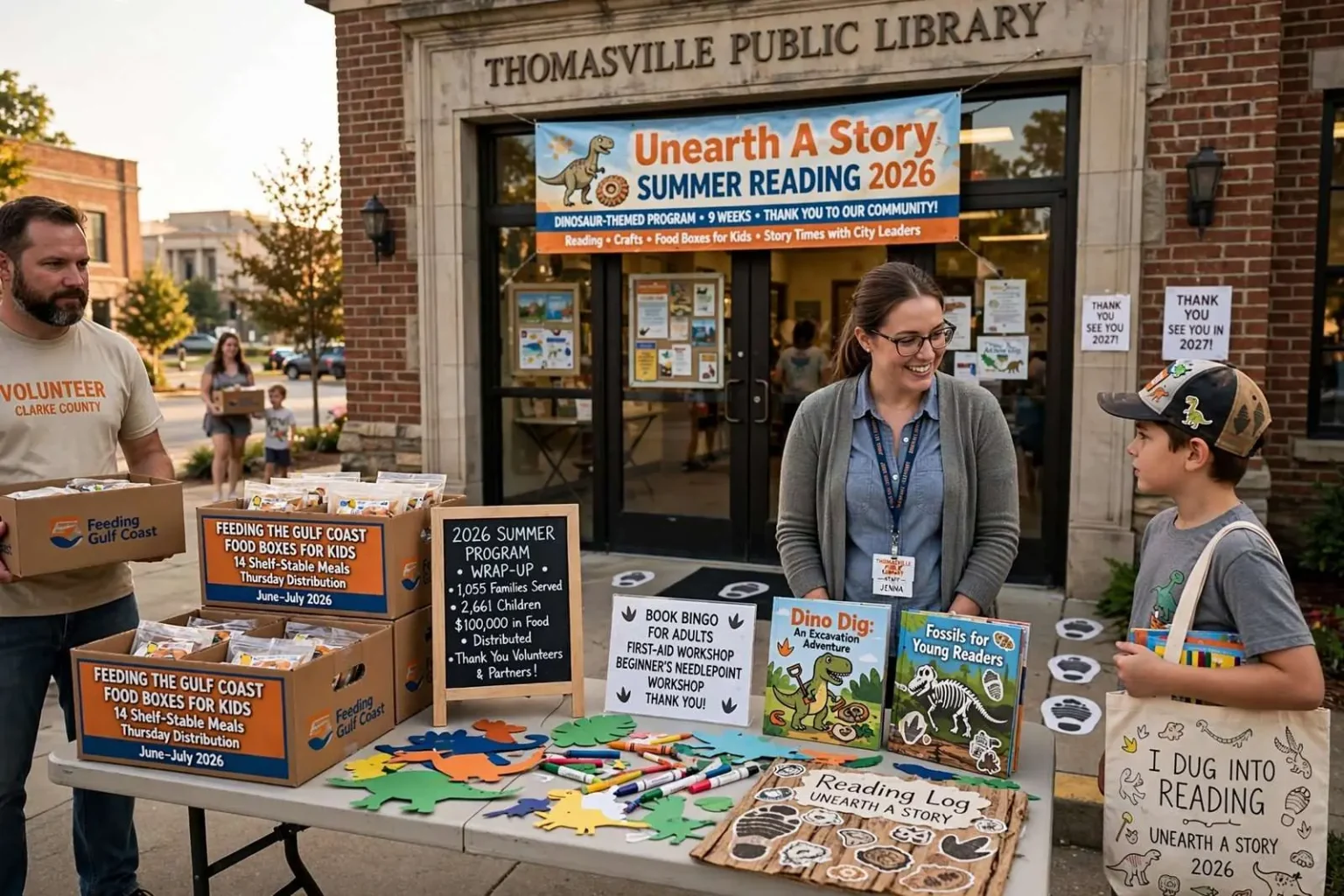
The Thomasville Public Library’s 2026 Summer Library Program, which closed in July, offered a range of events, activities and prize opportunities for children and adults. The dinosaur-themed program, titled “Unearth A Story,” encouraged attendees to explore new ways to fall in love with reading and their local library. For a small-town library in Clarke County, the summer program is the biggest thing on the calendar — weeks when the building hums with children, the staff runs at full sprint, and the community’s collective attention turns, briefly and happily, to the library shelves.
The dinosaur theme gave the whole season a unifying idea that librarians could hang everything on: story times about fossils and prehistoric creatures, crafts with scales and claws, and a name — “Unearth A Story” — that treated reading itself as an excavation, with treasures waiting under the surface for anyone willing to dig. It is the kind of packaging that turns a reading log into an adventure, and it worked.
Nine weeks of activities
For nine weeks, children read for prizes, listened to city leaders during story time, attended multiple family-friendly events at the civic center and took part in games, crafts and obstacle courses at the library. The rotation kept the summer moving: prize incentives gave young readers a reason to keep the books open, while the visiting story-time readers — local leaders taking turns behind the picture books — connected the library to the rest of the town in a way no poster can. When the mayor or a council member reads to a room of children, the children notice, and so do their parents.
The obstacle courses, games and crafts gave the program the physical, social side that keeps children coming back week after week. A summer reading program that only measures pages can lose its audience by July; one that also promises something to do and someone to see holds them. The civic center events scaled the program up beyond what the library building can hold, giving families a bigger stage for the program’s biggest moments.
Adults in the program too
Adults played Book Bingo in June and July for a chance to win prizes. The inclusion of adults is deliberate and important: summer programs that treat the library as a children’s-only space miss the readers who fund it, volunteer in it and model reading for the children in it. Book Bingo turns adult summer reading into a game — fill squares with titles across genres, and compete for prizes through the summer’s length — and it fills the library with grown-up readers during the same weeks the children’s programs are running.
The library also hosted its first basic first-aid training workshop in June and a beginners’ needlepoint workshop in July. Both additions show a small library stretching beyond books into the skills-and-community role that modern libraries increasingly fill. A first-aid workshop puts genuinely useful knowledge in the neighborhood’s hands; a needlepoint class builds a craft community in a room full of conversation. Neither requires a large budget, and both deepen the library’s claim to be the town’s living room.
Food Boxes for Kids
For the second consecutive year, the library hosted the Food Boxes for Kids weekly giveaway provided by Feeding the Gulf Coast Food Bank. The library distributed 14 shelf-stable meals in each food box on Thursdays throughout June and July. When school lets out for the summer, the cafeteria meals that many children count on disappear, and food banks across the country scramble to fill the gap. In Thomasville, the answer runs through the library — a building families already trust and visit, open on a predictable schedule, with the boxes handed out on Thursdays like clockwork.
The shelf-stable format is what makes the program work in a small town. Meals that need no refrigeration and minimal preparation can go wherever the family’s week takes them — to a grandparent’s house, a babysitter’s kitchen, a late shift’s leftovers reheated at night. Fourteen meals per box roughly covers two weeks of school-day lunches for one child, and the Thursday distribution through June and July spans the heart of the summer gap.
The numbers behind the need
The program saw an increase in participation, serving 1,055 families, including 2,661 children, and distributing $100,000 in food products. Those figures put the program’s scale in perspective: more than a thousand families served in a single summer, by a single distribution site, in a county whose total population is a fraction of that number. The year-over-year increase in participation reflects both growing need and growing trust — families return to a program that works, and they tell their neighbors.
The $100,000 in food products is the measure of the material effort behind the giveaway. Feeding the Gulf Coast, the regional food bank that supplies the boxes, moves donated and purchased food through its warehouse network to distribution partners across the central Gulf Coast, and community sites like the Thomasville library are the last mile of that chain. Without the local host, the boxes do not reach the children; the library’s parking lot on a Thursday in June is where a regional hunger-relief system actually touches a family.
Why the library
There is a reason the food boxes and the summer reading program share a roof. Libraries are among the most trusted and least intimidating public institutions in small towns — no eligibility paperwork to navigate at the front desk, no appointment needed, and a staff that knows its regulars by name. Pairing hunger relief with reading programs means a family that comes for food boxes walks past the children’s books, and a family that comes for story time sees the Thursday distribution. Each program strengthens the other.
The model also lightens the load on a small staff. A distribution that runs alongside an existing, busy summer schedule requires planning and volunteers, but it uses a building and an audience that already exist. In Clarke County, where distances are rural and transportation is not always easy, putting the food where the families already go is the difference between a program that reaches children and one that exists on paper.
A summer that added up
Put the pieces together and the scale of the library’s summer becomes clear: nine weeks of children’s programming under the “Unearth A Story” banner, story times with city leaders, civic center events, obstacle courses and crafts, Book Bingo for adults, a first-ever first-aid workshop, a beginners’ needlepoint class, and fourteen Thursday food distributions serving 1,055 families, 2,661 children and $100,000 in food. Any one of those lines would be a respectable season for a small-town library; together they amount to the library functioning as the center of community life for a full season.
The dinosaur theme may get the credit for the fun, but the underlying achievement is organizational. A summer like this one is planned months in advance, staffed through creative scheduling, and carried by volunteers and partners — the food bank, the civic center, the city leaders who sat down to read. Small libraries do not have large budgets; they have relationships, and the 2026 summer program is what those relationships look like when they are used well.
What the program means for Thomasville
For the town, a strong summer library program is an investment that compounds. Children who read for prizes in June return to school in August closer to grade level than they would have been otherwise; families that count on Thursday food boxes get through the summer with one less worry; adults who learned first aid or took up needlepoint found the library to be a place for them, not just their children. Each effect is modest on its own, and together they explain why small towns fight to keep their libraries strong.
The second year of Food Boxes for Kids suggests the pattern will hold. Programs that survive their first summer and grow in their second become fixtures, and fixtures change what a community expects from its institutions — in the best way. Thomasville families now have two consecutive summers of evidence that the library will feed their children on Thursdays and entertain them every week in between.
Looking to next summer
The 2026 program closed in July, and the library’s attention now turns to the school year ahead — and, quietly, to planning next summer. The organizers have a proven template: a theme that carries the season, a nine-week structure that families can plan around, adult programming that runs in parallel, and the food distribution that anchors the whole effort in the community’s real needs. Whatever theme lands on the 2027 posters, the bones of the program are in place.
For now, the numbers stand as the summer’s report card: 1,055 families, 2,661 children, $100,000 in food, nine weeks of reading and games, two new workshops, and a dinosaur theme that made an excavation of every library card. The Thomasville Public Library’s “Unearth A Story” summer dug up something more lasting than fossils — it uncovered, again, how much a small library can do when the town shows up to use it.