Thomasville Mayor Asks Governor to Secure Parole Transition Center or Close It
Mayor Sheldon Day asked Gov. Kay Ivey to secure or close Thomasville's LifeTech Transition Center after repeated walkaways and nearby home break-ins.
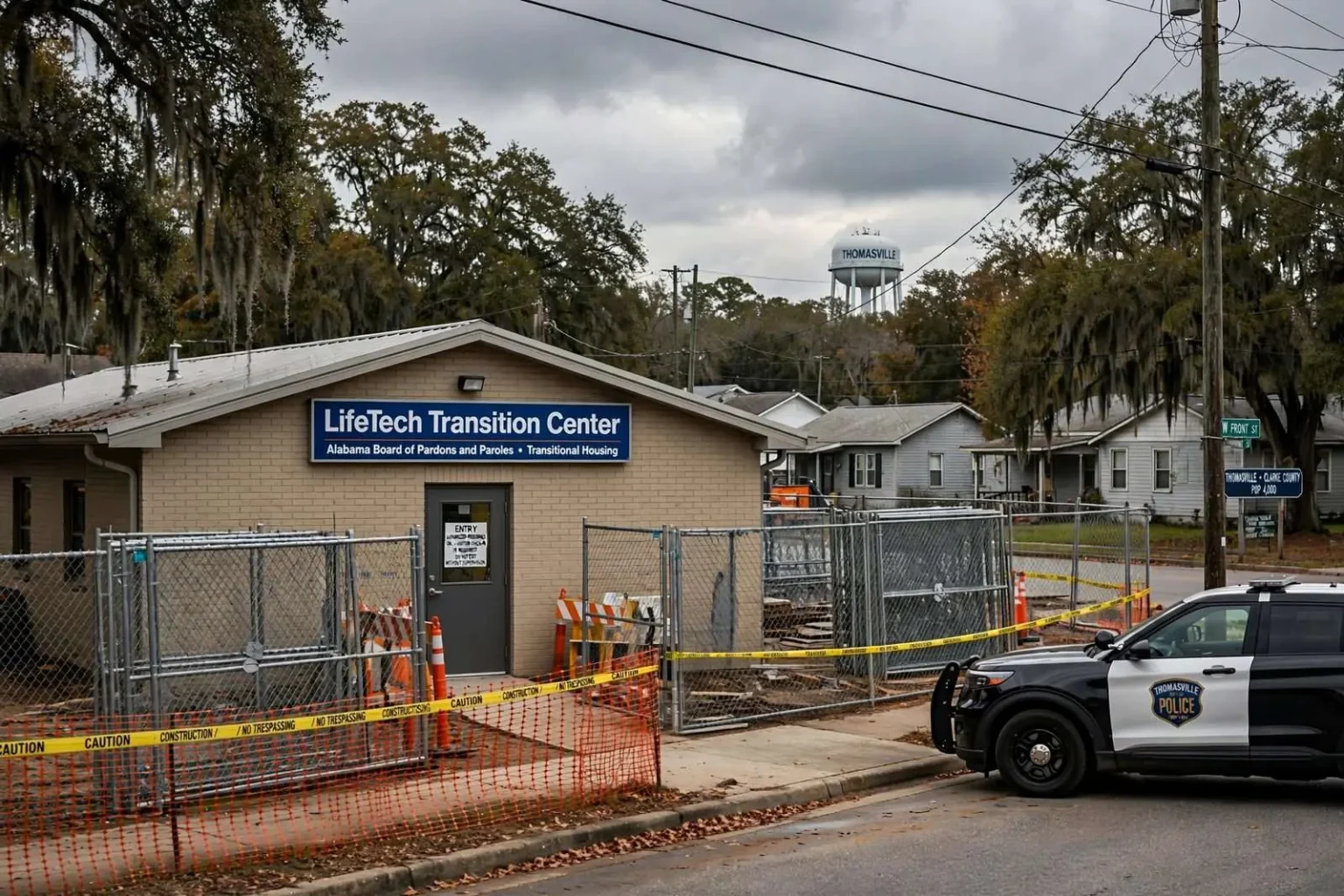
Thomasville Mayor Sheldon Day has asked Gov. Kay Ivey to step in and secure the LifeTech Transition Center in his city, saying repeated walkaways from the facility have put nearby neighborhoods at risk.
The center, run by the Alabama Board of Pardons and Paroles, houses people released on parole as they transition back into the community. Facilities of this kind are intended to provide structure — housing, supervision and program requirements — during the delicate period when a person has left prison but has not yet rebuilt an independent life.
Day said the city has dealt with multiple incidents over the past two years in which residents of the program simply left the property, walking away from a facility that was supposed to be monitoring them. Each walkaway sets off a search, rattles nearby residents and raises questions about how the state is running a program it placed in Thomasville.
Break-ins near the facility
According to the mayor, there have been several home invasions in neighborhoods around the center. Police Chief Mitchell Stuckey confirmed that in at least one case a program resident entered a home overnight, an admission that transformed the city’s concern from an abstract worry about supervision into a documented crime affecting a family in the community.
Day said state officials in Montgomery agreed in April to improve security at the site. The promises covered measures the city considered basic: a perimeter fence, GPS tracking devices for residents, and tighter control over who could come and go from the property.
As of this week, he said, residents still wear no GPS tracking devices and the property has no gate. More than four months after the state committed to upgrades, the mayor said, almost nothing tangible had changed on the ground in Thomasville.
Another walkaway
On Thursday another resident left the property, and police were searching residential areas of the city for him. Officers checked streets, yards and vacant structures near the center while notifying residents to be alert and to secure their homes.
Officials described the man as a non-violent offender but urged anyone who saw him to call police rather than approach him. The distinction between violent and non-violent offered little comfort to neighbors who had already experienced a home invasion tied to the facility.
Day said he was assured by state officials that only non-violent offenders would be placed at the facility, but that he was later told a murder suspect had also been housed there and had walked off. That revelation, he said, broke the fundamental understanding on which the city accepted the center in the first place.
Fence moving, GPS stalled
Fencing for the property is already in the works, the mayor said, but he was told Thursday that the GPS tracking devices were on hold in the state purchasing process. In other words, the physical barrier was moving forward while the monitoring technology — the measure the city considered most important — was stuck in paperwork.
In an email to the governor’s office, Day said he contacted parole board leadership directly and was eventually connected to state finance staff to find out why the purchase had not moved forward. The runaround, he suggested, illustrated the gap between promises made in Montgomery and execution on the ground in a small south Alabama city.
He asked that if the tracking devices cannot be made available immediately, the facility be closed until the security upgrades, including the fence, are finished. His position is straightforward: the state should not operate a transitional facility in a residential community while the safeguards it promised are still incomplete.
Day said he would clear his calendar to travel to Montgomery to meet with state officials in person, signaling that the city intends to escalate the matter to the governor’s office rather than continue trading emails with mid-level agency staff.
What the LifeTech center is
The LifeTech Transition Center is part of a network of facilities the Alabama Board of Pardons and Paroles uses to supervise people released from prison as they reintegrate. Residents are typically required to remain at the facility except for approved work, treatment or family activities, and the centers are meant to reduce recidivism by providing housing and structure during the first months after release.
The theory behind transitional programs is well established: people released from prison who have stable housing and supervision are less likely to reoffend than those released straight to the street. But the model depends entirely on security and monitoring. When residents can simply walk away, the facility stops being a transition program and becomes, in the eyes of neighbors, an unsupervised halfway presence in their community.
Thomasville, a city of roughly 4,000 people in Clarke County, agreed to host the center with specific commitments about the population it would serve and the safeguards that would protect surrounding neighborhoods. Mayor Day has long been an active voice for small cities in state government, and his decision to go directly to Gov. Ivey reflects both the seriousness of the situation and the limits of what local officials can do on their own.
The stakes for the neighborhood
For residents living around the center, the issues are concrete: a home invasion in which a program resident entered a house overnight, repeated walkaways that put police on alert, and the knowledge that the population inside was not limited to the non-violent offenders the city was promised.
Small cities like Thomasville have limited leverage over state facilities located within their borders. A municipality cannot impose its own security requirements on a state agency, cannot order a facility closed, and cannot compel a state purchasing office to speed up a procurement. That leaves local officials with persuasion and publicity — tools Day is now using by appealing directly to the governor and by speaking publicly about each new incident.
City leaders who host correctional or parole facilities typically negotiate a set of expectations when the facility arrives: who will be housed there, how residents are supervised, and who the city calls when something goes wrong. When those expectations are not met, the relationship between the host community and the state agency deteriorates quickly, and closure or relocation becomes the community’s central demand.
What Day is asking for
The mayor’s request to Gov. Ivey contains a clear either-or: either the state delivers the GPS tracking immediately, or it closes the facility until the fence and all security upgrades are complete. He has not, at this point, demanded permanent closure — his stated goal is a facility that operates the way the state said it would.
The email trail he described — from parole board leadership to state finance staff — shows how a single stalled purchase order can hold up an entire security plan. GPS units for program residents are, on their face, a routine procurement; the fact that one sat in the state purchasing process for months while walkaways continued is the heart of the city’s complaint.
The Board of Pardons and Paroles, for its part, has not publicly detailed the status of the security upgrades or explained how a murder suspect came to be housed at the Thomasville center. State officials agreed in April to improvements, and the pressure now on the agency is to show a timeline rather than assurances.
What happens next
Police in Thomasville continue to respond to each walkaway report and to search the surrounding neighborhoods when a resident leaves the property. The department has kept residents informed and has urged anyone who spots a walkaway to call authorities rather than confront the person.
The city is now waiting on a response from the governor’s office and on a meeting in Montgomery that Day has offered to attend at any time. The outcome will likely determine whether the LifeTech Transition Center continues operating in Thomasville under tightened security, or whether it sits empty until the state can guarantee what it promised in April.
For the neighborhoods around the center, the immediate measure of progress is simple: a fence that is finished, trackers that are actually worn, and no more residents walking off the property into residential streets.
Broader context: parole supervision in Alabama
The situation in Thomasville unfolds against a backdrop of intense scrutiny of Alabama’s parole and reentry system. The Board of Pardons and Paroles has faced years of criticism from lawmakers and county officials over parole grant rates, supervision workloads, and the condition of its facilities. Transitional centers like LifeTech are a visible piece of that system, often located in small communities that agree to host them with the expectation of careful management.
When supervision fails at a transitional center, the consequences land on the host city rather than the state office building where the decision was made. That asymmetry — the risk is local, the administration is in Montgomery — is precisely what Day’s appeal to the governor is designed to highlight. He is effectively arguing that the state must either resource the facility properly or not operate it at all.
The GPS question is also part of a larger trend. Electronic monitoring has become standard practice for many categories of supervised release across the country, and jurisdictions that use it well pair the devices with rapid response protocols: when a tracker leaves an approved zone, officers are notified within minutes, not hours. The absence of working trackers in Thomasville means walkaways are discovered only when staff notice someone is gone, and searches begin from scratch each time.
City officials elsewhere in Alabama have watched the Thomasville situation closely, since the outcome will shape how their own communities respond if the state proposes similar facilities. Day’s blunt public approach — naming each walkaway, each broken commitment, and each stalled purchase — has put a spotlight on the gap between a state agency’s promises and its performance, and it remains to be seen whether the governor’s office will intervene to close that gap or leave the dispute to the Board of Pardons and Paroles to resolve.