Thomasville Middle School Receives $100,000 State Grant for Cafeteria Upgrades
State Rep. Thomas Jackson secured a $100,000 grant for Thomasville Middle School to fund cafeteria improvements.
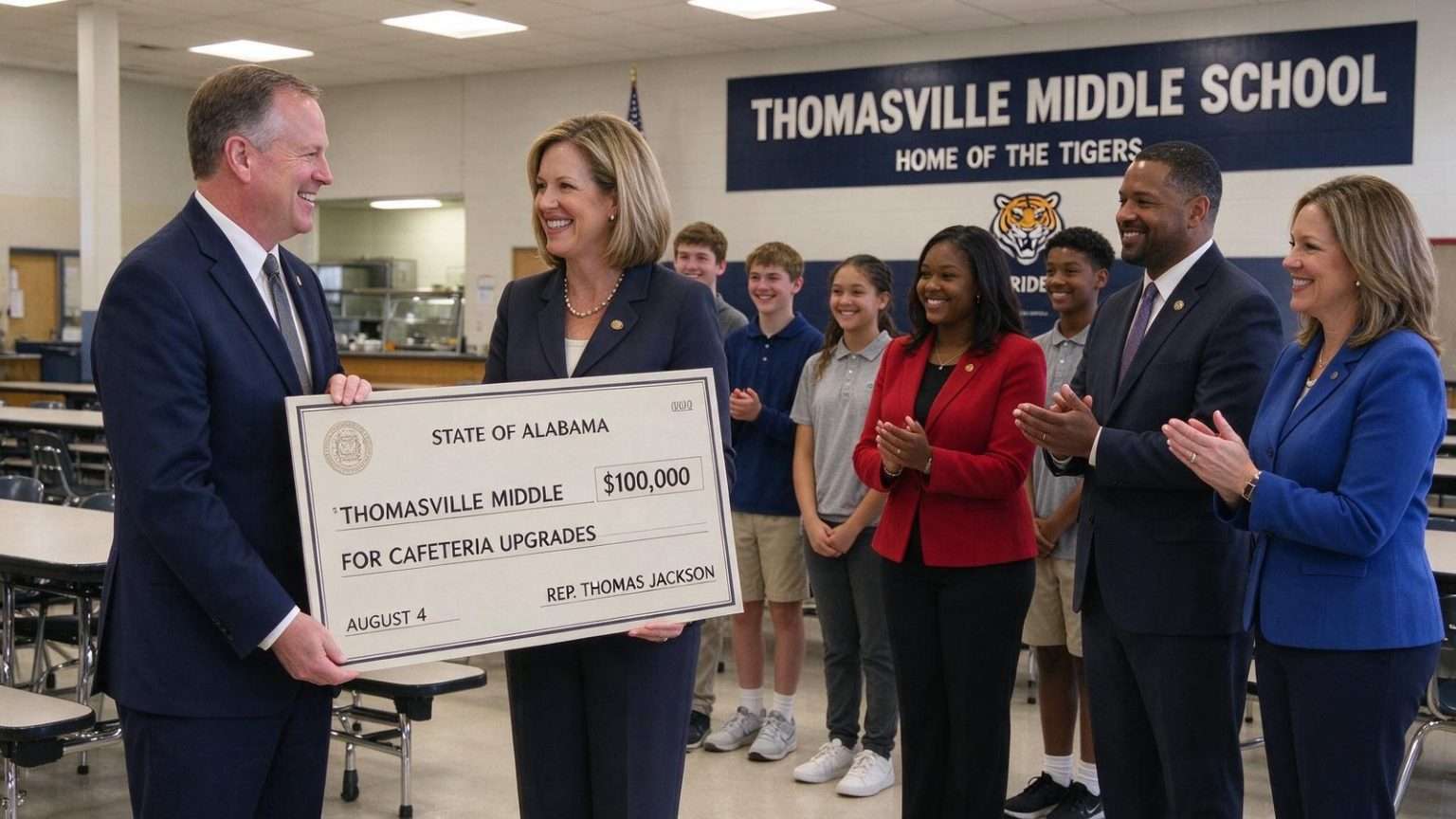
Thomasville Middle School received a $100,000 grant on Aug. 4 from state Rep. Thomas Jackson to fund improvements to the school’s cafeteria. The state grant will go toward upgrading cafeteria facilities at the school, which serves students in the Thomasville City School System in Clarke County.
The funding arrives at a moment when school nutrition spaces across Alabama have drawn increasing attention. Cafeterias are among the most heavily used rooms in any school, serving every student nearly every day, and upgrades to those facilities affect food service speed, sanitation, seating capacity and the overall experience of the school day. For a middle school, where students pass through in waves and meal periods are tightly scheduled, the physical condition of the cafeteria shapes how smoothly hundreds of students are fed in a matter of minutes.
How the Grant Came Together
State Rep. Thomas Jackson presented the $100,000 grant to the school on Aug. 4, directing state funding toward the cafeteria improvement project. Legislators in the Alabama House and Senate are able to secure funding for local projects in their districts, and education facilities are among the most common destinations for those dollars. School systems often pair such grants with local funds or future budget cycles to complete larger renovations.
The grant’s focus on the cafeteria reflects a practical priority. Kitchen equipment ages, serving lines wear out, and dining spaces built decades ago may no longer match the volume of students a school serves today. Improvements funded by grants of this kind can include anything from serving and refrigeration equipment to flooring, seating and ventilation — work that is difficult to fund from a school system’s regular operating budget, which is consumed primarily by salaries and instruction.
For Thomasville Middle School, the $100,000 represents resources the school system could not easily generate on its own. Alabama’s school funding formula is driven largely by enrollment-based allocations earmarked for instruction, leaving local systems to seek grants, local tax revenue and legislative support for facility work. A grant of this size can fund a meaningful renovation rather than piecemeal repairs.
About Thomasville City Schools
The Thomasville City School System serves students in Thomasville, a city of roughly 4,000 residents in Clarke County in southwest Alabama. The city system operates schools serving students from kindergarten through high school, with Thomasville Middle School covering the middle grades in that progression. City school systems like Thomasville’s are distinct from county systems, operating under their own elected board of education, their own superintendent and their own budget, though they remain subject to the same state standards and accountability measures.
Thomasville anchors the southern portion of Clarke County, a rural county where timber, manufacturing and small business form the economic base. The city’s schools serve as a central institution of community life, drawing families from across the area and serving as the site of athletic events, programs and gatherings that extend well beyond the school day. Investment in school facilities therefore resonates across the community, signaling commitment to the city’s future as well as its students’ present.
School cafeterias also play a role beyond meals. School nutrition programs in Alabama participate in federal meal programs that provide breakfast and lunch to students, with free and reduced-price eligibility for qualifying families. In rural communities, school meals are a significant part of student nutrition, making the facilities that produce them a matter of public health as well as convenience.
Public Education in Alabama
Alabama’s public schools are administered through a combination of local boards of education and the Alabama State Department of Education, which implements statewide standards and accountability measures. The state department, based in Montgomery, oversees everything from curriculum standards and teacher certification to school report cards and intervention for struggling schools, while local boards make the day-to-day decisions about personnel, budgets and facilities in their districts.
Public universities and community colleges operate under the oversight of the Alabama Commission on Higher Education and separate governing boards, a structure that separates postsecondary governance from the K-12 system. The state’s community college system, in particular, offers dual-enrollment and career-technical pathways that connect to the middle and high school grades, giving students in systems like Thomasville’s routes toward workforce credentials alongside traditional academic tracks.
Education funding, teacher pay, and curriculum standards are perennial subjects of debate in the Legislature, and decisions made in Montgomery affect classrooms from the Gulf Coast to the Tennessee Valley. The state’s education budget — funded substantially through sales and income tax revenue — sets the framework within which local systems operate, and annual legislative sessions bring recurring debates over teacher salaries, classroom funding, charter schools and capital needs.
Against that backdrop, individual grants like the one presented to Thomasville Middle School illustrate how state-level decisions reach specific communities. Legislators direct discretionary and targeted funding to district priorities, and school systems compete for state and federal facility dollars through applications and advocacy. The $100,000 secured by Rep. Jackson is one instance of that pipeline working for a rural southwest Alabama district.
Why Cafeterias Matter
The attention to cafeteria facilities reflects broader trends in school nutrition. Federal nutrition standards have reshaped school meals over the past decade, emphasizing fruits, vegetables and whole grains, and modern kitchen equipment makes meeting those standards operationally easier. Serving lines designed for speed and efficiency reduce the time students spend waiting, leaving more of the lunch period for eating — a persistent concern in middle schools where meal periods are often 30 minutes or less including transit from classrooms.
Facility condition also matters for staff. School nutrition workers prepare and serve hundreds of meals daily, and outdated equipment, poor ventilation and worn flooring make that work harder and slower. Upgraded facilities help systems retain trained staff and maintain the food safety practices that keep students healthy.
For students, the cafeteria is also a social hub — the largest common space in most schools and the site of everything from daily meals to assemblies and community events. Improving that space improves a part of the school every student touches every day, which is why cafeteria and kitchen projects rank among the most visible facility investments a school system can make.
Rural Districts and Facility Funding
Thomasville’s situation is common across rural Alabama, where smaller tax bases limit the local revenue available for school construction and renovation. The state has historically relied on local systems to fund facilities through property taxes and bond issues, supplemented by periodic state and federal programs. That structure leaves systems in poorer counties with older buildings and longer lists of deferred maintenance, making legislative grants and competitive programs especially valuable.
Clarke County and its school systems have seen the economic pressures typical of Alabama’s rural counties: population decline, a shrinking industrial base and the corresponding strain on revenue. In communities like Thomasville, the school system is often among the largest employers and among the most important factors in whether families stay or move away. Facility investments therefore serve economic development goals as much as educational ones, bolstering the case a city can make to prospective residents and employers.
Grants directed through legislators also carry practical advantages for small systems: they arrive without requiring a local match in many cases, they can be targeted to a single project like a cafeteria upgrade, and they demonstrate the district’s relationship with its legislative delegation. Superintendents across rural Alabama maintain close working relationships with House and Senate members for exactly this reason.
What Comes Next
With the grant in hand, Thomasville Middle School can move forward with its cafeteria improvements. School facility projects typically proceed through planning and procurement — defining the scope of work, obtaining quotes and scheduling construction around the school calendar to minimize disruption. Cafeteria work is often scheduled for summer or holiday breaks when the kitchen is not serving daily meals, though grants received during the year may fund projects in phases.
The school system will administer the funds and account for their use, with officials from the system and the legislator’s office typically participating in the presentation and, later, the dedication of the improved facilities. For students returning to school, the changes will arrive in the form of a better dining experience; for the community, the Aug. 4 presentation marked a tangible investment in a school that sits at the center of Thomasville life.
The grant also adds to the record of state support flowing to Clarke County schools. As Alabama’s education debates continue in Montgomery — over budgets, standards and the facilities needs of systems large and small — individual projects like Thomasville Middle School’s cafeteria upgrade show how those broad policies become concrete changes in specific schools.
Further details about the scope and timing of the cafeteria improvements were not announced with the grant presentation, but the funding gives the Thomasville City School System the means to begin work on a facility that serves every middle school student in the system, every school day.