Thomasville police sought 83-year-old man last seen near Nicholsville; later found safe
Thomasville police asked for the public’s help locating 83-year-old George Cowan, last seen driving a green Ford pickup near Nicholsville.
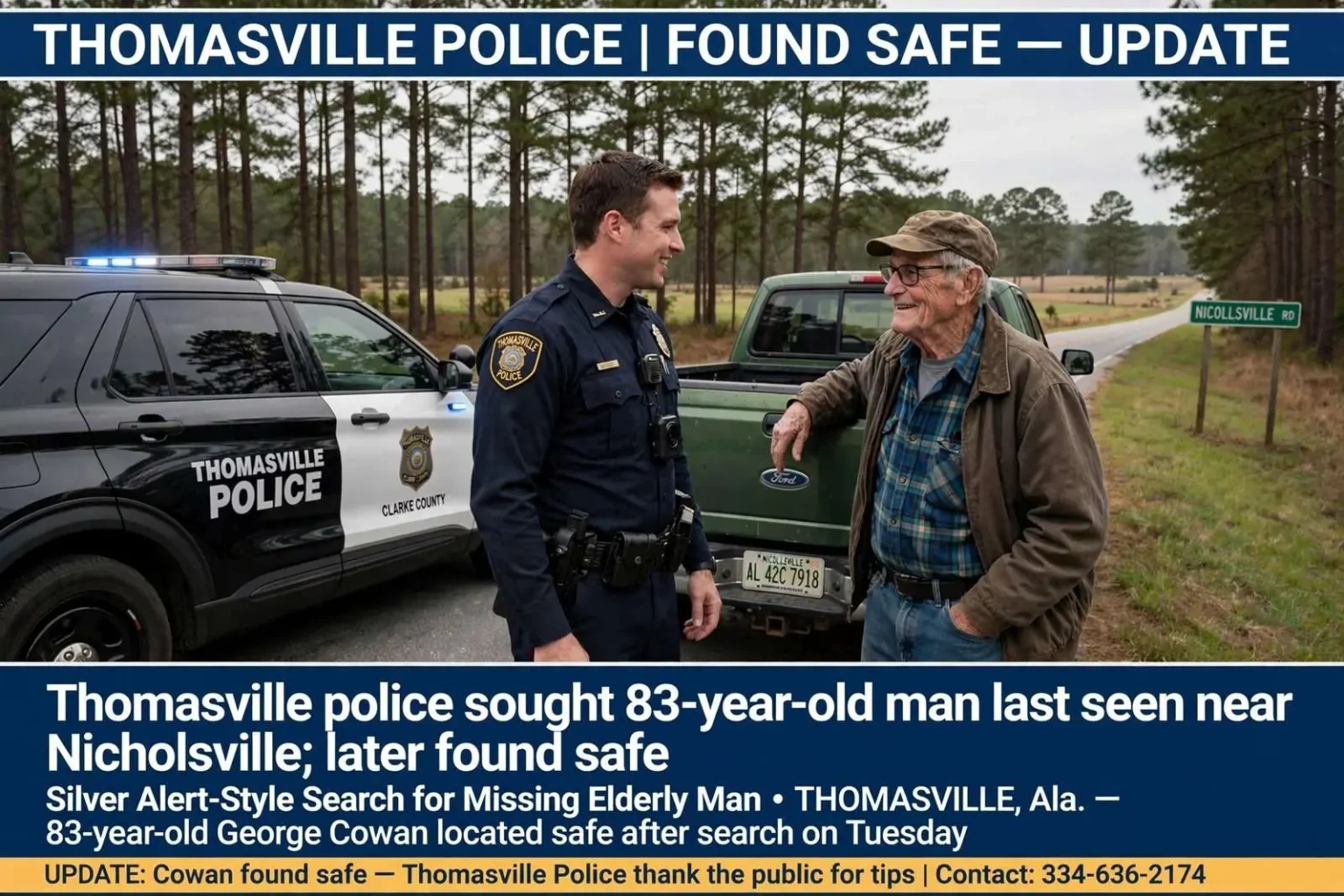
Silver Alert-Style Search for Missing Elderly Man
THOMASVILLE, Ala. — Thomasville police asked for the public’s help locating an 83-year-old man last seen Tuesday in the Nicholsville area. George Cowan was last seen driving a green Ford pickup, according to a release from the Thomasville Police Department. Anyone with information about his whereabouts was asked to contact TPD at 334-636-2174. Update: Cowan was later found safe, police said.
The search unfolded the way missing-person cases in small Alabama towns typically do: quickly, publicly and with the whole community watching. When an elderly resident is unaccounted for, time is the enemy. Age, and whatever medical or cognitive issues may accompany it, make every hour of uncertainty more dangerous, and police departments in towns like Thomasville know that their best asset is not equipment but the sheer number of neighbors who can be looking.
Thomasville, the largest city in Clarke County, sits along U.S. Highway 43 in the pine forests of southwest Alabama. The Nicholsville area lies in the rural country around the city, a community of homes, farms and churches spread along county roads. When word went out that an 83-year-old man had last been seen there driving a green Ford pickup, that description became the center of the search: residents scanned driveways and roadsides, and deputies and officers checked the places an elderly driver might plausibly go.
The department’s public release carried the essentials — who was missing, where he was last seen, what he was driving, and the number to call. That format matters. In a missing elderly person case, the difference between a tip called in at noon and one called in at night can be measured in outcomes, and clear public information is what generates useful tips rather than anxious but unactionable calls.
Why Elderly Missing-Person Cases Move So Fast
Searches for missing seniors follow a well-established playbook, refined over years of cases across Alabama and the nation. An 83-year-old driver may be navigating declining eyesight, slowed reaction times, medications, or the early stages of dementia — any of which can turn an ordinary errand into a crisis. Disorientation can take a driver miles from any intended destination, onto farm roads that all look alike, and fuel is finite. Police agencies therefore treat the first day as decisive.
Weather and terrain add their own urgency. In south Alabama, an afternoon of heat or a night of cold rain that a healthy adult could shrug off can be dangerous for an elderly person trapped in a disabled vehicle or a ditch. Vehicles leave roads on rural curves, phones are sometimes left behind or uncharged, and a man who planned a short drive can end up beyond shouting distance of any house. Searchers plan around those realities, prioritizing the roads most likely traveled and the spots where a green pickup might most plausibly be sitting unseen.
The tools available have grown considerably in recent years. Broadcast alerts and highway message signs can put a vehicle description in front of thousands of drivers within hours. Cell phone pings, where legally available and technically possible, can narrow a search area to a tower sector. Meanwhile, the oldest tool remains the most effective in rural counties: neighbors who know the roads, recognize the family name, and know which relatives to check.
In Clarke County, that human network is dense. Families have lived in the same communities for generations, and an 83-year-old man is someone’s father, grandfather, neighbor and fellow church member. When police asked for help locating George Cowan, the request went out through local media and social channels, and it reached precisely the audience most likely to recognize him or his green Ford pickup — the people who live and drive through the Nicholsville area every day.
The update that Cowan was later found safe brought the episode to the ending every such search hopes for. When an elderly person is located unharmed, the department that sought the public’s help owes the public the closing word — both as thanks and because the all-clear stops the flow of tips and lets a community exhale. Thomasville police provided that update, and the search that had drawn the town’s attention ended with the best possible news.
Thomasville’s Place in the Region
Thomasville serves as a commercial and medical hub for a broad stretch of rural Clarke County and its neighbors. Its hospitals and clinics draw patients from surrounding communities, its retailers serve customers from miles around, and its position on U.S. 43 between Grove Hill and Jackson places it on one of southwest Alabama’s main north-south corridors. That role shapes the police department’s work: the city’s officers handle urban-style calls in town while frequently coordinating with the Clarke County Sheriff’s Office on matters that spill into the surrounding countryside.
The Nicholsville community, where Cowan was last seen, is part of that rural ring. Roads there connect farms and family plots to the highway system, and a driver who takes a wrong turn can end up in neighboring Monroe, Wilcox or Marengo counties within a half hour. That geography is why searches for missing residents in the area are treated as regional matters from the outset, with descriptions passed to agencies in adjoining counties in case the vehicle crosses a line on a map that the driver never intended to cross.
The episode also illustrates the routine heroism of small-town law enforcement. Departments like Thomasville’s do not have specialized missing-person units or large detective divisions. They have officers who double as investigators, dispatchers who know callers by voice, and relationships with neighboring agencies built over decades of mutual aid. When an 83-year-old man goes missing, that machinery turns immediately — and, in this case, it worked.
For the Cowan family and the Nicholsville community, the outcome was relief. For everyone else, the case is a template worth remembering: the description that mattered was simple — an elderly man, a green Ford pickup, last seen Tuesday — and it was the public’s eyes that turned that description into a safe recovery. Thomasville police thanked the public in the way that matters most, by announcing that George Cowan had been found safe.
What Families and Neighbors Can Do
Searches like this one succeed on preparation as much as luck, and police departments across Alabama use resolved cases to remind families of the basics. For elderly relatives, keeping a current vehicle description, knowing the destinations a parent or grandparent habitually drives to, and acting on concern immediately — rather than waiting through a night of worry — all shorten searches. In Cowan’s case, the public information was specific and immediate: last seen Tuesday in the Nicholsville area, driving a green Ford pickup, with the Thomasville Police Department’s line, 334-636-2174, attached.
Drivers who spot a vehicle matching a missing-person bulletin are asked to do the same thing in every case: note the location, the time and the direction of travel, and call it in. Do not follow the vehicle or attempt to stop it, particularly when the driver may be confused or frightened. A location and a time give searchers a circle; a pursued driver can become a fleeing one, and confusion behind the wheel turns dangerous quickly.
The aftermath of a safe recovery typically involves a medical check, a conversation with family about what happened, and often a longer discussion about driving and safety. For an 83-year-old, an episode of getting lost is frequently the first visible sign of a condition that families then have to plan around. Communities that support their seniors — through churches, neighbors and informal check-ins — are the first line of prevention, long before any police department has to issue a bulletin.
The Region’s Search Network
Southwest Alabama’s counties have refined their mutual-aid habits over years of hurricanes, floods and manhunts, and a missing-person search benefits from the same infrastructure. The Clarke County Emergency Management Agency can push alerts, area radio stations broadcast descriptions to rural listeners who may not follow social media, and neighboring departments forward bulletins to their own communities. Within hours of the Thomasville release, the description of a green Ford pickup was in front of eyes from Grove Hill to Jackson and well beyond the county line.
That network is also why the closing update matters as much as the opening one. When Thomasville police announced that Cowan was found safe, that news traveled the same channels and stopped the search effort everywhere it had spread. Volunteers and off-duty eyes stand down, dispatchers close the incident, and the department’s public thanks closes the loop. In small towns, that closure is not a formality — it is how a community knows its effort worked.
The case ended as well as such cases can. An 83-year-old man was missing, a town was asked to look, and the man was found safe. Behind the simplicity of that sequence is the reality of rural Alabama policing: modest budgets, wide geography and a public that responds when asked. The Thomasville Police Department’s request — call 334-636-2174 with information — was answered, and George Cowan was recovered unharmed, which is the outcome every search of this kind is built to achieve.