Three Chickasaw High Students Hospitalized After Eating THC Gummies
Three Chickasaw High students were hospitalized after eating THC-infused gummies before a football game; all three have been released, police say.
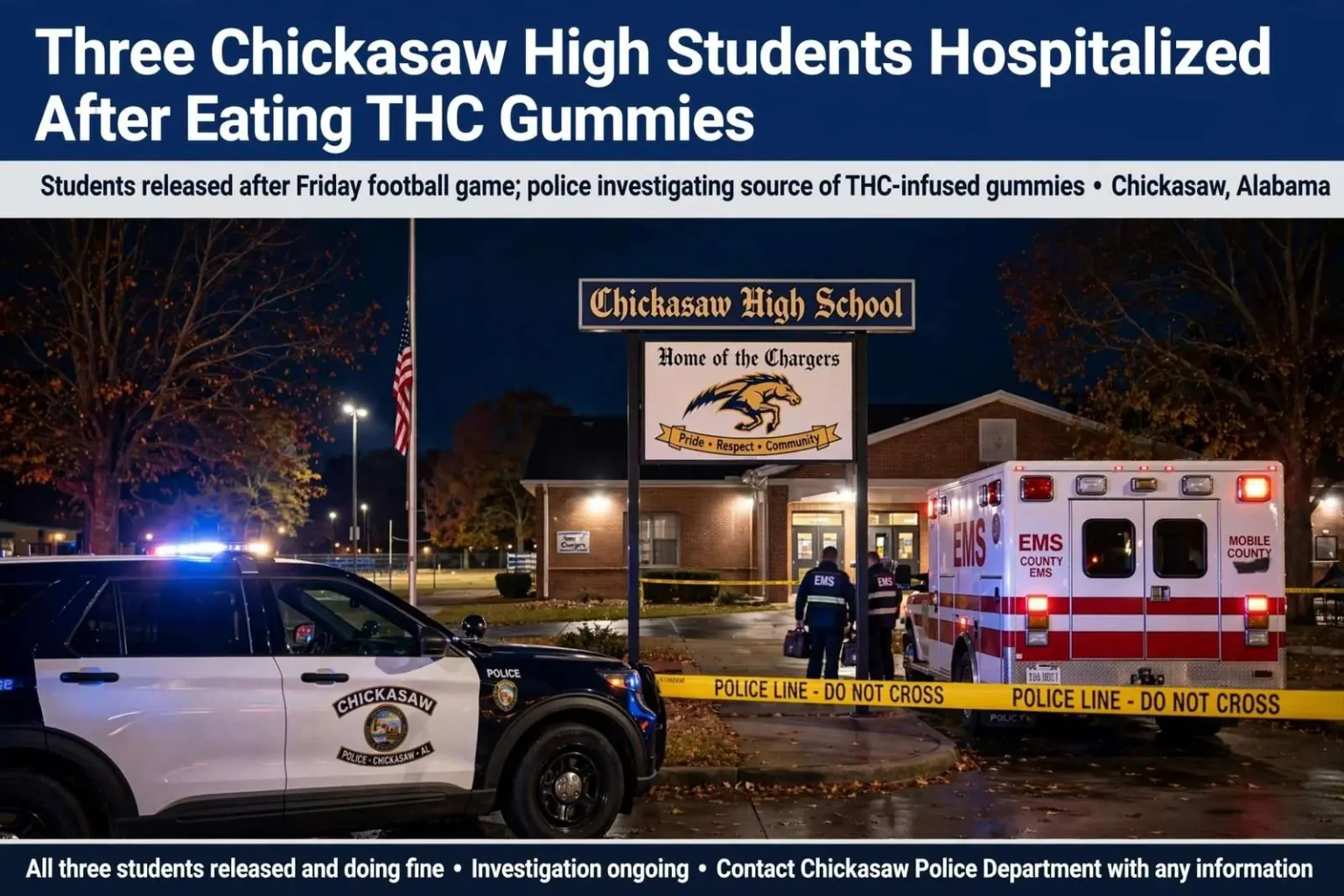
Three Chickasaw High School students were taken to a hospital ahead of a Friday football game after eating THC-infused gummies, according to Chickasaw police. All three students have since been released and are doing fine, police said. The incident remains an open investigation, with officers working to identify who distributed the gummies. Anyone with information is asked to contact the Chickasaw Police Department.
The hospitalizations came on the same evening as a Chickasaw High football game, with the school community gathering for the kind of Friday night event that defines fall in small Alabama cities. Instead of the game being the night’s only story, police and school officials spent the evening dealing with three students suffering reactions to the drug-laced candy, and families across the city heard about it before the final whistle.
THC gummies — candy infused with tetrahydrocannabinol, the intoxicating compound in marijuana — have become a recurring problem in schools across Alabama and the nation. They look indistinguishable from ordinary gummy candy, they are easy to carry and share, and their effects can be delayed and unpredictable, which is why students who consume them frequently end up needing medical evaluation.
What happened and how schools respond
When students show signs of intoxication at school or at a school event, the response follows a familiar pattern: staff isolate and monitor the students, summon school resource officers or police, and call emergency medical help for anyone whose symptoms are concerning. Vomiting, rapid heart rate, anxiety, and disorientation are the most common reactions, and while deaths from THC alone are rare, medical evaluation is standard because the strength of the dose is unknown and other substances can be mixed in.
Chickasaw police said all three students were taken to a hospital, evaluated, and released, with officers confirming they are doing fine. The medical outcome was the best possible under the circumstances, but the legal and disciplinary side of the incident was just beginning. Officers began working to identify who distributed the gummies, a task that involves interviews, school camera footage, and cooperation from students and parents.
Under Alabama law, marijuana remains illegal for recreational use, and possession of a controlled substance on school grounds carries enhanced penalties. Distributing THC products to minors — or selling them to other students — is treated far more seriously than simple possession, which is why police focused their investigation on the source of the candy rather than on the students who consumed it.
The challenge of THC edibles in schools
School administrators across the Gulf Coast have dealt with a wave of THC edibles incidents in recent years. The products arrive in communities through a legal gray market: hemp-derived THC products sold in shops and online, products brought from states where marijuana is legal, and counterfeit packaging that mimics popular candy brands. Because gummies and other edibles contain no odor, adults cannot detect them the way they can detect smoked marijuana.
The doses in homemade or black-market edibles are also wildly inconsistent. A single gummy might contain a fraction of the THC listed on its packaging or many times more, and students who share candy rarely know what they are taking. Emergency room physicians have described treating groups of students who ate the same batch and reacted very differently — some barely affected, others severely impaired.
Alabama lawmakers have responded with legislation targeting hemp-derived intoxicating products and school-zone drug offenses, and school districts have updated their codes of conduct to address edibles explicitly. But enforcement inside a school building remains difficult, and police say the most effective tool is information from students and parents about who is bringing the products in.
Chickasaw and its school system
Chickasaw is a small city in Mobile County, incorporated in 2008 after decades as an unincorporated community north of Prichard, and its city school system — formed in the years after incorporation — is one of the smallest in Alabama. Small systems like Chickasaw’s operate with tight staffs and close relationships between administrators, teachers, and families, which cuts both ways in an incident like this: problems are noticed quickly, but the entire community feels them immediately.
The city’s police department, likewise a small force, handles investigations with the same officers who patrol the city daily, and its appeal for information reflects that reality. Detectives pursuing the source of the gummies will depend on students, parents, and residents coming forward with what they know — through direct contact with the department rather than through social media speculation.
The message to parents
Incidents like Friday’s prompt the standard advice from police and school officials to parents: talk to children about drug-laced candy, check what they bring to school events, and take unfamiliar or unlabeled edibles seriously. Officials note that children and teens frequently underestimate edibles because they resemble ordinary candy, and that a conversation before the weekend is more effective than a lecture after an emergency room visit.
The three students involved were released from the hospital and are expected to be fine, but the investigation continues. The Chickasaw Police Department has asked anyone with information about who distributed the gummies to come forward, and school officials will handle the disciplinary side once the police investigation establishes the facts.
Friday night football will go on in Chickasaw, as it does across Alabama every fall, but the evening stands as a reminder of a modern risk that has followed students onto campuses across the state — candy that is not candy, shared with consequences that reach the emergency room.
How the investigation will unfold
Identifying the source of drug-laced candy in a school setting is rarely straightforward. Police will interview the students involved, review who they were with before the game, and examine any messages or social media activity that points to where the gummies came from. School resource officers and administrators may face reluctance from students who are afraid of being labeled informants, which is why police appeals for information usually extend to the whole community rather than just the student body.
If investigators identify a distributor, charges could range from possession with intent to distribute to more serious counts if the products were sold to minors or marketed on school property. In cases elsewhere in Alabama, sources of school THC edibles have included other students, older acquaintances, and products legally purchased as hemp-derived items and resold to teens. Each finding shapes how prosecutors handle the case.
The school system, meanwhile, will apply its code of conduct to any students found to have possessed or distributed the gummies, with penalties that can include suspension or expulsion depending on the role each student played. Districts generally separate the disciplinary process from the criminal investigation, allowing both to proceed on their own tracks.
The emergency response behind the outcome
The fact that all three students recovered fully reflects the response chain that schools have built for drug-related emergencies. Quick recognition by adults at the event, prompt calls to police and EMS, and hospital evaluation made the difference between a frightening evening and a tragedy. Medical staff treating THC ingestion monitor vital signs, manage symptoms, and observe patients until the effects subside, which can take hours depending on the dose.
School events like football games concentrate hundreds of students in one place with staff supervision, and administrators increasingly train event personnel to recognize the signs of drug reactions alongside the usual first aid duties. The fast recovery of the Chickasaw students shows that training and preparation working as intended.
A statewide pattern
Chickasaw’s experience mirrors incidents in school systems across Alabama in recent years, from large county districts to small city systems. Police and school officials in community after community have issued nearly identical warnings: THC gummies are circulating among students, they look like ordinary candy, and they can send a young person to the hospital with a frightening reaction.
Health educators note that the risks extend beyond the immediate intoxication. Products obtained outside regulated channels can contain synthetic cannabinoids, unknown potency, or contaminants, and the psychological effects — panic, paranoia, hallucinations — are among the most common reasons students end up needing emergency care. Parents who find unusual candy or packaging among a child’s belongings are urged to take it seriously and contact police if they suspect it contains THC.
The Chickasaw Police Department’s appeal remains open as the investigation continues. Officers have not said how many gummies were involved or where the students obtained them, and further details will depend on the cooperation of witnesses and the progress of the investigation. What is known is that three students spent an evening in the hospital and came home safely — an outcome that police, school officials, and families across the region all hope to repeat the next time candy and campus cross paths.