Three teams prepare bids for Mobile River Bridge and Bayway Project
Three teams - I-10 Mobility Partners, Gulf Coast Connectors and Mobile River Bridge Group - are preparing bids to build the Mobile River Bridge and Bayway.
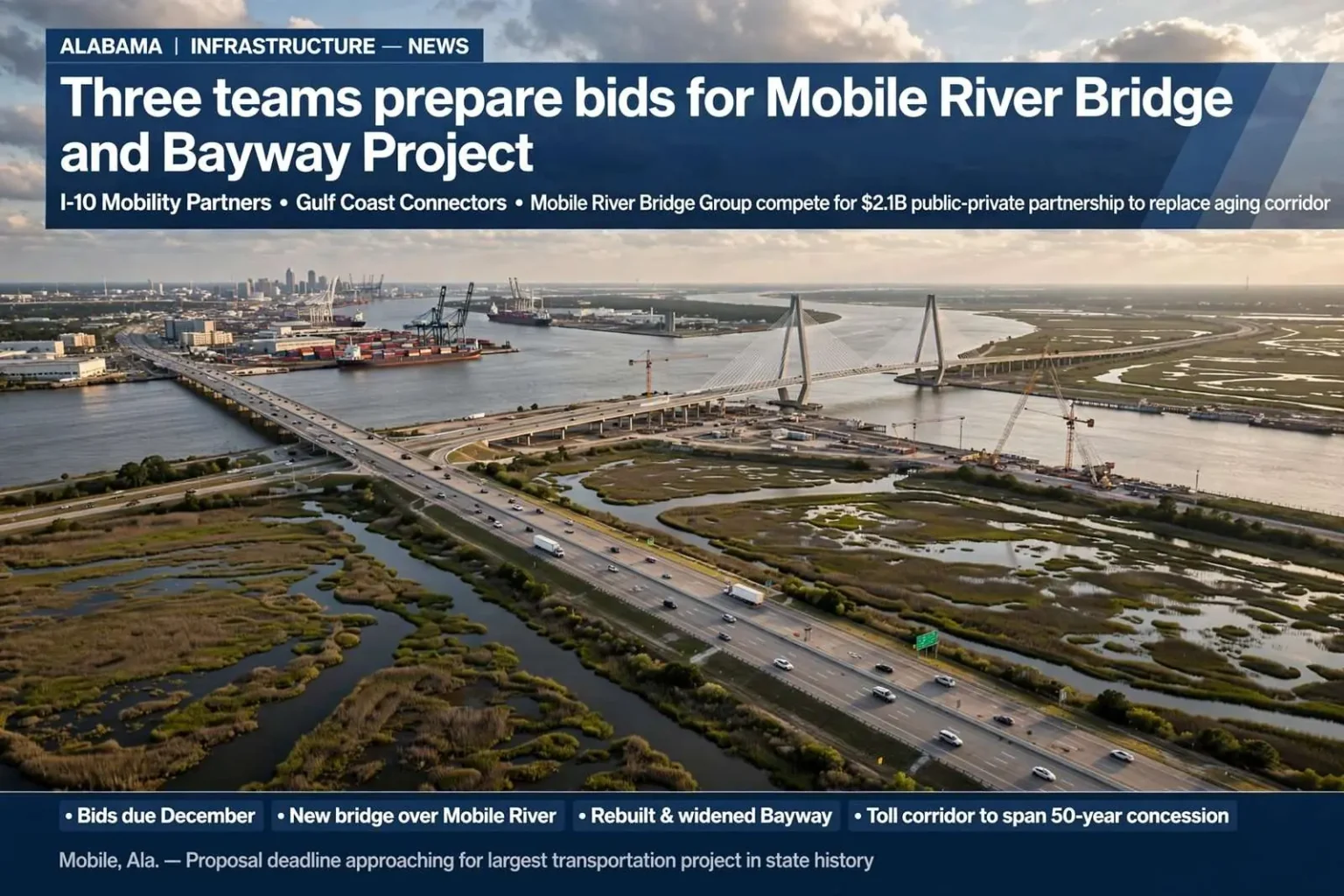
Three groups of companies are preparing proposals to build the Mobile River Bridge and Bayway Project, the Alabama Department of Transportation confirmed. The teams — known as concessionaires — are I-10 Mobility Partners, Gulf Coast Connectors and Mobile River Bridge Group, and whoever wins the bid stands to profit from an investment of $2.1 billion or more in one of the largest transportation projects in state history.
The project would deliver a new bridge over the Mobile River and a rebuilt, widened Biloxi Bayway along Interstate 10, the congested corridor that funnels Gulf Coast traffic through downtown Mobile and across the existing George Wallace Tunnel. Motorists would pay a toll to use the new crossing, and the prospect of private companies collecting that toll revenue for decades is what has transformed the effort from a conventional public works project into a public-private partnership with billions of dollars at stake.
State Sen. Chris Elliott, who represents District 32, questioned the scale of that return. “You’re talking about just shy of ten billion dollars. Well, that’s entirely too much profit,” he said, describing the lifetime toll collections the winning concessionaire could expect against the capital it puts in. His objection captures the central tension of the deal structure: the private teams are being asked to finance and bear risk on a project the state cannot yet fund outright, but the price of that financing is a long-term claim on one of Alabama’s busiest toll corridors.
Mostly International Bidders
Most of the companies in the bidding groups are international. The lead firms behind both I-10 Mobility Partners and Gulf Coast Connectors are based in Spain, with U.S. offices — a reflection of how consolidated the global market for toll-road concessions has become, with Spanish infrastructure giants among the most experienced operators of tolled highways on several continents.
Southland Holdings, a lead partner in the Mobile River Bridge Group, is based in Texas, and Figg Bridge of Florida is also part of that team. The presence of an American-led group alongside the Spanish-led consortiums gives state officials a choice among different financing structures and construction pedigrees rather than a single model.
Figg Bridge’s inclusion drew attention because the firm designed the pedestrian bridge that collapsed in Miami last year, a failure that killed six people and became one of the most closely examined bridge disasters in modern American history. The collapse, during a project at Florida International University, raised predictable questions when the same designer appeared on a bidder list for a billion-dollar crossing over the Mobile River.
Alabama Transportation Director John Cooper defended the firm. “I think it’s important to note about the Figg firm is that it is a firm with a long and really storied history in the construction of large bridge projects,” Cooper said. “The bridge that collapsed was actually not in their specialty space.” His argument was that the Miami structure — a pedestrian span built with an accelerated, unconventional construction method — bore little relation to the highway bridges on which Figg built its reputation.
Figg also designed at least four other Gulf Coast bridges, including the Dauphin Island bridge, the Cochran-Africatown bridge and the Garcon Point bridge. Those spans have carried traffic for years, and their performance record in the region is part of the firm’s case that its local experience outweighs the shadow cast by the Miami collapse.
How the Bidding Works
Proposals from the groups are due in December. The final decision will be made by the toll road bridge and tunnel authority, which receives advice from ALDOT, Cooper said. The process is structured as a competition among concessionaire teams, each of which proposes not only a design and construction plan but a financing package and a tolling scheme, with the state weighing the full package rather than a single number.
Under this kind of public-private arrangement, the winning team typically arranges private financing to supplement public contributions, builds the project under a long-term contract, then operates the tolling system for decades — collecting revenue and bearing maintenance obligations before handing the asset back at the end of the concession term. The state’s exposure shifts from up-front borrowing to a regulatory and oversight role, while the concessionaire’s return depends on traffic volumes and toll rates over the life of the deal.
That structure is why the profit question matters as much as the construction cost. A concessionaire that invests $2.1 billion and collects tolls for half a century will recoup many times its outlay if traffic meets projections, and Elliott’s arithmetic — toll collections approaching ten billion dollars — illustrates the scale of the long-term revenue stream that local officials are weighing against the immediate benefit of getting the bridge built without a corresponding tax increase.
The Toll Authority’s Makeup
The toll authority was created by the state legislature and is headed by the governor. Of its nine members, only two have direct connections to the Gulf Coast: Sen. Greg Albritton of District 22, who sits on the authority as chairman of the Senate Ways and Means General Fund Committee, and former U.S. Rep. Jo Bonner, now chief of staff to Gov. Kay Ivey.
The composition has drawn notice in Mobile because the members who will make the final call on the region’s most consequential infrastructure project are, for the most part, appointed from outside it. Toll decisions affect the drivers who cross the bridge daily — the commuters, port traffic and freight haulers of southwest Alabama — and local officials have been vocal about wanting Gulf Coast representation to reflect that stake.
Albritton’s role carries particular weight. As chairman of the Senate committee that oversees the General Fund budget, he sits at the intersection of the state’s finances and the project’s future, and his district stretches across southwest Alabama counties whose residents would pay the tolls. Bonner, as the governor’s chief of staff, brings the administration directly into the authority’s deliberations at a time when the project’s political future depends heavily on support in the governor’s office.
The authority’s decisions will extend beyond picking a bidder. It will ultimately sign off on toll rates, which the concession agreements typically allow to rise over time, and on the contract terms that govern the project for its decades-long life. For a project that has been discussed in Mobile since the 1960s, the coming months — proposals due in December, followed by evaluation and selection — represent the closest the effort has come to an actual groundbreaking.
A Project Decades in the Making
The Mobile River Bridge and Bayway Project has been on planning maps for generations. The twin tunnels under the Mobile River — the George Wallace Tunnel downtown and the Bankhead Tunnel nearby — were engineered in an era of far lighter traffic, and the four-lane Bayway across the Mobile-Tensaw delta has long since been outgrown by the freight and commuter volumes that Interstate 10 now channels through the region. Peak-hour backups stretching for miles are routine, and the congestion is expected to worsen as Gulf Coast populations and port volumes grow.
The proposed bridge would rise higher and wider than the tunnels, carrying Interstate 10 traffic over the river without the bottlenecks of tunnel approaches, while the rebuilt Bayway would add lanes and safety improvements across the delta. Together they represent the largest single transportation investment in the Mobile area’s history, and one of the largest in Alabama.
The route and the tolling plan have both been contentious. Residents of neighborhoods near the proposed alignment have raised concerns about displacement and noise, and drivers who use the corridor daily have objected to paying a toll for a crossing that today costs nothing. Supporters counter that the alternative — decades more of tunnel congestion — carries its own economic cost in lost time, wasted fuel and constrained port access.
Commerce along the Gulf Coast gives the project a reach far beyond Mobile’s city limits. Interstate 10 is the main east-west artery for the entire Gulf region, and freight moving between the Port of Louisiana, Mississippi’s casinos and shipyards, and Florida’s panhandle funnels through the Mobile bottleneck. Improving that choke point is a regional — arguably a national — freight priority, which is why federal planning studies have ranked it among the region’s most significant needs.
What the Concessionaires Are Competing For
Each of the three teams brings a different blend of financing muscle, construction expertise and tolling experience. The Spanish-led groups operate toll roads on multiple continents and can draw on decades of data about how drivers respond to tolls; the American-led group counters with domestic construction capacity and regional bridge experience. The state’s evaluators will score not just price but credibility — whether each team’s traffic projections, financing terms and construction schedule hold together.
The concession structure also transfers risk. If traffic falls short of projections, the concessionaire’s revenue falls short, not the state’s budget — a feature Alabama officials have emphasized as they compare this model to traditional bond-funded construction, in which taxpayers bear the shortfall. The trade-off is the margin the concessionaire earns for accepting that risk, the very profit senator Elliott flagged as excessive.
Local chambers of commerce and port interests have broadly supported moving the project forward, arguing that Mobile’s growth as a deep-water port hub depends on fixing the corridor. Opposition has focused on toll rates and on affordability for daily commuters, whose travel patterns are the least flexible and for whom even a modest toll adds up month after month. How the winning bidder structures its tolling plan — discounts, peak pricing, transponder arrangements — will shape public reaction as much as the bridge’s design does.
The December deadline sets up a decisive stretch. Once proposals are in, the authority’s evaluation and the state’s advice will move the project toward a selection, and Mobile will learn which of the three teams will build — and profit from — the crossing that has been promised, debated and redesigned for longer than most of the region’s drivers have been alive.