
Thursday Night Comedy Gives Mobile Stand-Up a Real Home at the Billiard Club
A new weekly stand-up showcase at the Billiard Club on Government Boulevard is giving Mobile comedians their first real home stage.
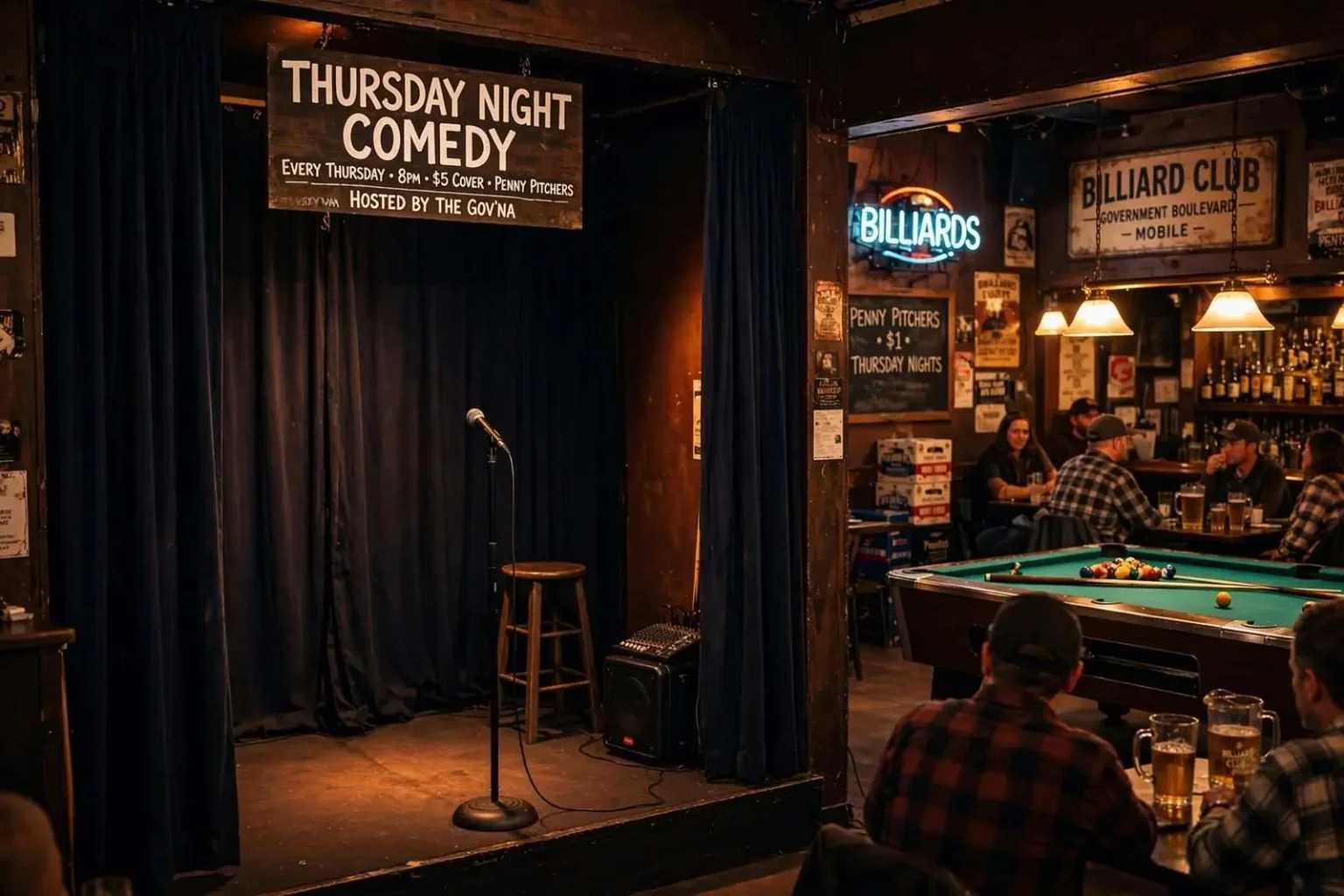
Mobile’s stand-up comedians have spent years without a room of their own, squeezed onto general open-mic bills between acoustic acts and performing for crowds more interested in their phones. A new weekly show is changing that.
Thursday Night Comedy at the Billiard Club on Government Boulevard, launched September 20 and hosted by the local comic known as the Gov’na, has quickly become the city’s most reliable stage for stand-up.
A room built for jokes
The production group Roman Empire helped put the night together, and the setup is a step up from anything comedy had downtown before: a low-lit stage with a stool and sound system, curtained off in the back corner of the hall away from the pool tables, so the audience actually listens. The cover is five dollars, and penny-pitcher beer specials keep the crowd lubricated and generous.
For performers, the difference is immediate. Comedy lives or dies on attention — a joke that would kill in a quiet, focused room dies in a bar where a band is loading in or a television is playing overhead. By curtaining the stage away from the pool tables and dimming the lights, the producers of Thursday Night Comedy have created something Mobile comics rarely get: a crowd that came for jokes and knows to quiet down when the mic is hot. Regulars say the room rewards tight writing in a way open mics never could.
The Gov’na has also used the night to import talent, booking out-of-town acts such as Anthony Taylor and Tie Bo alongside a growing bench of locals, including a performer billed as Class Clown who has been turning in multiple sets a week.
Bringing in visiting headliners matters for more than novelty. Out-of-town acts give local comics a chance to study how working professionals structure a set, handle hecklers and pace a room, and they give audiences a reason to keep coming back week after week. The mix of traveling talent and homegrown regulars is the formula that has built comedy scenes in bigger Southeastern cities, and Thursday Night Comedy is applying it at a five-dollar cover — a price point that keeps the show accessible to college students, service-industry workers and anyone else who wants a cheap Thursday out.
A scene coming back to life
Thursday nights are only part of the picture. William Masters has been hosting well-attended comedy showcases at Alchemy Tavern downtown on weekends, giving performers a second stage and audiences a second option.
The revival matters because Mobile’s comedy pipeline had thinned badly — a handful of the city’s best-known comics of recent years, among them Kevin Saucier and Nick Cassano, left for Atlanta, while others drifted into MC work for bands.
The exodus to Atlanta is a familiar story for Mobile’s creative class. Georgia’s capital sits about five hours up Interstate 65 and offers what Mobile historically could not: a dense circuit of comedy clubs, open mics every night of the week, and casting directors and comedy bookers passing through constantly. For comics who wanted to treat stand-up as more than a hobby, leaving often felt like the only move. Nights like Thursday Night Comedy are an attempt to give the next wave of local talent a reason to build their skills at home first.
Performers who cut their teeth at open mics at the Blind Mule or the Alabama Music Box say those rooms could be unforgiving for comedy; the Billiard Club, by contrast, was designed around it.
The Blind Mule, long a fixture of Mobile’s LoDa entertainment district, and the Alabama Music Box on Dauphin Street built their reputations on live music, and their open mics reflected it. Comics who signed up were often performing between singer-songwriters for patrons who came to hear songs, not jokes. Those rooms gave Mobile comics valuable stage time, but the format made it hard for stand-up to develop an audience of its own.
The Billiard Club on Government Boulevard occupies a different niche. The hall has been a west-Mobile gathering spot for pool players and beer drinkers for years, and its size — big enough to section off a comedy corner without shutting down the tables — turned out to be an asset. The penny-pitcher specials that draw the crowd are a holdover from the bar’s beer-hall roots, and they have proven an unexpectedly good match for a comedy crowd that shows up thirsty and stays through multiple sets.
What a weekly night changes
A reliable weekly stage changes how comedians work. With a guaranteed room every Thursday, a local comic can develop a tight five minutes, retire it, and build toward a longer set in a way that scattered monthly showcases never allowed. Material gets tested and refined instead of performed once and shelved. Audience members, meanwhile, start to recognize faces — both the performers’ and each other’s — and a scene acquires the regulars that sustain it between standout shows.
The Gov’na, whose stage persona has made him a familiar presence at local shows, has taken on the booker’s role that every healthy scene needs: someone who decides the running order, gives new comics a first slot to learn in, and puts the strongest acts near the end of the night. Booking acts like Anthony Taylor and Tie Bo from outside the city signals that the night aims to compete for audiences rather than merely provide a practice room.
Class Clown’s workload — multiple sets a week between the Billiard Club and other local stages — illustrates the other side of the equation. Stage time is the only currency that matters in comedy’s early years, and a comic who can perform several times a week in their own city develops at a pace that simply was not possible in Mobile during the years when open mics were the only option.
Part of Mobile’s wider nightlife revival
The show’s rise tracks with broader energy along Government Boulevard and in Mobile’s entertainment districts, where locally owned bars and venues have worked to give residents reasons to stay in the city for a night out rather than driving to Pensacola or New Orleans. Weekend showcases at Alchemy Tavern, a downtown staple near Dauphin Street, now give visitors and locals a two-night comedy option when paired with the Thursday show.
Regulars expect word of mouth to keep growing what is shaping up as one of the coast’s must-see weekly comedy nights.
For a city whose performers once had to leave to be taken seriously, the arithmetic is simple: five dollars at the door, penny pitchers on the table, and a curtained-off stage where Mobile comics finally get to work in front of a room that listens. If the momentum holds, the comics who might once have joined the migration to Atlanta will have a reason to build their careers here — and the Gulf Coast will have another reason to look to Mobile for a night of stand-up.
Going out to a show
Thursday Night Comedy runs weekly at the Billiard Club on Government Boulevard in Mobile. Doors open in the evening, the five-dollar cover is collected at the door, and penny-pitcher specials run through the show. Early arrival is recommended for the better seats near the stage, and as with any comedy room, the house asks that phones stay dark and conversations move to the bar while a set is underway.
How the night is run
Producing a weekly comedy show is a bigger job than it looks. Someone has to line up the lineup, manage sign-ups, work the sound system, coordinate with the bar on staffing and drink specials, and keep the show moving at a pace that holds the room. Roman Empire’s involvement means those duties are shared rather than resting on a single promoter, which is often the difference between a showcase that lasts a season and one that becomes an institution. The Gov’na’s hosting duties slot into that structure — a host who knows the room can slow down a rowdy stretch, bring energy back after a flat set and give newcomers a graceful landing.
The separation from the pool tables deserves particular credit. Comedy rooms across the country have learned the hard way that shared spaces breed distracted crowds; the shows that survive are the ones that physically or visually divide the comedy audience from the rest of the bar. A curtain, dimmed lights and a dedicated stool-and-mic setup sound like small details, but together they tell everyone in the hall where the show is and when it matters.
Why local comedy needs anchors
Every comedy scene that has produced working comics started the same way: one dependable room where beginners could fail safely and regulars could hone an hour. Cities along the Gulf Coast have watched this pattern play out repeatedly — a strong weekly night opens, talent concentrates around it, touring bookers start stopping through, and within a few years locals are getting paid slots in New Orleans, Pensacola and Atlanta. Without the anchor room, the same talent scatters and the city starts over from zero every few years.
Mobile now has the beginnings of that anchor on Thursdays and a weekend complement at Alchemy Tavern. The combination gives a comic at any level a path: first set at an open portion of the show, then regular featured slots, then weekend showcase appearances, and eventually booked gigs out of town — with a home audience waiting to hear about it when they return. That pipeline was exactly what Mobile lost when Saucier, Cassano and others moved on, and rebuilding it is the quiet project under way at the Billiard Club every Thursday night.


