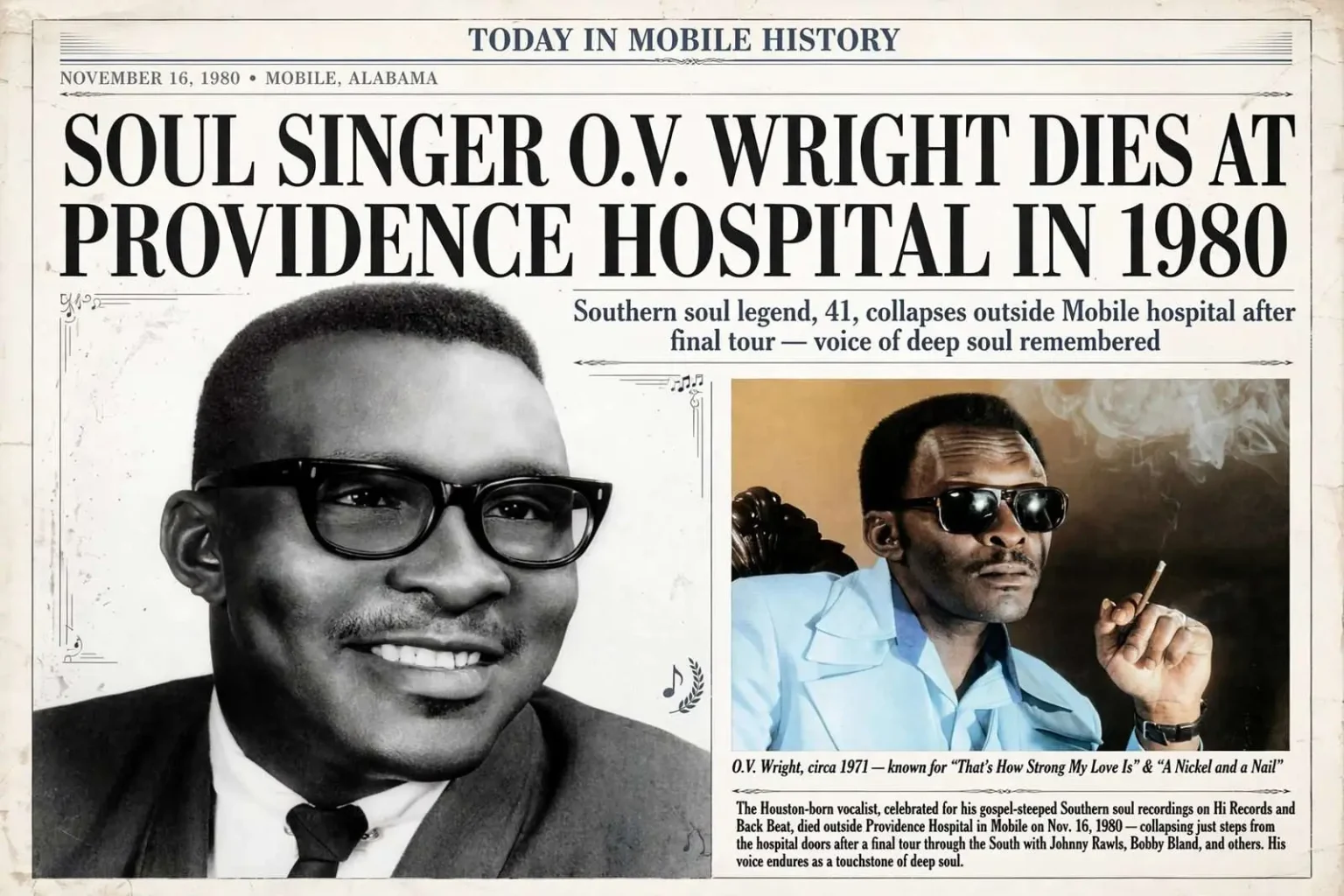
On November 16, 1980, Southern soul singer Overton Vertis “O.V.” Wright died at Providence Hospital in Mobile after collapsing outside the hospital’s doors. He was 41 years old. The death of the Houston-born vocalist on a Mobile sidewalk, within arm’s reach of the hospital he had come to for help, closed one of the most distinctive voices in Southern soul — a singer whose tremulous, church-hardened delivery influenced two generations of soul and blues singers and whose records remain touchstones of the deep soul sound more than four decades later.
Wright is remembered as one of the genre’s most distinctive vocalists, known for hits including “That’s How Strong My Love Is” (1964), “You’re Gonna Make Me Cry” (1965), “A Nickel and a Nail” (1971) and “Ace of Spades” (1971). The run of recordings traced the arc of Southern soul itself: the gospel-steeped balladry of the mid-1960s, the ache of the deep soul ballads, and the grooved, blues-drenched records of the early 1970s that kept him on charts and chitlin-circuit stages even as the industry’s attention shifted elsewhere.
The Voice
Wright’s instrument was unmistakable from its first syllable. Raised in the church’s Black gospel tradition, he carried the quaver, the melisma and the raw dynamics of the sanctified pulpit into secular music, and he never fully abandoned them. Singers and producers described a voice that could move from a cracked whisper to a full-throated cry inside a single line, and audiences heard a man testifying rather than performing. That quality — conviction you could not manufacture — is why his records endure. “That’s How Strong My Love Is” became a standard covered by artists across genres; “You’re Gonna Make Me Cry” remains one of the definitive deep-soul ballads ever recorded; and “A Nickel and a Nail” gave the genre a parable of love and poverty that singers still reach for.
His recordings were made largely for the Memphis-based Back Beat and Hi Records labels, the latter the home of Al Green and producer Willie Mitchell. Wright’s association with Hi placed him inside the most fertile Southern soul operation of the era — Memphis studios, house bands that could play gospel ache and blues grind with equal authority, and a production aesthetic that left the voice exposed at the center of the record. The Back Beat sides, cut with producer Don Robey’s Houston operation, captured him even earlier, and together the two label runs document a career that never chased fashion: Wright sang Southern soul from beginning to end, and the music moved around him while he stayed himself.
A Final Tour Through the South
According to fellow soul singer Johnny Rawls, who toured with Wright and was present in his final days, the two had performed together at a show in Atlanta alongside Tyrone Davis, Bobby Bland, B.B. King and Little Johnny Taylor before traveling on to Mobile. The bill itself was a portrait of Southern soul’s pecking order in 1980 — established stars, respected journeymen, and the one-nighter circuit that carried them through the South’s auditoriums and clubs, the same route Black entertainers had traveled for decades.
Rawls has said Wright had been struggling with his health for some time but resisted seeking medical treatment. Wright had undergone surgery in 1978, according to Rawls, but continued to decline care afterward. The reluctance is a familiar chapter in the lives of touring soul and blues singers of that era — men who worked through illness because the bookings paid the bills, distrusted hospitals, or had simply spent a lifetime not stopping. By Rawls’ account, recorded in later interviews, Wright grew increasingly ill during the tour, telling those around him less than he told the stage.
By the time the group reached Evergreen, Alabama, Wright was having serious trouble breathing, and Rawls took him to a hospital there. Evergreen sits along the route between the tour’s stops and Mobile — a small Conecuh County town on the old federal highway that predates the interstate, the kind of place where touring acts stopped for rest on the long drives through the Black Belt and toward the coast. Rawls has said the small hospital’s staff were reluctant to treat what he described as a serious buildup of fluid, and that after waiting several hours, Wright chose to travel on to Mobile, roughly 100 miles away, to seek further care at Providence Hospital.
By Rawls’ account, Wright collapsed just outside the hospital entrance upon arrival. Hospital staff worked on him for several hours before informing Rawls and other members of Wright’s circle, including his wife and brother, that they had been unable to save him. The detail — a singer who had spent his life pouring breath into song, dying of respiratory failure a few feet from emergency care — has given the story its enduring, bitter irony. Wright was 41. The date was November 16, 1980, and the city was Mobile, which thus entered the biography of one of Southern soul’s defining voices not as a tour stop but as the place the voice stopped.
The fluid buildup Rawls described — the serious respiratory distress that made the final stretch of the tour an ordeal — was consistent with the pneumonia and heart complications that biographical accounts have associated with Wright’s decline, though the singer’s resistance to treatment meant the full picture of his final illness was known only to those close to him. What is documented is the outcome: pronounced dead at Providence Hospital after staff efforts failed, with the people who knew him best waiting nearby.
The Man Behind the Records
Wright’s path to the studio ran directly through the church. Born in 1939 in Lenow, Tennessee, and raised around Memphis and Houston, he sang gospel as a teenager and was recruited toward secular music in his early twenties — a transition the era demanded and many gospel voices resisted. His first recordings for Back Beat in the mid-1960s established the template: gospel phrasing over blues-based arrangements, ballads of devotion and heartbreak delivered without compromise. When he moved to Hi Records later in the decade, the label’s Memphis operation gave those instincts their fullest settings, and the hits followed.
His stage presence completed the effect. Photographs and surviving footage show a compact man in tailored suits, head back, eyes closed, one hand working the air as though conducting his own trembling. Audiences on the chitlin circuit knew what they were getting: no choreography, no mixed-message showmanship — a man and a song. Younger singers who shared bills with him, Rawls among them, treated those performances as masterclasses, and accounts of Wright’s final tour describe a performer who, however ill, could still summon the voice when the band counted it off.
A Lasting Legacy in Southern Soul
Wright’s death cut short a career that helped define the deep soul sound of the 1960s and ’70s, recorded largely for the Memphis-based Back Beat and Hi Records labels. The music did not die with him. “That’s How Strong My Love Is” has been covered across soul, rock and country; British and American reissue labels returned his catalog to print for new audiences; and Northern soul, blues and Southern soul scenes each claimed a piece of him. Vocalists from O.V. Wright’s line — the trembling gospel-devoted singers who came up through church and chitlin circuit — continue to cite him first when asked who they listened to.
More than four decades later, his recordings remain touchstones for soul and blues musicians across the South, and his final hours in Mobile remain a notable, if somber, chapter in the city’s music history. Mobile has its own deep soul pedigree — clubs and promoters who hosted the national acts passing between New Orleans and the Southeast — and Wright’s death here joined the city’s music memory to one of the genre’s saddest stories. The singer who collapsed outside Providence Hospital left behind a body of work that still instructs anyone who wants to understand what Southern soul sounded like when it was made without a safety net: men in suits, house bands in Memphis and Houston, one-nighters across the South, and voices that carried church into every kind of heartbreak a song could hold.
The Circuit He Died On
Wright’s last tour belongs to a world that has largely vanished. The one-nighter circuit — Black auditoriums, urban clubs, and the promotion network that moved soul acts through the Southeast and Southwest on overnight drives — was how Southern soul earned its living in 1980, long after the hits had stopped coming as regularly and the industry’s money had moved on. Singers like Wright, Tyrone Davis, Bobby Bland and Little Johnny Taylor were its working royalty: artists whose names sold tickets in Memphis, Atlanta, Birmingham, Mobile and Houston even when radio had moved to other sounds. The Atlanta show that closed Wright’s touring life, on a bill with Davis, Bland, King and Taylor, was that circuit in miniature — a lineup assembled to draw a crowd on the strength of voices the audience had known for twenty years.
The economics explain the grind. Soul singers of Wright’s generation toured because touring paid; recording royalties, in an industry that routinely took its accounting elsewhere, often did not. So the schedule continued into middle age, and illnesses were worked around rather than treated. Rawls’ account of the final week — a singer wheezing between cities, declining the hospital, promising he would rest after the next show — describes not one man’s stubbornness but a career structure’s cost.
Memphis, Houston and the Sound
The geography of Wright’s catalog maps the history of Southern soul itself. The Houston sides, made under Don Robey’s Back Beat imprint, came out of the city where Robey’s Peacock and Duke labels had built a gospel-and-blues empire; the studios there carried the Texas take on soul, heavier in blues and horns. The Memphis sides for Hi came out of Willie Mitchell’s Royal Studios, where the rhythm sections clicked, the horn charts swung lightly, and the singer stood in front of everything with the kind of space fewer and fewer records allowed. Wright worked both systems without losing his identity — proof that the deep soul voice was a portable instrument, at home in any Southern studio that knew how to leave it room.
His Hi-era work sits chronologically beside Al Green’s classic run, and listeners who know only Green sometimes discover in Wright the rawer, unsoftened version of the same Memphis aesthetic — the tremolo and testimony that Mitchell’s production smoothed for pop radio. That contrast is why reissues of Wright’s material keep finding new listeners: his records show what the polished sound sounded like before polishing, sung by a man who never stopped sounding like the pulpit.
Remembering Him in Mobile
The fact of where he died has kept Wright’s name present in Mobile music history — a somber entry, but a real one, in the city’s long ledger of national acts that passed through and left something behind. Providence Hospital stood on Spring Hill Avenue then, part of the city’s Catholic healthcare tradition, and the image of the singer collapsing at its doors has been retold wherever soul fans gather: in liner notes, in blues and soul oral histories, and in the interviews Rawls gave over the years about the friend he tried to get to a hospital in time.
The measure of a singer’s legacy is what keeps happening to the songs. Wright’s keep happening: new covers, new reissues, deep-soul compilations that place “You’re Gonna Make Me Cry” at the center of the canon, and younger Southern soul singers — men carrying the same church tremor into modern studios — who name him as the standard. He was 41 when he died on a Mobile sidewalk in November 1980, with four hit records that still get played and a voice that biographers and musicians alike describe as one of the finest Southern soul ever produced. The city that witnessed his final hours keeps the date in its music memory, and the music keeps him far more alive than the obituaries could.