
Toll Rates Set for the Planned I-10 Bridge and New Bayway
Cars would pay $2.50 and local commuters $40 a month under the toll schedule announced for the new I-10 Mobile River Bridge and rebuilt Bayway.
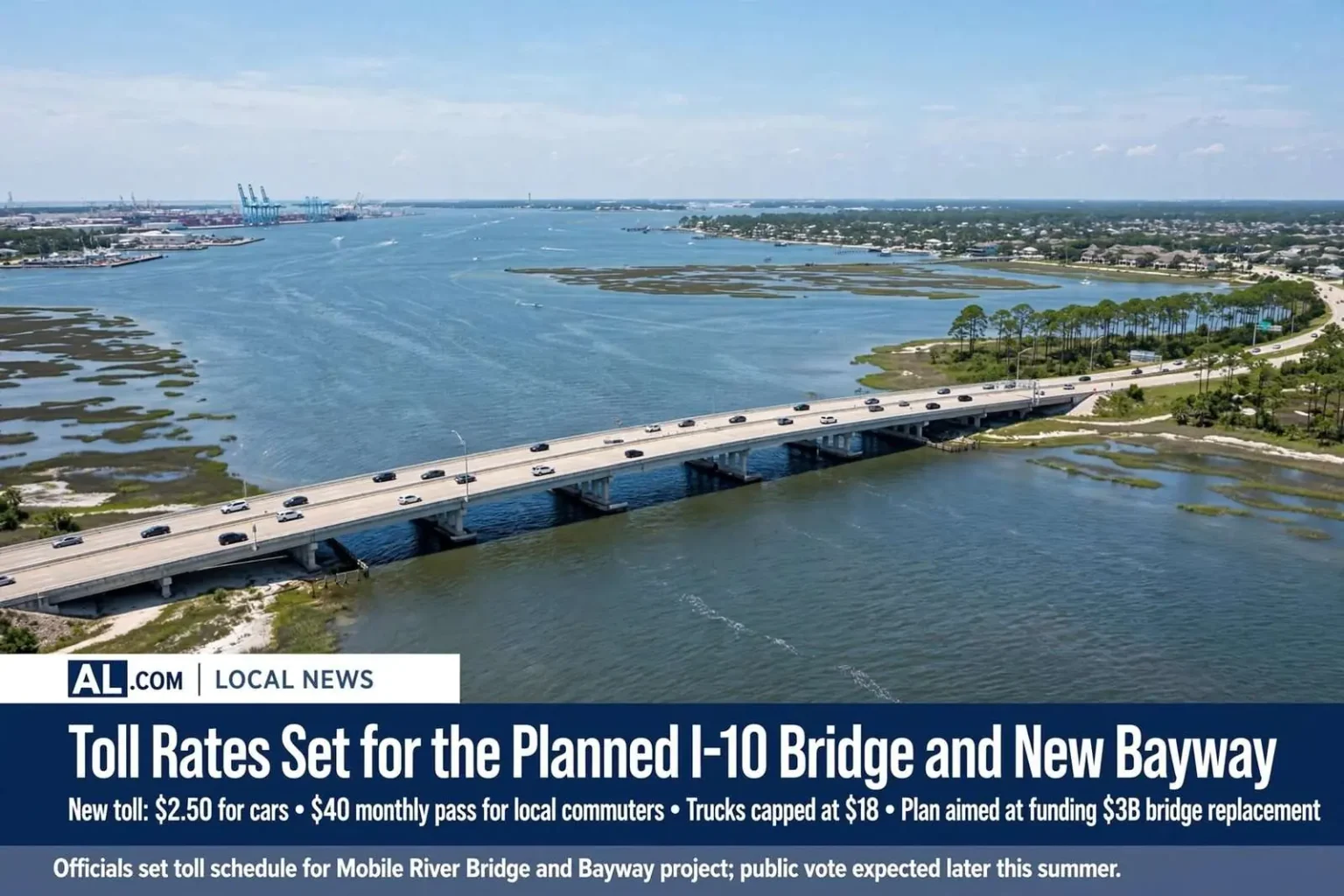
Drivers crossing Mobile Bay on a rebuilt Bayway and a new six-lane bridge would pay $2.50 per car under a toll schedule announced Friday by the metropolitan planning organizations for Mobile and Baldwin counties, the two bodies that must sign off on the region’s largest transportation project in a generation. Trucks would pay no more than $18, and commuters who live in Mobile and Baldwin counties would have the option of an unlimited-use pass for $40 a month — a structure designed to keep daily crossings affordable for the people who use the corridor most.
The schedule answers one of the biggest open questions about the Mobile River Bridge and Bayway project, the plan to replace the aging I-10 Bayway with a new six-lane bridge rising over the Mobile River and the bay. Officials on both sides of the bay have spent years debating not just whether the crossing should be rebuilt but who should pay for it and how much — questions with outsized consequences in a metro area whose two halves are joined by a single interstate corridor.
Officials defend the charge
“Nobody wants a toll. We want the toll to be zero as well,” said Jack Burrell, chairman of the Baldwin County metropolitan planning organization. “But we also know on peak days that traffic is three times the capacity for the existing Bayway and we need a solution.”
Burrell said the monthly pass effectively reduces the cost for regular users to roughly a dollar each way. “I think it’s a great day for South Alabama with a monthly pass of only 40 dollars,” he said. The pass structure mirrors approaches used in other toll regions, where unlimited plans keep commuters from bearing the full per-trip rate and give households a predictable monthly transportation cost.
The traffic numbers behind the argument are familiar to anyone who has sat on the Bayway in July. The Wallace Tunnel and the Bayway were designed for a fraction of the volume they now carry, and on peak summer travel days — when beach traffic from across the Southeast funnels toward the Gulf — the crossing backs up for miles in both directions. Planners have warned for years that continued growth in Baldwin County, one of the fastest-growing counties in the state, would overwhelm the crossing without a major expansion.
A rising price tag
The project was originally estimated at $2.1 billion. Inflation has pushed the figure closer to $3 billion, and toll revenue is intended to retire that debt. The gap between the first estimate and the current one reflects years of delay as studies, environmental review and funding debates accumulated — each year of which raised construction costs across the industry.
Burrell said the agreement puts in writing that tolling ends once the project is paid off, a commitment that addresses one of the most persistent public concerns about the plan: that a toll, once installed, would outlive the debt it was created to retire. Putting the sunset language in the agreement gives drivers a defined endpoint rather than an open-ended charge.
The financing structure matters because of the project’s unusual shape. A bridge high enough to clear the Port of Mobile’s shipping channel, connected to a rebuilt Bayway across the open water, is one of the most expensive pieces of infrastructure South Alabama could build, and no combination of federal and state dollars has ever been assembled to cover it outright. Tolling shifts the cost onto the people who use the crossing, in proportion to how much they use it.
Free routes stay free
The Causeway, the Wallace and Bankhead tunnels and the Africatown bridge would remain toll-free and stay open throughout construction, which is expected to take about five years. That guarantee matters enormously to locals: the Causeway, the old Bankhead-era route along the bay’s northern shore, serves as the free bypass for drivers unwilling or unable to pay, and the tunnels carry downtown traffic between Mobile and the Eastern Shore today.
Keeping those routes open and untolled also answers a fairness argument raised from the beginning of the debate. Fishermen heading to the Delta, workers crossing for shifts, and residents of communities north of the interstate all use bay crossings daily without touching I-10, and officials committed early to ensuring the project did not convert every route across the bay into a toll gate. The new bridge and Bayway would be the tolled option; the historic routes stay as they are.
The toll announcement arrives after decades of patchwork crossings across Mobile Bay. The Causeway, built in the 1920s along the bay’s northern rim, carried the region’s traffic until the Bankhead Tunnel opened under the Mobile River in 1941. The George Wallace Tunnel followed in the early 1970s, and the twin spans of the Bayway — the Jubilee Parkway — stretched the interstate across the open water toward Baldwin County, completing the I-10 corridor that now funnels beach traffic from across the Southeast onto the Gulf’s barrier islands.
Each generation of crossing was built for the traffic of its day, and each has been overtaken. The metro area’s population has spread steadily eastward into Baldwin County — Spanish Fort, Daphne, Fairhope and Foley have all grown rapidly — while the Port of Mobile’s expansion has raised the stakes for shipping clearance over the river. The existing Bayway, a low concrete viaduct exposed on all sides, also ranks among the region’s most vulnerable pieces of infrastructure in a hurricane, and its closure in storms strands evacuation plans on both shores.
The proposed replacement addresses those limits directly. A six-lane bridge over the Mobile River, high enough to clear the port’s channel, would connect to a rebuilt Bayway designed to modern standards. Planners have pointed to added capacity, improved interchanges and the simple geometry of a taller, wider crossing as the core of the fix — with the toll funding the work.
What happens next
The Mobile River Bridge and Bayway project still needs approval, expected later this summer. Both metropolitan planning organizations — the policy boards that program federal transportation dollars for their counties — must act on the agreement before the financing plan can move forward, and the toll schedule announced Friday was crafted to give those boards something concrete to vote on rather than an abstract funding concept.
Public reaction is likely to remain divided regardless. Supporters point to the daily reality of Bayway gridlock, the safety risk of an overloaded evacuation route and the economic cost of a bottleneck sitting between Alabama’s port city and its fastest-growing county. Opponents argue that tolls tax the same commuters the project claims to help, and that a free crossing is a public good the state has an obligation to maintain. The $40 monthly pass and the guaranteed free routes are, in large part, the answer officials have fashioned to that second argument.
For commuters, the math of the plan is straightforward to check. A driver crossing five days a week at $2.50 each way would pay about $100 a month at the full rate — more than double the unlimited pass. The pass therefore functions as a loyalty discount, and officials hope it keeps regular users from diverting to the Causeway in numbers that would simply recreate today’s congestion on the free route. Trucking companies, meanwhile, face the $18 ceiling per crossing, a cost that freight operators in the region will fold into their route planning.
The five-year construction window raises its own practical questions. Rebuilding a bay crossing while keeping the old one and the tunnels open means staged construction — work barges, lane shifts and occasional overnight closures along a corridor that never truly empties. Officials committed to maintaining traffic throughout, and the promise that the Causeway, tunnels and Africatown bridge stay open and free is as much a construction-management commitment as a pricing one.
Local officials have framed the vote expected later this summer as a once-in-a-generation decision. The Bayway crossing has been discussed, studied and debated since the 1990s, through multiple administrations and several failed funding concepts, and the toll agreement now on the table is the first version to pair a specific price with a written end date and protected free routes. Whether that combination finally earns five votes’ worth of consensus on the two boards will determine if the project advances to design and construction — or returns, once again, to the drawing board.
Either way, the fundamentals behind the debate will not change: a growing Baldwin County, a busy port on the Mobile River, and a single aging interstate crossing asked to carry it all. The $2.50 toll is the price officials have put on solving that puzzle — and the number around which South Alabama’s transportation argument will now revolve.


