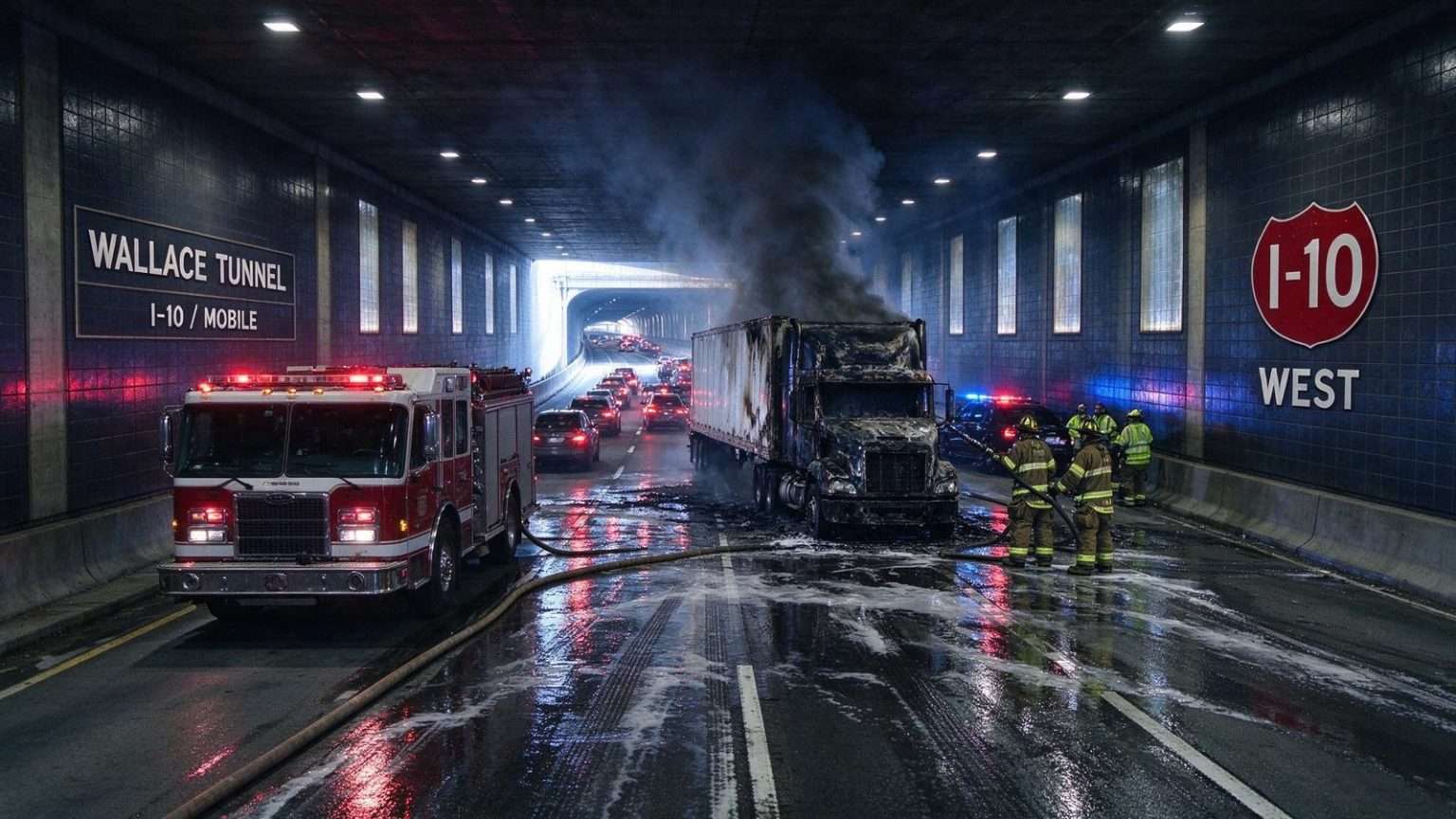
MOBILE, Ala. — A truck fire inside the westbound lanes of the Wallace Tunnel on Interstate 10 is causing traffic problems in Mobile this afternoon. ALGO Traffic cameras inside the tunnel showed westbound traffic at a standstill while emergency crews responded to the scene. The westbound lanes were closed roughly an hour after the fire was reported, and traffic was diverted through the Bankhead Tunnel. Drivers heading into Mobile should expect delays on the Bayway and Causeway. Crews worked to clear the scene and reopen the lanes.
A fire in a confined space
A vehicle fire anywhere on an interstate is serious; inside a tunnel, it is an emergency with its own rulebook. The George Wallace Tunnel carries Interstate 10 beneath the Mobile River, linking the Bankhead Tunnel approach downtown with the eastern approach near Blakeley Island, and its twin bores funnel thousands of vehicles a day through enclosed quarters with limited clearance and no shoulder to speak of. When a truck catches fire in that environment, smoke and heat have nowhere to go, and responders must manage both the blaze and the traffic trapped behind it.
ALGO Traffic, the Alabama Department of Transportation’s traffic monitoring system, showed the effects immediately: westbound vehicles at a standstill inside the tunnel while crews worked the scene. The closure of the westbound lanes followed roughly an hour after the fire was first reported, a delay that reflects the sequence of such incidents — confirm the fire, position equipment, evacuate or protect any motorists nearby, and only then commit to shutting down one of the state’s most important traffic arteries.
How Mobile absorbs an I-10 closure
Interstate 10 is the only interstate crossing of Mobile Bay and the Mobile River, which means there is no nearby alternate route for through traffic. When the Wallace Tunnel’s westbound lanes close, the diversion plan is essentially fixed: local traffic is pushed into the Bankhead Tunnel, the older and narrower crossing just north of the Wallace that carries US 98 and US 90 beneath the river. The Bankhead cannot begin to absorb full interstate volumes, so queues back up quickly along Government Street and the approaches downtown.
The delays extend far beyond the tunnel mouths. Drivers crossing the bay from the Eastern Shore found themselves inching along the Bayway — the elevated span across Mobile Bay — and along the Causeway, the older US 90 route that skirts the northern edge of the bay. The Causeway becomes the pressure-relief valve for anyone willing to take the long way around. For afternoon travelers heading into Mobile, the practical advice was to expect delays on both crossings and to delay trips where possible.
Why the tunnels matter
Mobile’s river crossings are unlike anything else on Alabama’s highway system. The George Wallace Tunnel, opened in 1973, and the Bankhead Tunnel, opened in 1941, both dive beneath the river rather than bridging it, a legacy of the port’s need to keep a clear channel for shipping upstream of the crossings. The bores dip well below the waterline, with steep approaches on both sides that slow traffic even on ordinary days.
That engineering makes the crossings vulnerable to any incident inside them. A disabled vehicle, a wreck or a fire chokes the single bore carrying westbound traffic, and there is no way around the problem except to close the tube and wait. Tunnel operators and fire crews drill for these events, ventilating smoke and coordinating with police to turn traffic at the approaches before it enters the bore.
What drivers should know
Incidents like this truck fire are a reminder of the geometry of Gulf Coast travel: the Interstate 10 crossing is a bottleneck by design, and any incident — wreck, fire, stalled vehicle — turns the bottleneck into a standstill. ALGO Traffic’s cameras and alerts give drivers a way to see the problem before committing to the crossing, and the Bankhead diversion gives local drivers an escape route most through travelers never learn.
Crews worked to clear the scene and reopen the westbound lanes, and once the burned vehicle was removed and any damage assessed, traffic would resume through the tunnel. Until then, drivers heading into Mobile this afternoon were advised to expect delays on the Bayway and the Causeway while the old Bankhead carried the load its bigger sibling usually bears.
Emergency response in a tunnel
Fighting a vehicle fire inside a tunnel differs from fighting one in the open. Fire apparatus cannot easily maneuver in the narrow bore, so response depends on access points, ventilation controls and the cooperation of traffic officers holding vehicles back from the scene. Smoke moves along the tube with the ventilation airflow, which can obscure visibility for drivers stuck inside and push toxic fumes toward either portal depending on the system’s configuration and the wind outside.
Mobile Fire-Rescue, which protects the city’s downtown and port district, trains for incidents in the tunnels along with the state agencies that operate the crossings. The first priorities are always the same: reach any occupants of the burning vehicle, keep the fire from spreading to other vehicles trapped behind it, and protect the tunnel structure itself, which can suffer damage from prolonged high heat. A burned truck removed from a bore is often followed by an engineering inspection before normal traffic resumes.
The truck factor
Commercial trucks present particular risks in tunnels. Their larger fuel loads and cargo can burn hotter and longer than passenger vehicles, their height restricts clearance, and a breakdown blocks most of a bore’s width. Tunnel regulations nationwide restrict hazardous cargo from traveling through under-river crossings for exactly these reasons, directing trucks carrying dangerous materials to longer detours around the water.
The truck fire in the westbound Wallace Tunnel closed that bore for the afternoon, and the closure’s timing — in the middle of the day, when freight and commuter traffic both peak on the crossing — magnified the disruption. Westbound travelers bound for the Eastern Shore, Spanish Fort, Daphne and points toward Florida found their route reduced to a single diversion through a 1941 tunnel built for a much smaller city’s traffic.
Waiting for the reopen
Once the fire was out and the scene secured, the work of reopening began: removing the burned vehicle, checking for structural or equipment damage, clearing debris and standing water from firefighting, and releasing the queue of vehicles that had accumulated on the Bayway and downtown approaches. Traffic typically resumes in stages as police release the held lines at the tunnel entrances.
For Mobile drivers, the afternoon’s lesson was familiar — the tunnels that make the city’s skyline and skyline views possible also concentrate its traffic risk, and when something burns inside one of them, the whole region feels it. Drivers were urged to monitor ALGO Traffic for reopening updates, to use the Causeway if their route allowed, and to build extra time into any trip crossing Mobile Bay for the rest of the day.
The Bayway and the Causeway
The two routes drivers weigh during a tunnel closure behave very differently. The Jubilee Parkway, known locally as the Bayway, carries Interstate 10 across the open water of Mobile Bay in a long, low, twin-span concrete bridge that was itself the site of a massive 1979 chain-reaction wreck in fog. It is fast when traffic moves and a parking lot when it does not, and it funnels every vehicle heading for the tunnel approaches into the same downtown choke point.
The Causeway, by contrast, is the old way across. US 90 runs at water level along the northern edge of the bay, through a corridor of seafood restaurants, bait shops and marsh views, past the USS Alabama’s mooring site, with a drawbridge at The Rouse and lower speed limits throughout. It adds miles and minutes but keeps moving when the interstate does not, which is why every Mobile driver keeps it in mind for exactly this kind of afternoon.
Why the crossings stay busy
The traffic that funnels through the Wallace Tunnel includes far more than local commuting. Interstate 10 is the primary freight corridor connecting Florida’s peninsula to the rest of the country, and trucks hauling goods between Jacksonville, New Orleans and everywhere between must cross Mobile Bay here. The port’s container terminal, the city’s growing industrial employers, and beach traffic bound for the Baldwin County resort towns all load the same twelve lanes into two tunnel bores and one bay bridge.
Planning studies for a new Interstate 10 crossing have documented the daily volumes and the fragility of the current arrangement, and incidents like this truck fire are the case studies behind those proposals. Until a new crossing exists, every wreck, stall or fire on the Bayway or in the tunnels converts the region’s single interstate link into a temporary dead end.
Monitoring and recovery
ALGO Traffic’s network of cameras and sensors — including the cameras inside the tunnels that captured the standstill during this fire — gives both transportation officials and the public a real-time view of events. Motorists checking the system during the closure saw the westbound bore blocked and the Bankhead handling diverted traffic, and they could time their trips or choose the Causeway accordingly.
The recovery from a tunnel fire follows the same clock whether anyone is watching or not: extinguishment, medical evaluation if needed, vehicle removal, damage assessment, cleanup, and staged reopening. Crews worked through the afternoon to complete those steps and return the westbound lanes to service. For the drivers stuck on the Bayway and the Causeway while they did, the incident was another demonstration that in Mobile, the shortest path across the water is also the most fragile — and that the region’s traffic plans always include a place for the day when the tunnel is closed.