Tuberville, Britt Introduce Bill to Help Rural Hospitals Preserve Emergency Care
Sens. Tuberville and Britt introduced a bill aimed at helping rural hospitals preserve emergency care and expand flexibility under Medicare rules.
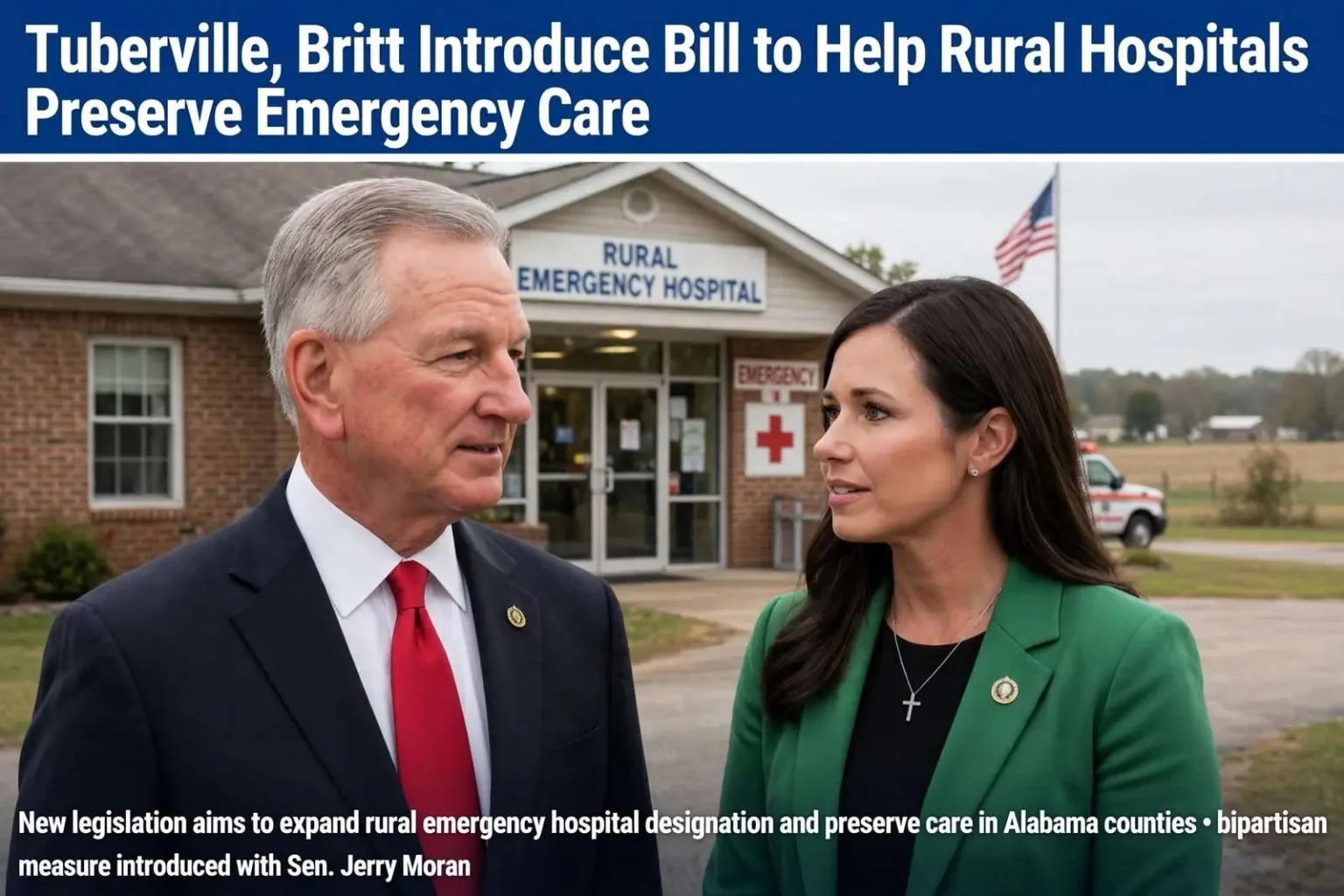
U.S. Sens. Tommy Tuberville and Katie Britt have introduced legislation aimed at helping struggling rural hospitals preserve emergency services and gain more flexibility under a federal Medicare designation that has become a lifeline for small facilities across Alabama and the nation.
Tuberville, R-Auburn, and Britt, R-Montgomery, joined U.S. Sen. Jerry Moran, R-Kan., in introducing the Rural Emergency Hospital Designation Improvement Act, a bill that would expand who qualifies for the rural emergency hospital program and loosen the rules for facilities already operating under it. The measure is the latest congressional attempt to slow the wave of rural hospital closures that has hit Alabama harder than almost any other state.
“Fifty-five of Alabama’s 67 counties are rural and our rural hospitals provide a lifeline to Alabamians who live further away from larger medical facilities,” Tuberville said, adding that he doesn’t want location to prevent Alabamians from accessing quality care in emergencies. In counties without a hospital, an emergency can mean a drive of 30 minutes or more to the nearest emergency room, and deliveries, heart attacks and serious injuries all carry added risk in that gap.
Britt echoed those concerns. “This legislation will help preserve local hospitals and prevent them from closing altogether,” she said. “Strengthening this program will help ensure rural families can continue receiving essential, and potentially lifesaving, care close to home.” Together, the state’s two Republican senators have made rural health care a recurring theme of their legislative agendas, framing hospital survival as both an economic issue and a quality-of-life issue for the counties they represent.
Rural emergency hospitals have become a rare point of agreement in health policy circles, where the original Medicare designation passed with support from both parties after years of warnings that small hospitals were failing faster than Washington could respond. The designation’s authors designed it for facilities with 50 beds or fewer, the hospitals that anchor Main Streets across the Plains, the Delta and the Alabama Black Belt. Alabama’s senators argue their state has more at stake in the program’s success than perhaps any other, given the sheer share of its counties classified as rural.
How the Designation Works
The rural emergency hospital designation was created in 2023 as an alternative for small rural hospitals at risk of closing. Facilities that convert generally stop providing inpatient care but continue offering emergency, observation and outpatient services in exchange for enhanced Medicare payments. The trade-off is designed to let a hospital shed the money-losing parts of its operation while keeping the emergency room doors open — the service rural residents say they cannot lose.
The model emerged from years of debate over how to stop rural hospital closures without forcing money-losing inpatient wings to keep operating. Hospitals that convert to the designation receive a monthly facility fee under Medicare, a steady payment stream that replaces the unpredictable revenue from overnight stays. For small facilities that were admitting only a handful of patients a night but paying staff around the clock, the arrangement can be the difference between restructuring and shutting down.
Under the new bill, certain rural hospitals that closed between 2015 and 2020 could reopen and apply for the designation, a provision aimed at communities that have already lost their facilities and watched residents drive farther for basic care. The U.S. Department of Health and Human Services would also be directed to create a waiver program for facilities that operate similarly to a rural emergency hospital but don’t currently qualify, giving the agency flexibility to fit the program to hospitals whose circumstances don’t match the standard categories.
What the Bill Would Add
The legislation would also allow rural emergency hospitals to operate inpatient psychiatric and obstetric units, offer limited inpatient rehabilitation services, and receive additional federal funding for laboratory services. Those additions respond to two of the most persistent complaints about the original designation: that mental health care and maternity care are precisely the services rural communities struggle most to reach, and that converting hospitals were forced to abandon them entirely.
Obstetric care has become one of the most acute pressure points in rural Alabama. Expectant mothers in many counties already travel long distances for deliveries, and each maternity ward closure stretches the drive farther. Allowing rural emergency hospitals to keep psychiatric and obstetric units operating while converting the rest of their inpatient operations would, supporters say, preserve the services residents use most often while eliminating the ones costing the facility money.
The bill would clarify eligibility for rural hospital improvement grants, permit direct transfers to skilled nursing facilities, and allow certain hospitals to return to critical access hospital status if their circumstances change. The last provision addresses a worry that has kept some small hospitals from converting at all: that the designation is a one-way door. Under the legislation, a hospital whose finances or patient volumes rebound could return to its prior status rather than remaining locked into the emergency-only model.
Skilled nursing transfers matter more in rural health care than they might first appear. Small hospitals frequently keep patients overnight not because they need hospital care but because no nursing home bed within driving distance will take them, tying up beds and staff. A clearer transfer pathway lets the hospital move those patients to appropriate settings faster, freeing capacity for the emergencies the facility is built to handle and reducing the costs that come from holding patients who do not need to be there.
Laboratory funding addresses another quiet pressure point. Rural emergency hospitals still draw bloodwork, process samples and run the diagnostics that emergency medicine depends on, but the original designation did not account for the full cost of maintaining lab operations around the clock. The additional federal funding in the bill would help those departments stay staffed, which administrators say is essential to keeping the emergency room itself viable — a lab that cannot run forces transfers and slows every diagnosis the facility makes.
Alabama’s Rural Hospital Crisis
Rural hospitals across Alabama continue to face staffing, reimbursement and financial pressures that have made the state a national focus of the closure crisis. The state currently has three rural emergency hospitals, and a hospital in Greenville announced last year that it would convert to the designation. Alabama’s rural hospitals have operated for years with some of the lowest margins in the country, squeezed by low reimbursement rates, uncompensated care and the difficulty of recruiting physicians and nurses to small communities.
The stakes extend beyond health care. In small Alabama towns, the hospital is frequently among the largest employers, and its closure removes jobs, payroll and the sense of security that attracts families and businesses to a community. Studies of rural hospital closings across the country have documented the pattern: after a hospital shuts down, the town’s population and tax base shrink, births move out of the county, and ambulance response times lengthen for everyone.
Alabama’s experience has made it a testing ground for the rural emergency hospital concept. The state’s first conversions attracted attention from hospital administrators across the Southeast who wanted to see whether the enhanced Medicare payments could actually sustain emergency operations in communities where the inpatient model had failed. The three facilities now operating under the designation in Alabama are being watched as proof of concept for the program nationwide.
The Greenville conversion illustrates the calculation hospitals are making. Facilities that convert give up inpatient revenue but gain the steady Medicare facility fee, and administrators must project whether that trade stabilizes their finances over years rather than months. In communities watching the decision, the question is simpler: will the emergency room stay open? In Greenville and the other Alabama communities that have made the switch, the answer so far has been yes — which is exactly the outcome the designation was created to produce.
What Comes Next
The bill now moves through the congressional committee process, where its sponsors will seek a hearing and, eventually, floor action. Rural health legislation has historically drawn bipartisan support, and the improvement act’s sponsors span three states. Whether the provisions advance in this Congress will depend in part on how Congress addresses the broader Medicare payment package, to which rural hospital measures are frequently attached.
For the administrators of Alabama’s small hospitals, the bill’s practical appeal is flexibility — the chance to keep an obstetric unit, a psychiatric ward or a laboratory that the current designation would force them to close, and the option to reverse course if conditions improve. Supporters in the state’s hospital association have argued that no single fix will save rural care, but that each service preserved is a drive a family doesn’t have to make in an emergency.
Until Congress acts, the rural emergency hospital designation remains the only federal alternative available to struggling rural facilities, and Alabama’s hospitals continue to weigh it against their own balance sheets. The legislation proposed by Tuberville, Britt and Moran would widen that path — for hospitals still open, for those that closed in the late 2010s, and for the counties where the difference between an emergency room and no emergency room can be measured in lives.