Twenty-Five Years Later, South Alabamians Still Remember Exactly Where They Were on 9/11
From an eighth-grade history class in Thomasville to a newspaper pressroom in Clarke County, residents of South Alabama recall the morning of Sept. 11, 2001, and the changes that followed in the days after.
It is more than 1,000 miles from southwest Alabama to New York. On Sept. 11, 2001, the distance made no difference.
Twenty-five years later, South Alabamians still describe that Tuesday in the particular, granular way people describe events that reorganized their sense of the world — the classroom they were sitting in, the road they were driving, the television someone rolled into the room.
What Happened That Morning
The World Trade Center towers in New York were struck by two hijacked airplanes. The Pentagon in Washington was hit by another. A fourth crashed in rural Pennsylvania, brought down by passengers to keep it from striking another target, possibly the U.S. Capitol or the White House.
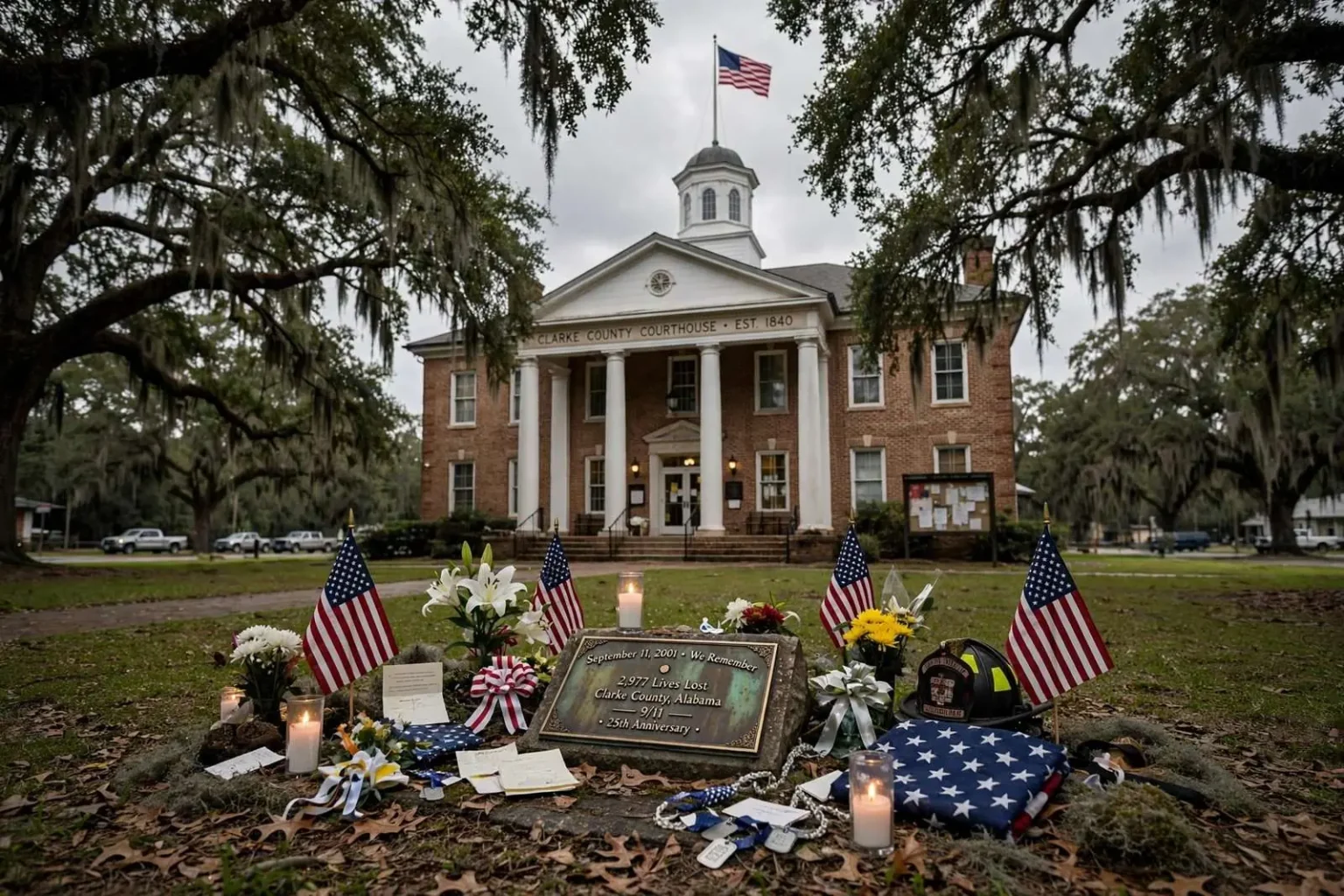
In all, 2,977 lives were lost. The number includes civilians who worked in the towers, civilian and military personnel at the Pentagon, firefighters, law enforcement officers and the passengers aboard the planes. It was the deadliest foreign attack on American soil, carried out by al-Qaeda terrorists.
The first tower was hit at 7:46 a.m. Central time. The second was struck 17 minutes later.
In the Classrooms
Many of the memories belong to people who were children that morning.
Ember McKinley was an eighth-grade student at Thomasville Middle School.
“Our history class that day became watching the news,” she said.
Claire Moton was in third grade at Jackson Academy, where she remembers watching the events on an old roll-in television.
Ethan Elmore’s mother picked him up from Clarke Prep.
“I watched the sky for planes until we got home and watched the news the rest of the day, expecting enemy tanks or some foreign army to march up our street any minute and questioning my parents about what we would do,” he said.
Elmore said his father assured him that would not happen — “knowing good and well he had no idea what the next days would bring.”
At Work
Jim Cox, then a newspaper publisher, had just dropped his 3-year-old daughter Maggie at daycare and was headed to the office when he heard the news on the radio. The report was sparse: a plane had hit one of the World Trade Center towers. He remembered thinking it must have been a small aircraft and wondering how such an accident could happen.
When he reached the newspaper office and turned on a television, he understood it was something else. He was watching when the second plane struck.
“I couldn’t believe what I had seen and I ran through the building all the way to the pressroom telling it,” he said.
Charity Hudson was working at Dr. Mohammed Nayeem’s office in Thomasville. Not much work got done, she said. Doctors, staff and patients spent the day watching the news or talking about it.
“There were so many tears and prayers,” she said. “We were scared for everyone around us that day and in the weeks that followed.”
Angie Newsom called Ivey Griffin at a radio station in Thomasville and asked whether the country was under attack. Griffin, who usually had a ready answer for almost anything, said: “I don’t know.”
“The next day I was still sad but also furious,” Newsom said. “I was ready to load up the tanks and planes and go find whoever was responsible.”
Myra Dewitt was with her husband, Gay, at the Alabama Forestry Association annual meeting in Orange Beach. Gay Dewitt handled public relations for the paper mill in Jackson, then Boise Cascade. She watched the news of the first plane hitting the tower.
“It took a second for me to understand this was really happening!” Dewitt said.
The Local Aftermath
The attack came on a Tuesday, and local newspapers printed the next day. One devoted more than half of its front page to art of a U.S. flag under the headline, “Still Proudly Waving.”
Gas prices spiked within hours.
“By late afternoon, cars and trucks were lined up at local gas stations reminiscent of the gas shortages of the ’70s,” a newspaper story said. “Rumors of gas skyrocketing to $4 and $5 a gallon fueled the panic buying.”
Local prices rose 20 to 25 cents a gallon. Businesses blamed distributors.
“We’ll doggone sure prosecute (station owners) if someone wants to press charges,” then-Clarke County District Attorney Bobby Keahey said. “I don’t think there is a judge in this circuit who would go against price gouging under these circumstances.”
All planes were grounded immediately. Grove Hill attorney and pilot Gil Gilmore had flown his own aircraft from Grove Hill to Nashville and caught a commercial flight to Chicago on business. With flights canceled, he rented a car and drove back to Nashville, where he waited for clearance to fly home to Grove Hill.
President George W. Bush was attending an elementary school event in Florida when he received the news. The uncertainty of the situation kept him aboard Air Force One for hours, with brief touchdowns in Louisiana and Nebraska.
Cox wrote in a column that week: “Never before has a U.S. president been forced to run from an enemy. This made me mad.”
‘You Will Always Remember Where You Were’
Clarke County High School coach Duane Davis chaired the school’s safety committee. At an assembly on Sept. 12, he told students that he remembered being in a classroom at Fulton Elementary School when he heard President Kennedy had been assassinated on Nov. 22, 1963.
“You will always remember where you were when everything happened yesterday,” Davis told them.
He was right, and the accounts collected here are the proof of it. Davis was speaking to students who are now adults in their forties, describing a mechanism he had experienced himself thirty-eight years earlier.
What Changed
The attacks altered daily life in ways that persisted. Anxieties and suspicions increased. The nation became more cautious and security conscious. Air travel became more complex, with restrictions and long check-ins. Public buildings tightened security.
In Clarke County, plans to install a metal detector at the courthouse accelerated. The detector was in place by Sept. 20.
That detail captures something about how quickly the change propagated. Nine days after an attack on New York and Washington, a rural Alabama county courthouse more than a thousand miles away had screening at the door — and it never came back out.
The Larger Accounting
Beyond the lives lost, the attacks led the United States into wars in Afghanistan and Iraq. The financial cost of property loss, increased security, post-9/11 spending and veteran care has been estimated at $8 trillion.
All of the hijackers died in the crashes. The United States identified al-Qaeda leader Osama bin Laden as the mastermind behind the attacks. He was found and killed in Pakistan by a U.S. special operations force in 2011.
Twenty-Five Years On
A new World Trade Center has been built, and a memorial occupies the footprint of the North and South Towers. The Pentagon attack site has a memorial. So does the field in Pennsylvania where the fourth plane came down.
Memorial programs are held each year, and this year’s carry the weight of a quarter-century. In New York, former presidents Bush, Bill Clinton, Barack Obama and Joe Biden are expected to attend. The names of the nearly 3,000 victims will be read aloud, as they are each year.
President Trump has opted to attend the ceremony at the Pentagon, where he will make remarks.
The Generation That Does Not Remember
Twenty-five years is long enough that a substantial share of Americans have no memory of the day at all.
Every high school student in South Alabama this fall was born after 2001. For them, 9/11 is history in the way Pearl Harbor was history for the people telling these stories — something learned rather than lived, understood through accounts rather than through the physical memory of watching it happen.
That transition is what makes the accounts collected here worth gathering now. The people who watched a roll-in television in a third-grade classroom in Jackson, or who ran through a pressroom telling what they had just seen, are the ones who can still describe it firsthand.
The names read aloud in New York on Friday are the same names read every year. The number is 2,977. Twenty-five years later, in a county more than a thousand miles from any of the crash sites, people still remember exactly where they were standing.