Two Arrested After Mobile Boys Say Strangers Offered Candy To Lure Them Into A Car
Mobile police charged two people with enticing a child after two 12-year-olds said strangers offered candy to get them into a vehicle at a Chevron station.
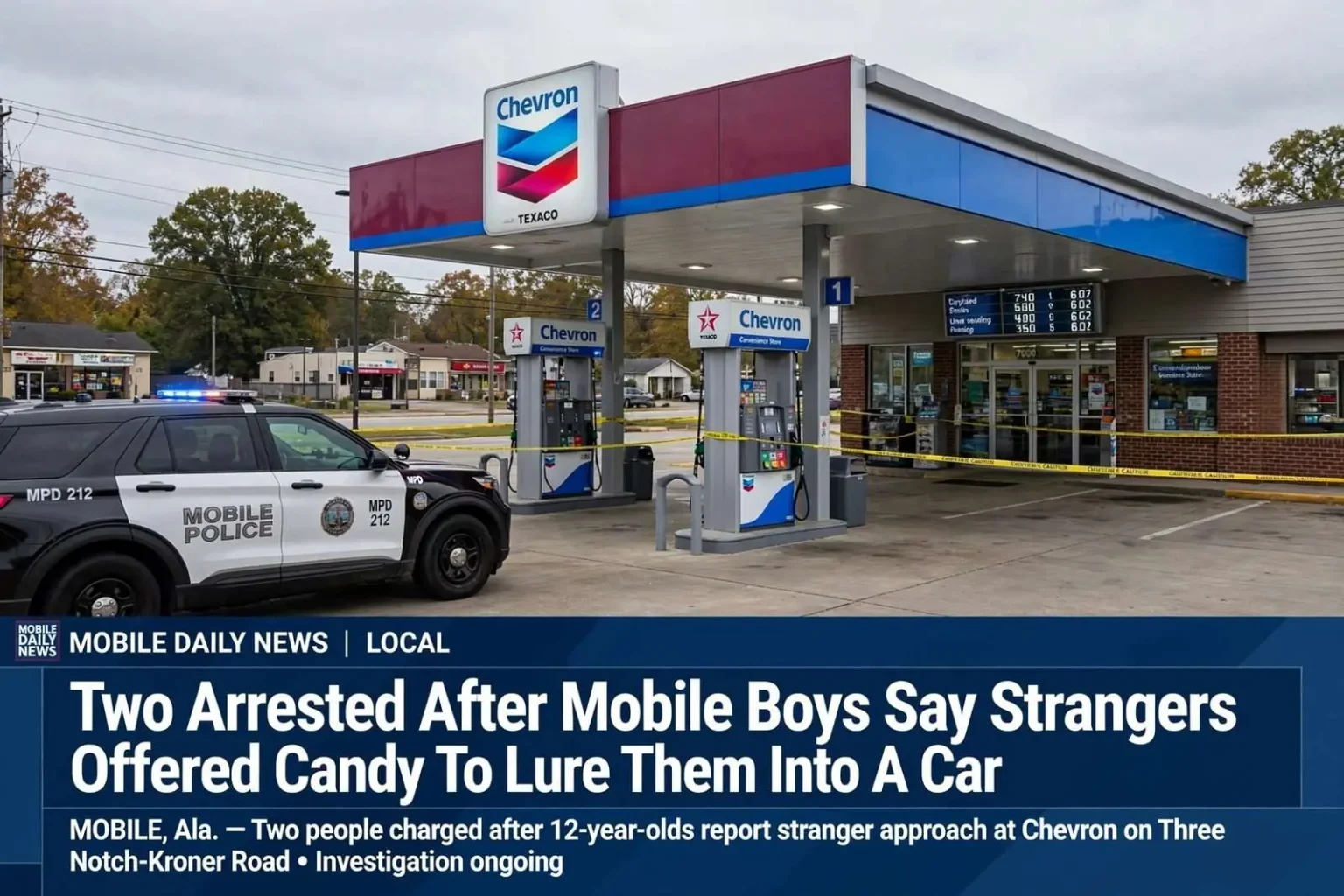
MOBILE, Ala. — Two people face charges after two 12-year-old boys reported that strangers tried to coax them out of a convenience store and into a vehicle on Three Notch-Kroner Road, an incident that has unsettled families across the west Mobile corridor where the encounter took place. The episode unfolded in daylight, inside a busy store, and ended only because the boys walked away, wrote down a license plate number and kept telling adults what was happening until word reached their parents.
The encounter happened Thursday afternoon at the Chevron station in the 7000 block of Three Notch-Kroner Road, a stretch of road that runs through a residential and commercial part of Mobile where convenience stores, churches and neighborhood streets sit close together. Late that same night, Mobile police arrested Tosha Slack, 41, and Douglas Jones, 56, each on two counts of enticing a child to enter. Slack also faces two counts of first-degree sexual abuse, escalating the case from a disturbing stranger encounter to felony sexual charges.
Under Alabama law, enticing a child to enter a vehicle, building or other space for unlawful purposes is a felony offense, and first-degree sexual abuse likewise carries serious prison exposure for a conviction. Police have not said what evidence led to the two arrests within hours of the report, and a department spokesman said the investigation is ongoing. Both defendants are presumed innocent unless convicted in court.
A Mother’s Account
April Teal, the mother of one of the boys, said her son and his friend had slipped away from a nearby house and walked to the store when a woman approached them at the checkout counter. The distance between the house and the store was short enough that the walk felt routine, the kind of small errand children in the neighborhood make without a second thought. What happened at the counter, she said, was anything but routine.
“She literally took her fingers and was running her fingers through my son’s hair, and was trying to convince him to get into her vehicle, was offering him ice cream and candy,” Teal said. She said the woman also touched her son’s leg during the encounter, physical contact that turned what might have been dismissed as a strange conversation into something far more alarming.
The offers followed a pattern child-safety advocates have warned about for decades: sweets and treats presented by a stranger as a way of building quick trust with a child. Candy and ice cream are among the most common lures reported in attempted child enticements, precisely because they work on children who have been taught to be polite to adults and hesitant to make a scene in public.
Security footage from the store shows a woman walking up to the two children at the counter and speaking with them, confirming the boys’ account of where and when the approach happened. Store surveillance has become a central tool in cases like this one, because convenience store cameras typically cover the counter area and the doors, capturing both the interaction and the vehicle waiting outside.
Teal said her son hesitated before pulling away, a pause she has replayed since the incident. “I watched my son pause,” she said. “He’s a kid. What kid doesn’t want candy or ice cream?” Her point, she indicated, was not that her son did anything wrong but that the lure was designed to be irresistible to a child, and that a few seconds of hesitation was all it would have taken for the encounter to end differently.
Boys Recorded A License Plate
According to Teal, the boys left the store and wrote down the license plate number of the vehicle, a step that investigators in cases like this consistently describe as one of the most valuable things a witness can do. Plate numbers give detectives a direct line to a registered owner, and they hold up in ways that memory-based descriptions of faces and clothing often do not.
She said the boys stopped at several houses along the way to tell adults what had happened while the occupants of the vehicle followed and called out to them. Rather than heading home silently or waiting until later, the boys turned themselves into a moving report, alerting one household after another until adults were involved and the situation was no longer between two children and two strangers.
Child-safety instructors teach a version of exactly that response: leave the area immediately, move toward other adults, keep talking about what happened, and never accept a ride or stop to answer questions from someone following in a car. The boys’ decision to keep moving and keep reporting likely kept the encounter from escalating and gave police multiple witnesses to contact the same night.
Teal said she believes the two people arrested are the same people who approached her son. Mobile police have not confirmed that connection, and a department spokesman said the investigation is ongoing. Until charges are tested in court, the official record stops short of linking the defendants to the convenience store footage, and investigators have not said whether additional charges or additional victims are possible.
The case has resonated in the neighborhood around Three Notch-Kroner Road, where parents describe the incident in the terms parents everywhere use after a close call with a stranger: it was ordinary, it was local, and it nearly worked. School officials and neighborhood groups in Mobile periodically repeat the standard guidance after reports like this one, reminding children never to approach a stranger’s car, to walk in pairs, and to tell a trusted adult immediately.
What Happens Next In The Case
The two defendants will next appear in the Mobile County court system, where prosecutors will decide how to proceed on the four counts against Slack and the two counts against Jones. First appearances in cases of this type typically occur within days of arrest, with bond conditions addressing any contact with the children involved or with minors generally while the case is pending.
Detectives will be working to line up the pieces that turn an arrest into a conviction: the store’s security footage, the license plate number the boys recorded, statements from the households the boys alerted, and any forensic evidence tied to the sexual abuse counts. Investigators have not said whether the vehicle has been searched or whether Slack and Jones have made statements to police.
Police have also not ruled out the possibility that other children were approached, and departments in cases like this typically ask the public to come forward with any similar encounters in the area, even ones that were never reported at the time. A single confirmed pattern of approaches can change the posture of a case and the charges that prosecutors pursue.
Keeping A Closer Watch
“It makes you sick to your stomach,” Teal said, adding that she is keeping a closer watch on her son. Her account has circulated among Mobile parents as a reminder that enticement attempts do not only happen in stranger-danger stories; they happen at checkout counters, in daylight, a short walk from home.
For families in the area, the practical takeaways are the ones the boys themselves followed. Children should be encouraged to walk with a friend, to treat any adult who offers gifts or physical affection as a reason to leave, and to report immediately rather than later. Parents, for their part, can rehearse those responses with children the same way families rehearse fire drills, so that the hesitation Teal described turns into movement toward safety.
Anyone with information about the case or about similar encounters in west Mobile can contact the Mobile Police Department, which has said its investigation remains active. The charges against Slack and Jones will be tested in court, and the presumption of innocence applies to both. What is already established, though, is the version of events the two 12-year-olds gave: a stranger’s hands in a boy’s hair, an offer of candy and ice cream, a license plate written down, and a string of front doors knocked on until the adults knew exactly what had happened.
The charges reflect how seriously Alabama courts treat encounters of this kind. Enticing a child counts are built to cover exactly the conduct described at the store: using persuasion, offers or physical contact to draw a minor toward a vehicle or another enclosed space. First-degree sexual abuse, the additional count Slack faces, involves sexual contact by forcible compulsion or with a victim unable to consent, and each count is judged on its own evidence. Because two boys were involved, the enticing charges were filed twice, once for each child.
School resource officers and neighborhood associations along the Three Notch corridor have long emphasized the same checklist that this case accidentally demonstrated in full. A child walking with a friend is harder to isolate than a child alone. A child who leaves at the first uncomfortable moment removes the stranger’s chance to escalate. A child who reports to the nearest adult, and then keeps reporting, multiplies the number of witnesses. And a child who notes a license plate hands detectives the single most concrete lead an investigation can receive.