Fort Walton Beach Okaloosa County
Two Arrested, Meth and Fentanyl Seized in Fort Walton Beach Drug Investigation
Okaloosa County sheriff's investigators seized methamphetamine, fentanyl and cash during a Fort Walton Beach warrant service that led to two arrests.
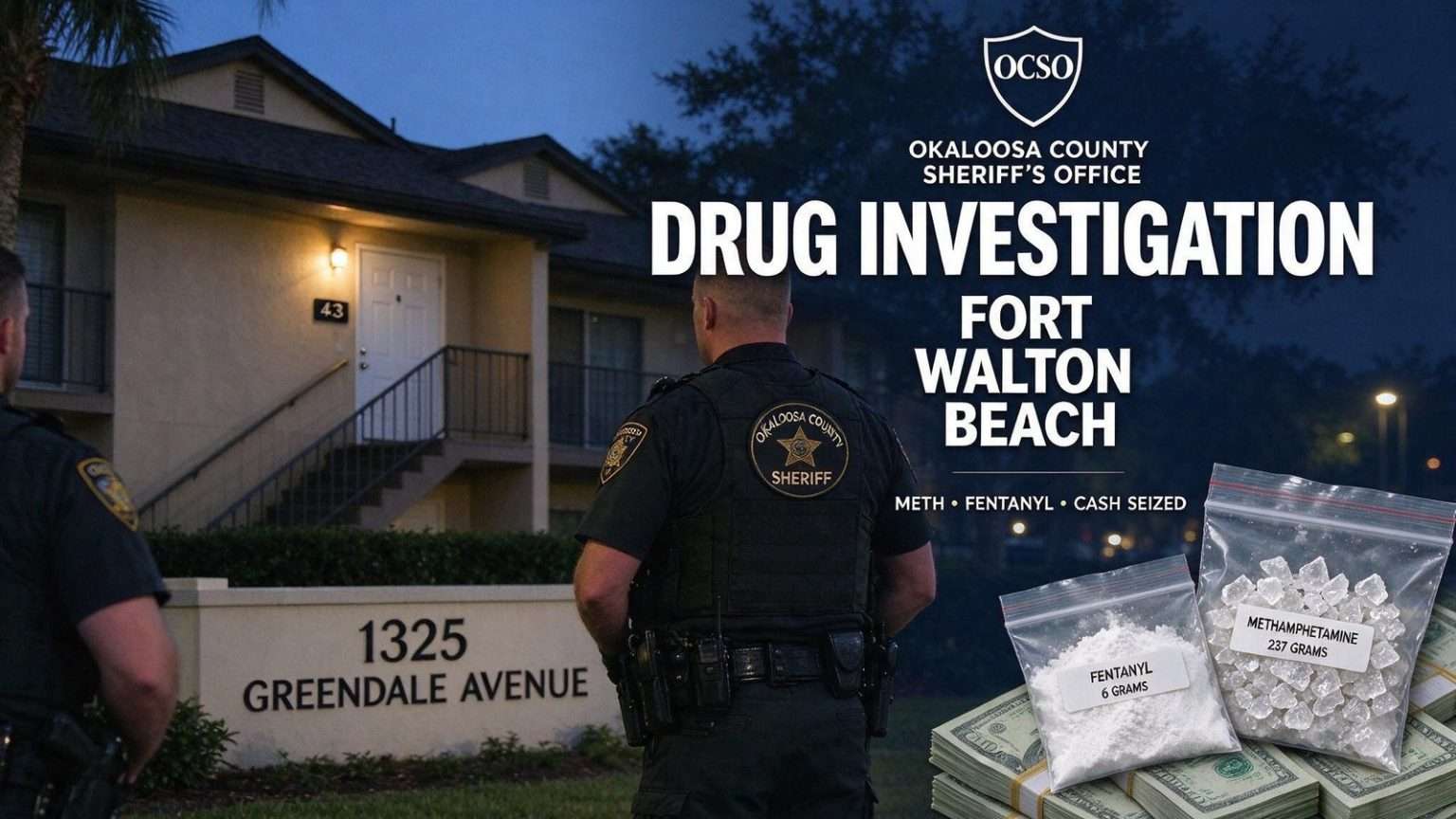
Two people are facing multiple drug charges after Okaloosa County sheriff’s investigators served warrants Wednesday evening at a Fort Walton Beach apartment.
The Okaloosa County Sheriff’s Office Narcotics Unit went to Apartment 43 at 1325 Greendale Avenue to serve warrants on 28-year-old Ian Wilde, who lived there. As deputies arrived, another man — later identified as Troy MaGill — came out of the front door, and investigators said they could smell marijuana coming from inside.
After developing probable cause, detectives obtained a search warrant and found trafficking amounts of controlled substances and a large sum of cash inside a safe.
The evening’s work took a routine warrant service and expanded it into a significant seizure — first the odor of marijuana that deputies encountered on the doorstep, then the judicial process of a search warrant, then the discovery inside the apartment of quantities that moved the case from possession into trafficking territory.
The charges against Wilde
Wilde was charged with trafficking in methamphetamine (237 grams), trafficking in fentanyl (6 grams), possession of marijuana with intent to distribute (259 grams), possession of drug paraphernalia and violation of probation.
The methamphetamine quantity is the headline number. Under Florida law, trafficking in methamphetamine begins at 14 grams, and the 237 grams recovered puts the case far above the threshold — into the range where the statutory penalties escalate further and the charge carries a mandatory minimum prison sentence upon conviction. Trafficking amounts of that size are typically described by investigators as distribution-scale rather than personal use.
The fentanyl charge follows the same structure. Florida’s trafficking threshold for fentanyl is 4 grams, and the 6 grams attributed to Wilde clears it — a quantity that, given fentanyl’s potency, investigators treat as a significant community danger. Synthetic opioids have driven overdose deaths across the Panhandle and the nation, and fentanyl seized in gram quantities is enough for hundreds of potentially lethal doses.
The marijuana count is framed differently: 259 grams — roughly half a pound — charged as possession with intent to distribute rather than trafficking, which under Florida’s thresholds requires much larger weights. The paraphernalia count covers the equipment associated with use or packaging, and the probation violation stems from Wilde’s existing supervision status, adding a separate proceeding to the criminal case.
How the evening unfolded
The operation began as a warrant service, not a search. The Narcotics Unit arrived at the Greendale Avenue apartment to take Wilde into custody on existing warrants, and the case changed shape at the door.
MaGill’s exit from the apartment as deputies arrived gave investigators a look inside and a person to identify; the smell of marijuana coming from within gave them grounds to look further. Neither observation alone justified a search, but together they formed the beginning of the probable cause that detectives took to a judge for a search warrant.
That step matters legally. Evidence seized inside a residence is only as good as the warrant that authorized the search, and the sequence — observation, probable cause, judicial review, then entry — is the constitutionally required order. The warrant obtained Wednesday evening protected the seizure that followed, and everything found inside, from the controlled substances to the cash in the safe, entered the case through that document.
The money and civil forfeiture
The U.S. currency was seized pending civil forfeiture.
Civil forfeiture is a legal process distinct from the criminal charges. Rather than prosecuting a person, the state proceeds against the property itself — in this case, the cash found in the safe — alleging that it is proceeds of, or was used to facilitate, illegal drug activity. The seizure happens on the spot; the forfeiture requires a separate legal proceeding in which the state must establish the money’s connection to crime.
Because civil forfeiture runs parallel to the criminal case rather than inside it, the outcome of one does not automatically determine the other. A defendant acquitted of trafficking can still contest — or lose — the forfeiture of seized cash, and a defendant who pleads out can agree to forfeit the money as part of the resolution. Pending that process, the currency sits in the sheriff’s office custody, counted, documented and held as evidence.
The large sum of cash in the safe, sitting alongside trafficking quantities of methamphetamine and fentanyl, is the kind of finding investigators cite as evidence of distribution activity — drug sales generate cash, and money stored with the product strengthens the state’s theory of the case.
The second arrest
MaGill, also of the Greendale Avenue address, was charged with possession of methamphetamine.
The distinction between MaGill’s charge and Wilde’s is the quantity and the corresponding intent attributed to each man. Possession of methamphetamine — without the trafficking weight or an intent-to-distribute allegation — is a far less severe charge, though still a serious felony in Florida depending on the amount and prior record.
Investigators’ account of the evening leaves the scope of MaGill’s involvement an open question: he came out of the apartment as deputies arrived, and the methamphetamine charge reflects what the evidence attributed to him individually. His case will proceed separately from Wilde’s, with his own court dates, his own defense and his own exposure under the sentencing guidelines.
The shared address ties the two men to the same scene, and prosecutors will sort out individual culpability as the cases develop through discovery and any plea negotiations.
The Narcotics Unit’s work
The Okaloosa County Sheriff’s Office Narcotics Unit operates as the county’s specialized drug enforcement arm, building cases against dealers and traffickers through surveillance, informant work, undercover purchases and coordination with federal and regional task forces.
Warrant services like Wednesday’s are the visible end of investigations that typically run weeks or months before officers knock on a door. The unit’s caseload mirrors the region’s drug market: methamphetamine and fentanyl dominate the trafficking seizures, marijuana remains a fixture of the possession-and-distribution cases, and the county’s location in the heart of the Panhandle — along the corridors between Pensacola, Fort Walton Beach and Destin — makes it a conduit for drugs moving along the Gulf Coast.
Fentanyl’s particular danger
The fentanyl seizure stands out even in a case built around 237 grams of methamphetamine. Fentanyl, a synthetic opioid many times more potent than heroin, has become the dominant killer in the nation’s overdose epidemic, and even milligram-level miscalculations in dosage can be fatal.
Law enforcement agencies across Florida warn that fentanyl now appears mixed into other drugs — pressed into counterfeit pills, blended into cocaine and methamphetamine — often without the buyer’s knowledge. Deputies handling seizures take precautions against accidental exposure, and first responders carry naloxone, the overdose-reversal drug, as standard equipment.
For the community, the 6 grams recovered at the Greendale Avenue apartment represent precisely the kind of quantity that fuels local overdoses: too much for personal use, and enough doses to move through a neighborhood’s worth of users before anyone traces the source.
Fort Walton Beach and the county’s drug picture
Fort Walton Beach, the largest city in Okaloosa County, anchors the Panhandle’s densely populated stretch between Eglin Air Force Base and Hurlburt Field. The city’s residential neighborhoods, including the area around Greendale Avenue, sit minutes from the tourist beaches and the military installations that define the local economy.
Sheriff’s investigators describe the county’s drug trade as a persistent, evolving market — methamphetamine and fentanyl shipped in from major distribution hubs, sold through local networks and accompanied by the cash, scales and packaging that recur in seizures across the county. Cases like Wednesday’s, built on warrant service and a doorstep observation, are the routine output of that enforcement effort.
The coordination between patrol deputies, the Narcotics Unit and the state attorney’s office determines how such cases resolve. Trafficking charges carry mandatory minimum sentences under Florida law, giving prosecutors significant leverage in plea discussions — and giving the quantities themselves, gram by gram, a direct role in the eventual outcome.
What happens next
Wilde faces the heavier path: five charges, including two trafficking counts with mandatory minimum exposure, a probation violation and the pending forfeiture of the cash found in the safe. His case will move from first appearance through arraignment and, absent a plea, toward trial in Okaloosa County court.
MaGill’s possession charge follows a simpler track, though a felony conviction carries its own lasting consequences. Both men remain in the custody of the Okaloosa County Jail pending their court proceedings, and the sheriff’s office has indicated that the investigation remains active.
For the Greendale Avenue neighborhood, Wednesday evening’s raid was a single visible action in an ongoing effort. Investigators say the seizures — the methamphetamine, the fentanyl, the marijuana and the money in the safe — remove from the market quantities that would otherwise have been sold on local streets, and they point to the case as an example of how a routine warrant service, pursued through the proper legal steps, can end with a trafficking operation dismantled.