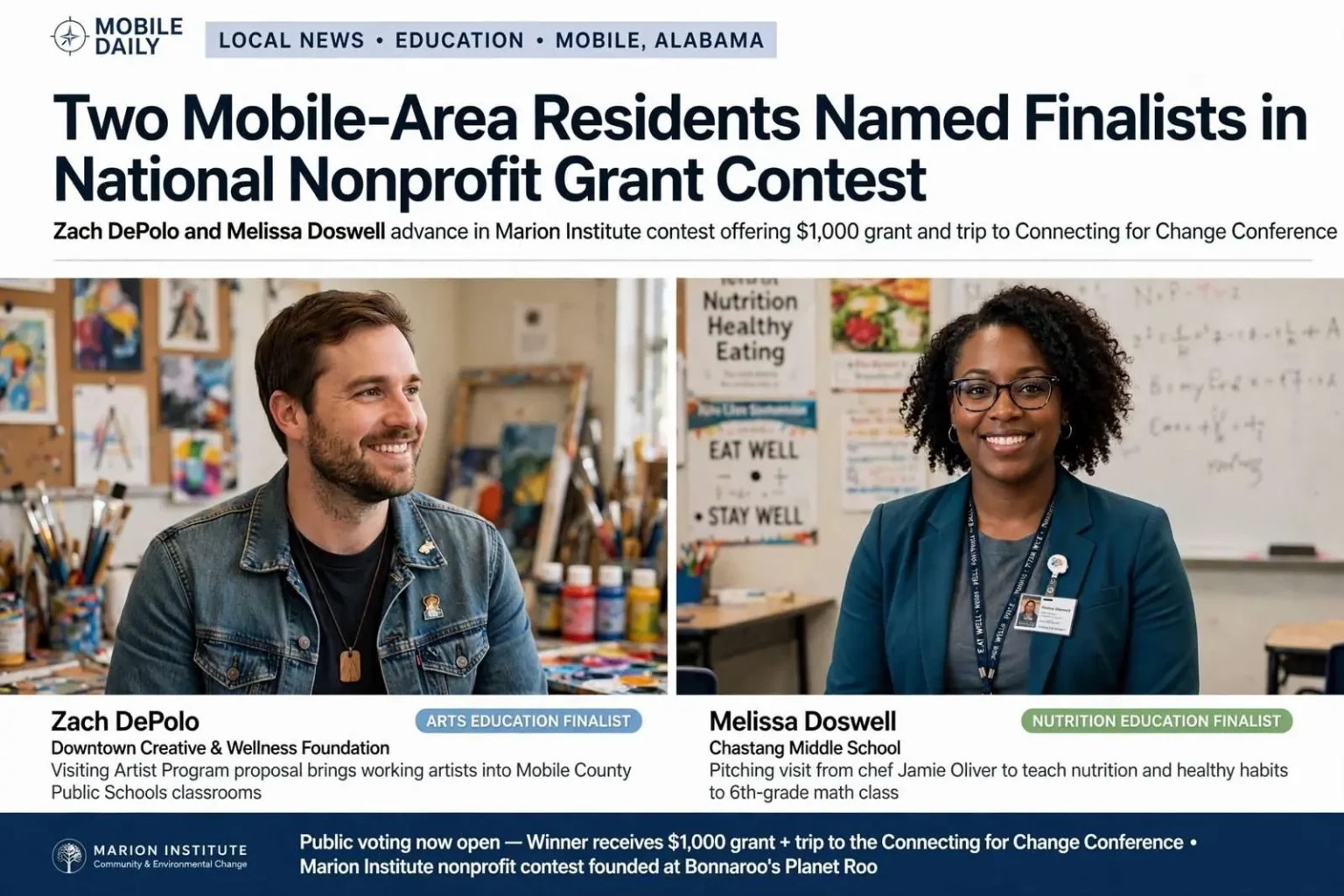
Two Mobile-area residents are finalists in a national contest run by the Marion Institute that offers $1,000 in grant funding and a trip to the Connecting for Change Conference to the winning proposal. The contest asked everyday people to pitch a way to use the money for good in their own communities, and two proposals with roots in the Mobile area made the final round.
The Marion Institute, a nonprofit focused on community and environmental change, launched the contest this spring after tabling at the 9th Annual Bonnaroo Music and Arts Festival in Manchester, Tennessee, where the organization joined dozens of other nonprofits in the festival’s Planet Roo section. The festival’s sustainability-minded gathering area gave the institute a chance to reach a national, mostly young audience, and the contest grew out of that outreach.
The contest invited entrants nationwide to pitch ideas for using the grant money to create positive change in their communities, with the public voting on finalists. That structure puts the outcome in the hands of voters rather than a small review panel, which means finalists need more than a good idea: they need networks of friends, coworkers and neighbors willing to show up and click for them.
The local finalists
Among the finalists are two proposals rooted in the Mobile area. Zach DePolo proposed a grant for the Downtown Creative & Wellness Foundation’s Visiting Artist Program, which brings working artists into Mobile County Public Schools to lead hands-on workshops for students. The program connects students with people who make their living in the arts, giving them instruction and a realistic picture of creative careers that classroom exercises alone cannot provide.
Melissa Doswell, a teacher at Chastang Middle School, proposed using the $1,000 to bring chef and food-education advocate Jamie Oliver to speak with her sixth-grade math class about healthy, positive eating habits as part of a broader push for nutrition education in local schools. Doswell’s pitch ties food to the classroom directly, using a widely known advocate to make lessons about healthy eating memorable for students at an age when habits are still forming.
Both ideas are modest in cost and concrete in effect. A thousand dollars goes a long way toward workshop materials or a single high-impact school visit, and that practicality is exactly what the contest format rewards: small money, applied locally, with results people can see.
The Downtown Creative & Wellness Foundation proposal
DePolo’s pitch centers on the Visiting Artist Program of the Downtown Creative & Wellness Foundation, an organization built around the connection between creative practice and community wellbeing. The program’s model sends working artists directly into Mobile County Public Schools classrooms, where they lead hands-on workshops rather than simply talking about their work.
Hands-on instruction changes what students take away. A workshop led by a practicing artist gives students materials, techniques and immediate feedback, and it introduces the idea that art is a profession with skills, standards and career paths. For schools where arts budgets are thin, an outside program that supplies both the artist and the experience fills a gap that the school system cannot always cover on its own.
The $1,000 grant would fund that work directly, covering the materials and logistics that a series of school workshops requires. If the proposal wins, the visible result would be more students in more Mobile County classrooms spending class time actually making things under the guidance of someone who does it professionally.
The Chastang Middle School proposal
Doswell’s pitch aims at a different gap: nutrition education. Her plan would bring Jamie Oliver, the chef and food-education advocate known internationally for campaigns to improve school food and teach ordinary families to cook, to Chastang Middle School to speak with her sixth-grade math class about healthy, positive eating habits.
The choice of audience matters. Sixth graders are young enough that food habits are still flexible, and a memorable visit from a well-known figure can shift attitudes in ways a textbook chapter rarely does. Tying the visit to a math class also opens practical doors, since food-related lessons naturally involve measurement, portions and budgeting.
Doswell framed the visit as part of a broader push for nutrition education in local schools rather than a one-time event. The grant would fund the appearance itself, and the classroom work around it, lessons and discussions before and after, would be what turns a single visit into a lasting lesson for the students involved.
Why it matters locally
Both proposals reflect ongoing efforts in the Mobile County Public Schools system to expand arts programming and nutrition education despite tight budgets. The district, one of the largest school systems in Alabama, serves students across a wide range of neighborhoods and income levels, and outside partnerships and grant funding have long supplemented what local revenue can support.
A win in the national contest would provide a modest but meaningful infusion of funding directly into local classrooms, along with national recognition for both the Downtown Creative & Wellness Foundation and Chastang Middle School. Recognition of that kind compounds: it validates the organizations behind the proposals, makes future fundraising easier, and shows other local educators that national contests are worth entering.
For the students, the value is direct. A visiting artist workshop or a memorable speaker is the kind of classroom experience that stays with a child long after the school year ends, and both finalists designed their pitches around exactly that kind of moment rather than around equipment or administrative costs.
The Marion Institute and the contest model
The Marion Institute’s approach to the contest reflects its broader mission of supporting community-level and environmental change from the ground up. The organization has a history of backing small, practical projects rather than large institutional programs, and a public-voting contest extends that philosophy: it lets communities decide which local idea deserves the boost.
Launching the contest from a table at Bonnaroo’s Planet Roo was a deliberate way to find entrants. The festival draws tens of thousands of attendees, many of them civically active, and the nonprofit section gives organizations a venue for face-to-face outreach that a website alone cannot match. The contest carried that festival energy into a nationwide call for ideas.
Public voting as the finalist mechanism also serves the institute’s goals beyond the prize itself. Every finalist campaign spreads awareness of the institute’s work, and every voter who follows a link to support a local proposal learns about community-scale change in the process.
What the finalists represent for Mobile
Having two of the contest’s finalists come from the same metro area says something about the local landscape of civic engagement. Both proposals came from people embedded in the community, one connected to a downtown creative organization and one teaching inside a public middle school, and both identified needs in Mobile County classrooms that a thousand dollars could meaningfully address.
The proposals also highlight two long-running concerns for the school district: keeping arts education alive as budgets tighten, and building healthier habits among students as childhood nutrition has become a national concern. Mobile County educators and their partners have pursued both goals through a mix of grants, volunteers and outside programs, and the two finalist pitches slot into that pattern exactly.
How the voting round works for supporters
Because the public votes on finalists, the outcome depends on how well each proposal’s supporters mobilize. For Mobile-area residents, that means the two local pitches are within reach of winning if enough people who know the organizations, the school and the people behind the ideas take the time to vote. Small contests like this one are often decided by exactly that kind of local turnout.
The prize structure concentrates the stakes: one winning proposal receives the $1,000 grant plus a trip to the Connecting for Change Conference, where the winner’s idea gets a national audience among people and organizations focused on community and environmental work. The conference trip extends the value of the prize beyond the money, connecting the winner to a network that can help the idea grow.
However the vote ends, the finalists’ presence in the round already produced a benefit for Mobile: two classroom-centered ideas, one for visiting artists and one for nutrition education, gained visibility at a national level, with a nonprofit and a public middle school named as the beneficiaries. The remaining question was whether one of them would bring the grant itself home to the Port City.
The case for arts education in Mobile County classrooms
DePolo’s proposal arrives in a school district where arts teachers, materials and visiting programs compete for limited funding every year. Research and classroom experience alike point to the same conclusion: students who spend time making art build focus, collaboration and problem-solving skills that transfer across subjects. The Visiting Artist Program was built to bring that benefit into schools through the most direct route available, a working professional standing in front of the class.
The program also gives Mobile County’s artistic community a structured way to contribute. Artists who participate gain classroom experience and compensation, while students meet adults who have built careers around creative work. Those encounters matter for teenagers deciding what is possible for their own futures, and they cost the district little when an outside foundation organizes them.
Nutrition education and the habit-forming years
Doswell’s pitch addresses a concern that has moved steadily up the national agenda. Childhood nutrition shapes attendance, concentration and long-term health, and schools have become the front line for teaching healthy eating because that is where children spend their days. A single visit from an advocate as recognizable as Jamie Oliver gives a school’s nutrition push a moment students remember and talk about at home.
The sixth-grade math class setting makes the visit more than an assembly. Food is a natural math subject, from measuring ingredients to calculating portions and prices, and a teacher like Doswell can carry the excitement of the visit back into daily lessons. That is the difference between a guest appearance and an educational event, and her proposal was built as the latter.
Together, the two Mobile-area finalist pitches cover a pair of classroom needs that grant writers and educators across the country recognize, and either one would put the Marion Institute’s $1,000 to work where it can be seen: in front of Mobile County students during the school day.